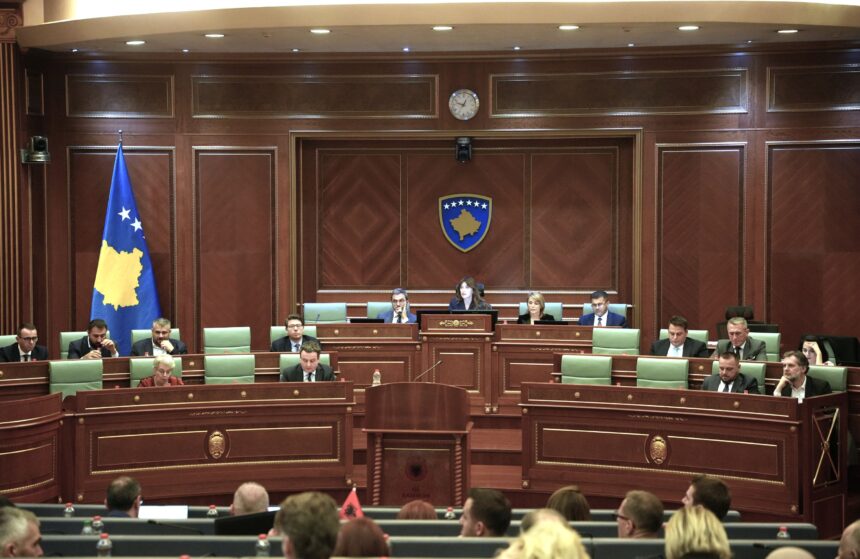
The Kosovo Assembly has approved the 2027 Draft Budget in principle, setting public spending at €4.27 billion, following a lengthy debate between the government and opposition that continued well past midnight.
The draft budget received 61 votes in favour. Parliamentary discussions focused on the government’s economic policies, capital investment, public sector salaries and social support measures.
The proposed budget is approximately €300 million higher than the initial budget for 2026. Presenting the document, Prime Minister Albin Kurti said it was designed to take Kosovo into a new phase of economic transformation, with a focus on higher wages, family support and infrastructure investment.
Among the key measures announced by Kurti is the introduction of a 13th-month salary for public sector employees, alongside an increase in the wage coefficient to €120 from 1 July 2027. The government has allocated €1.085 billion for salaries. According to the prime minister, this would translate into an average gross monthly salary of more than €1,000 for approximately 85,000 public sector employees.
The draft budget also provides for a 25 per cent increase in child allowances from 1 January 2027. The increase is described as the first stage of a four-year plan to double the payments by 2030. Kurti said families with two children, who currently receive €60 per month, would see their allowance rise to €75, while families with four children would receive €225, up from €180.
More than €1 billion has been earmarked for capital investment, which the government says will support road, water and environmental infrastructure projects. Among the projects highlighted by Kurti were the Prishtina Outer Ring Road, the Duhël–Banullë road section, the Dukagjin Highway and the construction of new dams.
Kurti also announced that the budget for official travel abroad had been cut by half, with the savings redirected towards essential medicines.
The opposition, however, challenged the government’s approach, arguing that an increase in the nominal budget does not necessarily translate into economic development.
LDK leader Lumir Abdixhiku said the proposed budget was around seven per cent higher than the 2026 budget, but argued that inflation would offset much of that increase. He criticised what he described as an excessive focus on social assistance and called for greater investment in energy, education, technology and infrastructure. Abdixhiku also proposed raising the wage coefficient to €150.
The Democratic Party of Kosovo (PDK) also criticised the draft. MP Arben Mustafa said the main concern was not the amount allocated but the results delivered by public investment. He pointed to delays in the Pristina–Gjilan motorway and other infrastructure projects.
PDK MP Mërgim Lushtaku called on the government to account for previous commitments, including the construction of 160 kindergartens, 4,000 housing units for young families and the modernisation of the railway network.
Alliance for the Future of Kosovo (AAK) MPs Teuta Haxhiu and Time Kadrijaj described the proposed budget as more focused on consumption than development. Haxhiu raised concerns about the impact of inflation, while Kadrijaj criticised the lack of funding for the Pristina–Durrës railway and what she described as slow implementation of capital projects.
LDK MP Jehona Lushaku-Sadriu also questioned the government’s priorities, claiming that the education grant had been reduced despite the government’s repeated statements that education was a priority.
Responding to the criticism, Finance Minister Hekuran Murati defended the government’s economic and social policies. He said the number of employed people had increased from 350,000 to 450,000 during the government’s term.
Murati said financial support had focused primarily on children and pensioners, while employment opportunities had been created for people able to work. LVV MP Enver Haliti described the budget as a reflection of the government’s programme, adding that it was based on regular revenues.
The parliamentary debate was also briefly interrupted by a power outage in the Assembly building. Discussions on the energy sector continued beyond midnight.
Despite opposition objections, the governing majority secured enough votes to pass the draft budget in principle. The document must now proceed through further parliamentary