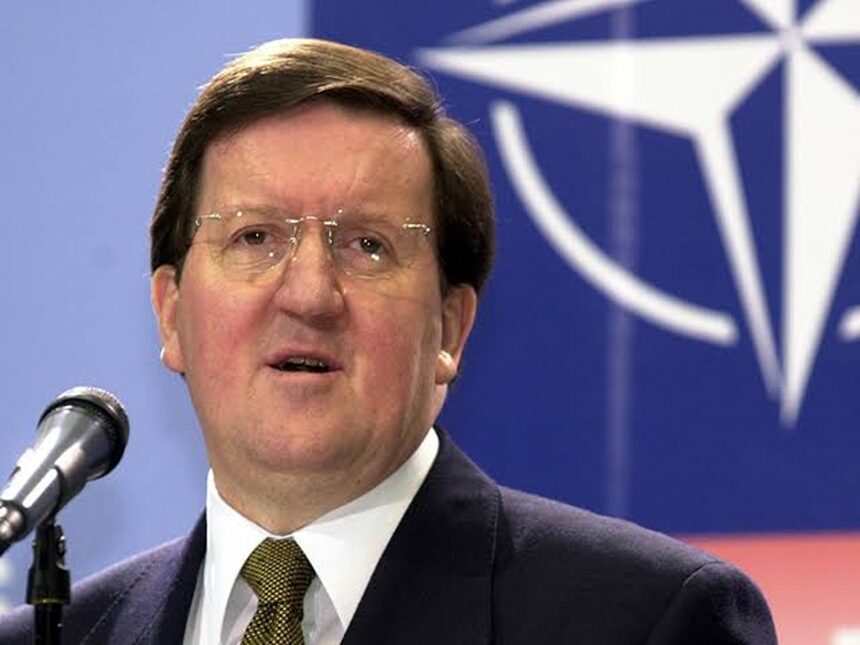
Former NATO Secretary General Lord George Robertson has warned that Kosovo is facing pressure not only from Serbia but also from other actors seeking to limit the country and push it back toward its historical position within the former Yugoslavia.
Speaking to KTV’s Interaktiv, Robertson said the Western Balkans has increasingly become a battleground for great-power competition, with outside actors exploiting divisions and interfering in regional politics.
“Kosovo’s enemy is not only in Serbia. It has other enemies in the world who want to constrain it and return it to its historical position as part of the old Yugoslavia,” Robertson said, urging Kosovars to understand the wider geopolitical pressures facing the country.
Robertson also delivered a strong warning about Kosovo’s ongoing political paralysis.
He called on Kosovo’s political parties and citizens to remain united, arguing that internal divisions are precisely what the country’s opponents can exploit.
“I have no doubt in my mind that the current paralysis in Kosovo only helps the enemies of Kosovo, and helps Serbia with its malicious campaign against Kosovo’s independence,” he said.
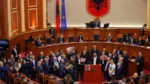
According to Robertson, Kosovo needs its institutions functioning and must elect a president so that the country can be properly represented internationally.
“Electing a president is surely the minimum that Parliament should be able to do,” he said.
He stressed that Kosovo has many friends internationally, including in the United Kingdom and among countries that supported Kosovo during the 1999 war. But, he warned, Kosovo’s opponents will seize on every internal disagreement they can find.
Robertson also addressed the upcoming verdict involving former Kosovo Liberation Army leaders at the Kosovo Specialist Chambers in The Hague. He urged Kosovars to accept whatever verdict is delivered and move forward, arguing that Kosovo’s future must take priority.
He further stressed that whatever decision the court reaches does not diminish NATO’s 1999 intervention to protect Kosovo’s population from the violence of Slobodan Milošević’s regime and the paramilitary forces it deployed.
Robertson’s message is ultimately a warning: Kosovo’s external adversaries do not need to create every weakness themselves. Internal political paralysis can create the openings they need.
For a country seeking a stronger Euro-Atlantic future, he argues, unity and functioning institutions are not optional—they are part of the country’s security.