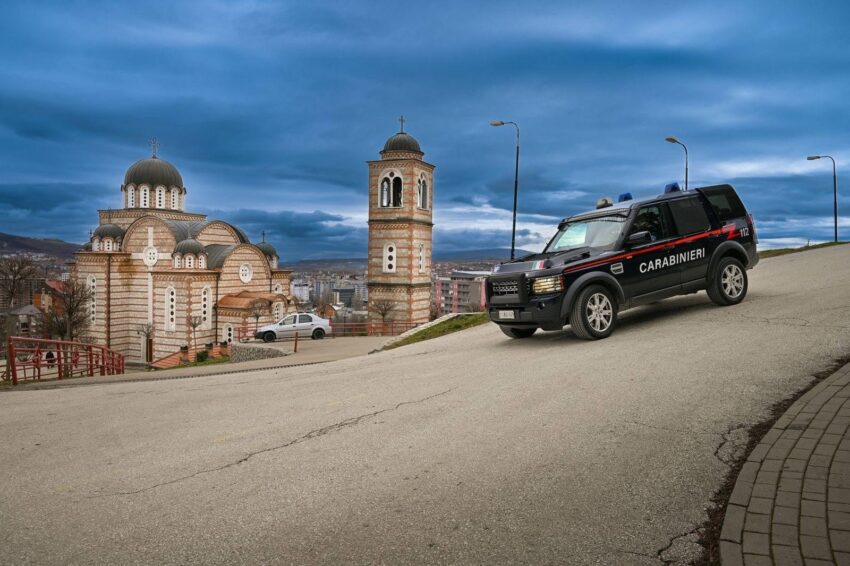
Italian Carabinieri assigned to the Multinational Specialized Unit (MSU) within the NATO-led KFOR mission have intensified their foot and vehicular patrols across North Mitrovica.
According to an official communique released by KFOR command, these operations are specifically calibrated to sustain a visible and continuous presence on the ground, gather real-time situational awareness across northern municipalities, and ensure a stable environment amid ongoing ethnic and political sensitivities.
1. The Core Objective: Stability and Free Movement
The presence of the specialized Italian gendarmerie forces serves as an indispensable operational buffer in northern Kosovo, where regional friction frequently challenges local administrative order.
The operational deployment leverages a multi-faceted approach to peacekeeping:
- Preventative Deterrence: Maintaining active foot patrols along major commercial corridors, ethnically mixed neighborhoods, and critical infrastructure links like the Ibar River Bridge.
- Civilian Reassurance: Directly interacting with local residents and business owners to build institutional trust and diffuse street-level anxieties.
- De-escalation Buffers: Serving as a highly trained, rapid-reaction gendarmerie force capable of bridging the gap between standard international military units and municipal law enforcement.
KFOR officials emphasized that these tactical efforts directly reflect the alliance’s enduring, statutory commitment to guaranteeing a safe and secure environment (SASE) and upholding unconditional freedom of movement for all communities residing in Kosovo. These mandates are executed in a strictly transparent, neutral, and impartial manner.
2. The Strategic Anatomy of KFOR’s Specialized Response
The Multinational Specialized Unit (MSU) remains unique within the broader KFOR framework due to its composition and policing capabilities.
The Tactical Architecture of the MSU Deployment

 [ MARITIME & LAND INTEGRATION ] ──► TOTAL SECTOR OVERSIGHT
 • Motorized and foot units execute unpredictable, overlapping patrol grids
   linking North Mitrovica to Zvečan, Leposavić, and Zubin Potok.

 [ GENDARMERIE METRICS ] ──► MILITARY-CIVILIAN BRIDGE
 • Unlike standard infantry, the Carabinieri possess specialized training
   in crowd control, civil disturbance management, and localized intelligence.

 [ IMPARTIAL MANDATE ] ──► RESOLUTION 1244
 • All security protocols operate strictly under NATO's international
   peacekeeping charter, independent of regional administrative shifts.
“Such efforts reflect KFOR’s commitment to guarantee a secure environment and support freedom of movement for all people living in Kosovo, transparently and impartially.”
— Official Statement from KFOR Public Affairs Office
3. KFOR’s Tri-Layered Security Architecture
The Italian Carabinieri operate within a deeply integrated, hierarchical security matrix designed to prevent localized disputes from escalating into systemic territorial conflict.
| Security Layer | Primary Institutional Actor | Specific Operational Role |
| First Responder | Kosovo Police (KP) | Standard municipal law enforcement, routine traffic control, and domestic criminal investigations. |
| Second Responder | EULEX (EU Rule of Law Mission) | Monitoring judicial proceedings, advising local police, and deploying tactical crowd-and-riot control units if requested. |
| Third Responder (Ultimate Arbiter) | KFOR (NATO Forces / MSU Carabinieri) | Executing robust military deterrence, safeguarding borders, and stabilizing active flashpoints to prevent large-scale civil collapse. |
By maintaining an unwavering and visible presence on the streets of North Mitrovica, the Italian Carabinieri are signaling to both local political factions and outside actors that international peacekeeping forces remain fully engaged. As geopolitical dynamics shift across the Western Balkans, this localized vigilance remains the primary line of defense against destabilization on the ground.