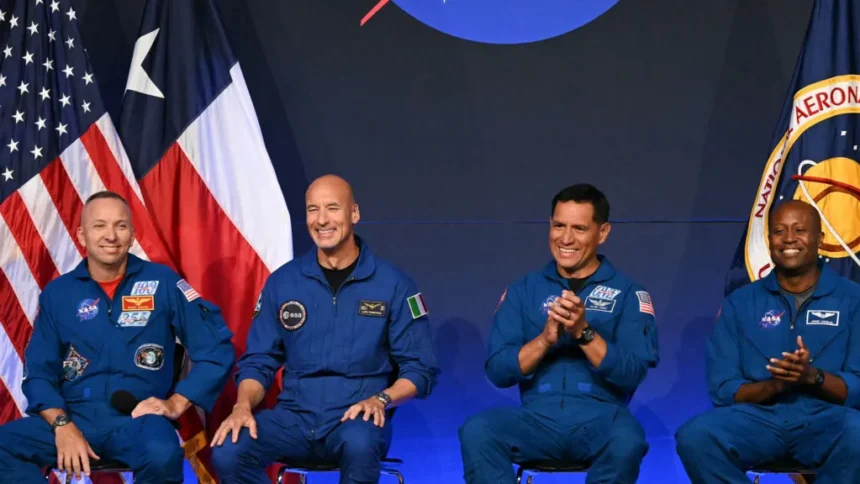
In a historic live broadcast on Tuesday, June 9, 2026, NASA officially revealed the names of the four astronauts selected for the highly anticipated Artemis III mission, currently scheduled for launch in late 2027.
The mission, which follows the successful lunar flyby executed by Artemis II in April of this year, will serve as a critical orbital test flight for automated rendezvous and deep-space docking procedures before humanity attempts its return to the lunar surface.
Meet the Four Cosmic Ambassadors
The newly minted crew brings together an exceptional blend of military flight testing, combat aviation, medical research, and advanced systems engineering, highlighting a deep international partnership with the European Space Agency (ESA):
- Randy Bresnik (Commander): A retired U.S. Marine Corps Colonel and veteran of two previous spaceflights, Bresnik has logged over 149 days in space and led multiple high-stakes spacewalks.
- Luca Parmitano (Pilot): An elite ESA astronaut and former Italian Air Force test pilot. Parmitano is renowned for his extensive long-duration stints aboard the ISS and his calm handling of orbital emergencies.
- Frank Rubio (Mission Specialist): A U.S. Army Colonel and physician who holds the record for the longest continuous spaceflight by an American (371 consecutive days).
- Andre Douglas (Mission Specialist): A coast guard officer and systems engineer. This will be Douglas’s first flight into space after serving as a vital backup crew member for Artemis II.
Note: NASA astronaut Bob Hines has been officially named as the backup pilot and crew member, standing ready to step in should any of the primary crew be grounded before launch.
Re-Profiling Artemis III: Why It’s Remaining in Earth Orbit
In early 2026, NASA made a calculated strategic pivot to alter the flight profile of Artemis III. Originally envisioned as the mission that would land the first woman and person of color on the Moon, structural delays in the private sector forced NASA to re-designate Artemis III as a low-Earth orbit (LEO) test and checkout mission.
[Artemis III Core Mission Parameters]
• Launch Site:     Kennedy Space Center, Florida via the Space Launch System (SLS) rocket.
• Duration:        Approximately 10 to 14 days in low-Earth orbit.
• Core Objective:  Executing real-world docking and crew-transfer maneuvers with commercial landers.
• Environment:     Testing internal life-support systems of human landing vehicles under space conditions.
Technical Hurdles: The Blue Origin Explosion & SpaceX Timeline
The crew announcement arrives at a deeply turbulent moment for America’s commercial space partners. NASA Administrator Jared Isaacman confirmed that the mission’s primary objective is to test how the Orion spacecraft interfaces with the two Human Landing Services (HLS) vehicles currently under development: SpaceX’s Starship HLS and Blue Origin’s Blue Moon.
                  ┌────────────────────────────────┐
                  │  COMMERCIAL LANDER BOTTLENECKS │
                  └───────────────┬────────────────┘
                                  │
         Issues influencing the 2026 orbital re-profiling:
                                  │
         ┌────────────────────────┴────────────────────────┐
         ▼ SPACEX (STARSHIP HLS)                           ▼ BLUE ORIGIN (BLUE MOON)
┌─────────────────────────────────┐                       ┌─────────────────────────────────┐
│ • Currently mastering orbital   │                       │ • Suffered a catastrophic       │
│   cryogenic propellant transfer │                       │   propulsion explosion during a │
│   maneuvers in deep space.      │                       │   New Glenn test on May 28, 2026.│
│ • Crew-cabin pressurization and │                       │   Pad infrastructure damages    │
│   docking collars still in test.│                       │   have delayed delivery schedules.│
└─────────────────────────────────┘                       └─────────────────────────────────┘
Despite these industrial setbacks, the newly announced crew will begin intensive, specialized simulation training immediately at the Johnson Space Center in Houston. Their orbital flight next year is designed to clear all remaining human-rating hurdles, ensuring that the subsequent Artemis IV mission can safely return humans to the lunar South Pole in 2028.