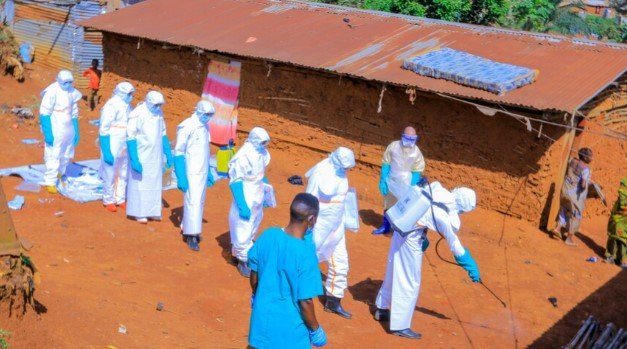
The Democratic Republic of the Congo (DRC) is facing a rapidly escalating healthcare crisis as suspected cases of Ebola have surged past the 1,000 mark. According to an emergency report released by the Congolese Ministry of Health, a aggressive spike in infections across the country’s volatile eastern provinces has prompted international health agencies to tighten border controls and elevate emergency response frameworks.
Data provided by the Ministry indicates there are currently 1,077 suspected cases of Ebola, with 121 laboratory-confirmed cases and 17 confirmed deaths documented since the formal outbreak declaration.
The epidemic has now systematically spread across 13 health zones spanning three heavily populated eastern provinces: Ituri, North Kivu, and South Kivu.
The Bundibugyo Strain: A Critical Medical Challenge
International health officials note that the current crisis is exceptionally dangerous due to the specific variant driving the infections. Laboratory sequencing by the National Institute of Biomedical Research (INRB) confirmed the pathogen as the Bundibugyo Ebola virus (BDBV).
Unlike the more common Zaire strain of the virus, the Bundibugyo variant presents unique operational challenges:
- No Approved Vaccine: Existing widely deployed Ebola vaccines—such as Ervebo—were engineered specifically to target the Zaire strain and do not offer recorded immunity against Bundibugyo.
- No Targeted Therapeutics: Standard monoclonal antibody treatments used in previous Congolese outbreaks are ineffective against this specific strain, limiting medical teams to supportive fluid and symptom care.
Strict Containment and Regional Lockdowns
In a desperate bid to blunt the chain of transmission, Congolese Minister of Public Health Roger Kamba announced that rapid response teams have successfully logged roughly 3,600 individuals who have come into contact with known patients.
[Ebola Containment Strategy]
├── Ituri Province (Epicenter) --> Complete suspension of public gatherings, sports, and social events.
├── Border Controls           --> Uganda implements temporary border closures with the DRC.
└── Africa CDC Risk Warning    --> 10 neighboring nations placed on high alert for cross-border travel.
In Ituri province—the acknowledged epicenter of the outbreak—local authorities have enforced a mandatory freeze on all public gatherings and social events, including regional sports leagues, to limit close-contact transmission.
Border Shuttering and International Domino Effect
The rapid movement of populations along regional mining corridors has accelerated the international spread of the virus. The Africa Centres for Disease Control and Prevention (Africa CDC) officially placed ten neighboring nations on high-alert status, including Rwanda, Kenya, Tanzania, Angola, Burundi, the Central African Republic, the Republic of the Congo, Ethiopia, South Sudan, and Zambia.
| Country | Suspected Cases | Confirmed Cases | Confirmed Deaths | Border Policy Status |
| DR Congo | 1,077 | 121 | 17 | High-risk internal movement bans in place. |
| Uganda | Under Evaluation | 7 | 1 | Temporary border closure enforced along DRC line. |
Following the verification of seven cases inside Uganda—including infections discovered in the capital city of Kampala linked to individuals arriving from eastern DRC—the Ugandan government announced the temporary closure of its shared border with the Congo.
Citing the volatile mix of active local militia conflicts, massive internal displacement, and the lack of specialized vaccine infrastructure, the World Health Organization (WHO) officially upgraded its regional risk assessment to “very high,” declaring the situation a Public Health Emergency of International Concern (PHEIC) to free up emergency global funding.