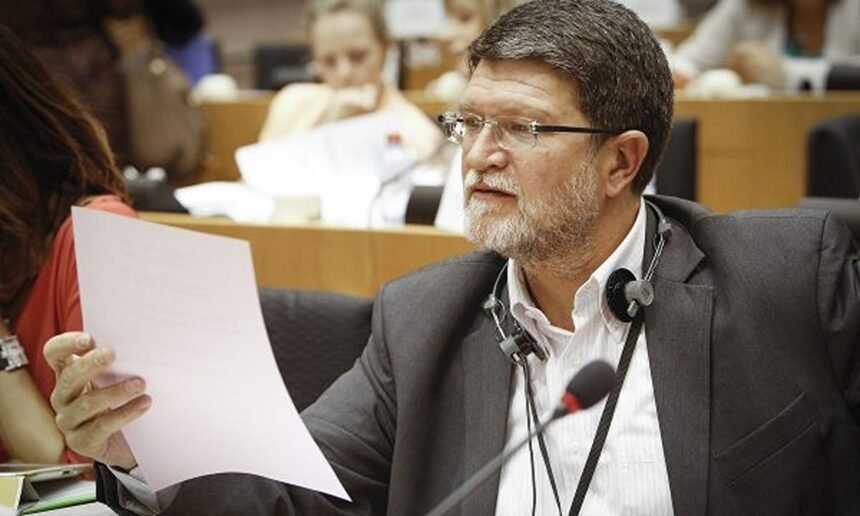
Croatian MEP Tonino Picula has warned that a change of government in Serbia will not automatically bring a shift in the country’s approach to its wartime past, arguing that political attitudes inherited from the era of Slobodan Milošević remain deeply rooted in Serbian society.
In an interview with Jutarnji list, Picula, the European Parliament’s standing rapporteur for Serbia, commented on the opposition expressed by the Students’ List to a proposed European Parliament resolution marking the 35th anniversary of the fall of Vukovar.
Picula was among four Croatian MEPs who initiated the resolution, alongside Karlo Ressler, Gordan Bosanac and Stephen Nikola Bartulica. The document condemns the destruction of Vukovar, calls on Serbia to open wartime archives and provide information about mass graves, and denounces the denial or glorification of war crimes.
Picula said he was not surprised by the Students’ List’s reaction, despite its recent electoral victory over the political bloc led by Aleksandar Vučić. He described the movement as a heterogeneous coalition bringing together different social, political and interest groups.
He cautioned against assuming that the removal of Vučić’s government would automatically transform Serbia’s political culture.
“Getting rid of an autocrat is much easier than getting rid of the clientelism that brought them to power and kept them there,” Picula said, referring to both Milošević and Vučić.
Picula sees continuity with the Milošević era
The Croatian MEP argued that Serbia has yet to fully confront its role in the wars of the 1990s, describing the siege and destruction of Vukovar as one of the most brutal consequences of Milošević’s policies.
According to Picula, political patterns from that period continue to influence attitudes towards institutions, international relations and the country’s recent history.
He said these attitudes had also been inherited by some people involved in the student movement, adding that it would be unrealistic to expect the movement to immediately accept Serbia’s responsibility for events in Croatia, Bosnia and Herzegovina and Kosovo.
Picula also questioned whether the Students’ List would be able to break away from established political networks and practices once it assumes government responsibilities.
Questions over the Students’ List’s European orientation
Picula raised concerns about the movement’s position on European integration, asking what EU membership actually means to a political group preparing to take power with more than 140 parliamentary seats.
He argued that opposition to Vučić should not automatically be interpreted as support for European integration.
The MEP cited the Students’ List’s opposition to the Vukovar resolution as an example, saying the document had been misrepresented as an attempt to place the entire Serbian people on trial.
“That is simply a misreading,” he said.
Dispute over the resolution and Serbian civilian victims
Picula also rejected criticism from the Students’ List that the resolution fails to sufficiently address the suffering of Serbian civilians in Vukovar and should include events such as Croatia’s military operations Flash and Storm, during which crimes against Serbs were committed.
He explained that the resolution was specifically intended to mark the 35th anniversary of Vukovar’s fall and establish the political context surrounding the destruction of the city, rather than provide a comprehensive account of all wartime events in Croatia and Bosnia and Herzegovina.
Picula maintained that the final text acknowledges that victims in Vukovar came from different ethnic backgrounds and not exclusively from the Croatian community.
However, he stressed that the resolution’s central purpose was to address the circumstances and political responsibility behind the city’s destruction.
Claims of indoctrination among young people
Picula also expressed concern about how younger generations in Serbia understand the wars of the 1990s.
He argued that many young people have been influenced by the education system, tabloid media and limited access to historical facts, describing this as a form of indoctrination.
He said the resolution should help raise awareness of these issues and encourage a different approach to communication between Zagreb and Belgrade, as well as between Belgrade and Brussels.
Picula welcomed the Students’ List’s stated willingness to cooperate in locating missing persons and establishing individual responsibility for war crimes. However, he said those commitments would need to be demonstrated through concrete action.