
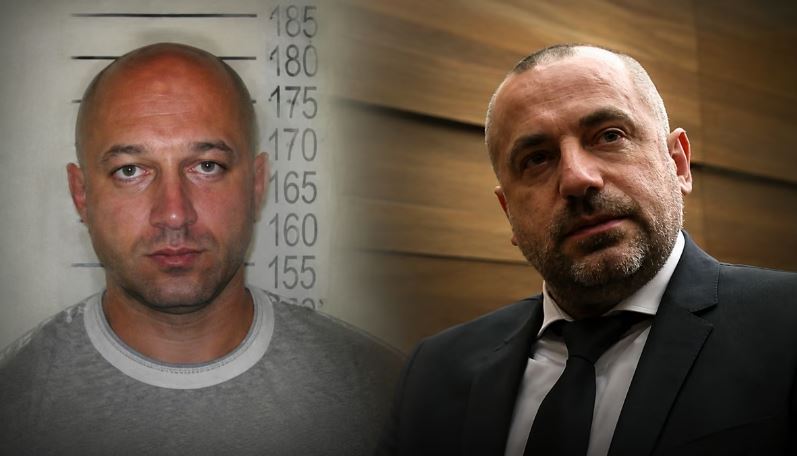
The decision by Bosnia and Herzegovina to ban Milan Radoičić and brothers Zvonko and Žarko Veselinović from entering the country has exposed weaknesses in its security system, as well as the political and business connections that allegedly allow individuals suspected of criminal activities to move across the region.
According to an analysis by Deutsche Welle (DW), the case involving three figures linked to northern Kosovo has raised questions about border controls between Serbia and Bosnia and Herzegovina, as well as political divisions within Bosnia’s institutions.
Bosnia and Herzegovina’s Intelligence and Security Agency (OSA) imposed entry bans on Radoičić and the Veselinović brothers, citing national security concerns.
The decision followed an investigation by the Serbian investigative network KRIK, which reported that Zvonko Veselinović had travelled from Sarajevo to Istanbul earlier this month.
The case has renewed concerns over how individuals facing investigations, police searches or international sanctions have been able to use Bosnia and Herzegovina as a transit route to leave Serbia.
Alleged connections with Republika Srpska’s political leadership
Predrag Petrović, research director at the Belgrade Centre for Security Policy (BCSP), said Radoičić and the Veselinović brothers were not simply influential political and business figures in northern Kosovo, but were allegedly part of a broader system of informal control maintained by the Serbian Progressive Party (SNS).
According to Petrović, their main role was to exert political control over the Serbian population in northern Kosovo.
He described northern Kosovo as a testing ground for a model of political control that was later extended across Serbia, including through organised groups allegedly deployed around polling stations.
Petrović believes their departure from Serbia at this particular moment may be connected to attempts to avoid potential criminal accountability, amid political changes in Belgrade and the possibility of greater independence for police and prosecutorial institutions.
He said the Veselinović brothers had used Sarajevo as a transit point before travelling to Istanbul, while unconfirmed information suggested that Radoičić may have travelled to Russia.
However, Petrović stressed that there was no evidence that officials in Republika Srpska had helped them leave Serbia.
The Interior Ministry of Republika Srpska has denied reports that Radoičić was staying in the entity or receiving institutional protection, stressing that responsibility for controlling the country’s borders lies with Bosnia and Herzegovina’s Border Police.
Why Bosnia can serve as a transit route
One of the main problems concerns the legal status of requests submitted by Kosovo institutions to Bosnia and Herzegovina.
Kosovo authorities have issued an arrest warrant for Radoičić over the armed attack in Banjska. The request was also transmitted through Interpol channels via the United Nations Interim Administration Mission in Kosovo (UNMIK), since Kosovo is not an Interpol member.
However, Bosnia and Herzegovina does not recognise Kosovo’s independence and has no mutual legal assistance or extradition agreement with Prishtina, limiting the implementation of Kosovo’s requests within its judicial and security systems.
Security expert Safet Mušić said the case did not necessarily demonstrate that Bosnia’s borders were technically uncontrolled, but rather that the system intervened only when a formal legal basis existed.
He explained that Bosnia’s Border Police could allow individuals to enter if there was no recognised entry ban or arrest warrant registered in the relevant databases.
He also noted that Bosnia was not legally obliged to automatically transform US or EU sanctions into entry bans.
As a result, individuals who had been under US sanctions and subject to Kosovo arrest warrants for years were still able to enter Bosnia, remain there and travel by air from Sarajevo.
Mušić added that decisions to ban Serbian citizens from entering Bosnia frequently trigger political disputes rather than being treated solely as professional security matters.
SNSD previously opposed entry bans, including against Aleksandar Vulin
According to DW, political interference in Bosnia’s security institutions has also emerged in previous cases.
Representatives of Milorad Dodik’s Alliance of Independent Social Democrats (SNSD) previously opposed the possibility of banning former Serbian Deputy Prime Minister and former head of the Security Intelligence Agency (BIA), Aleksandar Vulin, from entering Bosnia. Vulin is also subject to US sanctions.
Political controversy also surrounded the 2018 entry ban imposed on Russian writer Zakhar Prilepin, who was considered a security threat because of his participation in pro-Russian armed formations in Ukraine.
At the time, SNSD leaders accused Bosnia’s security agencies of acting arbitrarily and creating lists of undesirable individuals without the approval of representatives of the Serb community.
Mušić argued that political pressure often forces security agencies to wait until cases become publicly known before taking action, allowing them to defend their decisions against political criticism.
He warned that this approach results in preventive measures being introduced only after the individuals concerned have already left the country.
Lack of trust between institutions and weak border controls
Duško Vejnović, a professor at the University of Banja Luka and head of the European Centre for Defendology, also highlighted structural problems within Bosnia’s security system.
He said the lack of trust between police and intelligence agencies leads to selective information-sharing, influenced not only by ethnic divisions but also by political and economic interests.
Vejnović argued that weak parliamentary oversight of the security sector creates opportunities for individuals and groups with criminal records to evade accountability.
Security expert Vladimir Vučković pointed to additional practical challenges, noting that Bosnia and Herzegovina has approximately 1,600 kilometres of borders while its Border Police continues to face staff shortages.
Difficult terrain and numerous illegal crossing points further complicate border surveillance.
He also recalled the case of Zoran Galić, former director of Bosnia’s Border Police and deputy director of the State Investigation and Protection Agency (SIPA), who illegally crossed the border into Croatia in July 2024, shortly before his anticipated arrest.
Serbia’s political transition could test regional security cooperation
Beyond Bosnia’s internal weaknesses, analysts believe the cases involving Radoičić and the Veselinović brothers will test future security cooperation between Belgrade and Sarajevo.
Petrović does not expect immediate improvements in police and intelligence cooperation between the two countries, despite the political changes in Serbia.
He said Serbia’s police, intelligence services and prosecution authorities were still going through a period of uncertainty, with parts of their leadership structures remaining connected to the previous political establishment.
He distinguished routine technical cooperation against cross-border crime from investigations involving high-level political and criminal networks, which require clear political commitment.
Petrović argued that once the new government is formed in Belgrade and effective civilian oversight of the security apparatus is established, cooperation with Bosnia and Herzegovina should become a priority.
He stressed that relations between security institutions must be based on the rule of law rather than the political connections of individuals under investigation.
Otherwise, he warned, the border between Serbia and Bosnia and Herzegovina could remain easier for criminal networks to cross than for justice institutions to pursue them.