Serbian activist Marko Marjanović was returning from a supermarket in Belgrade when masked officials allegedly forced him into a car and took him to the basement of a police station, where he was held in isolation for two days under bright lights.
Marjanović, a well-known social media commentator and outspoken longtime critic of Serbian leader Aleksandar Vučić, said the experience had terrified him and was not the first time he had faced such treatment. In August 2025, police allegedly beat him during anti-government protests. He and his lawyer describe the incidents as part of a campaign to silence him, Reuters reports.
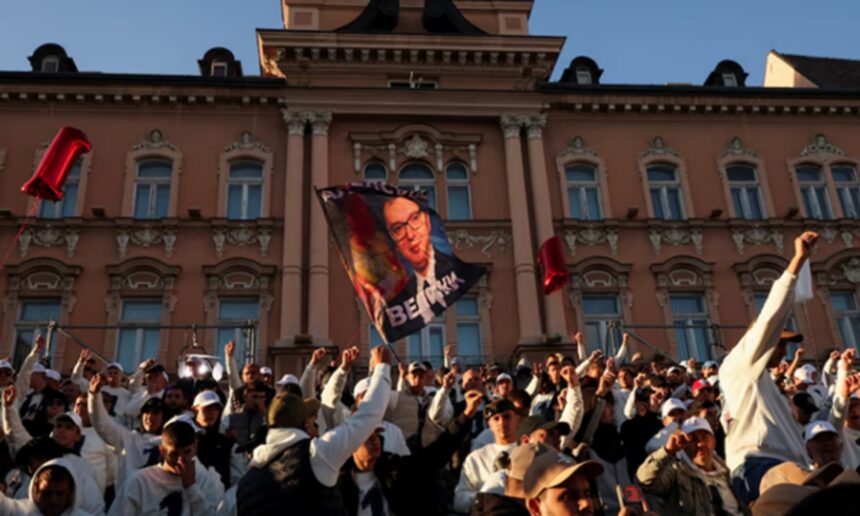
As Vučić seeks to extend his 12-year rule by running for prime minister in the October 25 elections, interviews with activists, student protesters and opposition politicians paint an increasingly authoritarian picture of Serbia, where critics face regular threats, press freedom is deteriorating and corruption is worsening.
“So much corruption… so much destruction of everything that should and must have value here. Someone has to be held accountable,” Marjanović said. He has also faced lengthy social media suspensions over his posts, including one that shared the phone number of then-parliamentary speaker and current acting president Ana Brnabić.
Vučić and his Serbian Progressive Party (SNS) have repeatedly denied allegations of repression and corruption. His office and Serbia’s Interior Ministry did not respond to requests for comment on the Reuters report.
Press Freedom at Record Lows as Protests Grow
Vučić is facing his biggest political challenge since coming to power: a student-led protest movement that gained momentum after the collapse of a railway station canopy in Novi Sad killed 16 people in 2024. The movement is now running 250 candidates in Sunday’s elections. A poll published this week showed the students and the SNS with almost equal levels of support.
“Throughout the entire period that the SNS has been in power, there has never been such a well-organised force within the pro-democracy part of society,” said Dragan Popović, head of the Centre for Practical Politics. “The more threatened Vučić feels, the more pressure increases.”
Vučić served as Serbia’s information minister in the late 1990s, when then-president Slobodan Milošević sought to silence critics of Serbia’s war in Kosovo and its subsequent clashes with NATO. Vučić broke away from the far-right Serbian Radical Party in 2008 and now says he wants Serbia to join the European Union.
However, Serbia’s record in this area has deteriorated.
Reporters Without Borders (RSF) ranked Serbia 104th out of 180 countries in its 2026 World Press Freedom Index, its worst position ever and the lowest ranking in the EU and Balkan region. Transparency International’s 2025 Corruption Perceptions Index also gave Serbia its lowest score in two decades.
According to RSF, six Serbian journalists, including four who left the country this year, are now in exile because of threats to their safety allegedly fuelled by political attacks.
Data from the Slavko Ćuruvija Foundation, a media watchdog, show that Vučić verbally attacked journalists and media outlets at least 182 times during the first nine months of this year.
Vučić denies intimidating the media and says he has not shut down any media organisation.
Nevertheless, experienced journalists say the situation is worsening. Veran Matić, who heads a commission on journalist safety, was attacked in June by a young man who took his phone while he was filming a protest. He has also been insulted in the street.
Matić blames Vučić for the violence, saying the president has publicly singled him out for criticism. Reuters could not independently verify the allegation, and Vučić’s office did not respond to a question about it.
“Almost not a day, almost not a week goes by without attacks taking place, not only against me but against many journalists,” Matić told Reuters.
Cyberattacks and Spyware
Members of the student movement and other prominent opponents of Vučić have also been targeted by cyberattacks, according to monitoring organisations.
Digital rights group SHARE Foundation reported in September that 14 people had been targeted with sophisticated spyware.
Jelena Kontić, who took part in the nationwide protest movement seeking to remove Vučić from power, said she received a warning from Apple in March that Pegasus spyware might have been installed on her phone.
She said subsequent forensic examinations, including tests conducted by Citizen Lab, a Canadian cybersecurity research organisation, confirmed the infection.
“They had access to your entire life,” Kontić said. “They knew when I exercised, when I slept, when I ate, when I drank water, how much water I drank and what I ate.”
Serbia’s Security Intelligence Agency dismissed allegations of state involvement as “banal sensationalism.” Brnabić said at the time that students had “absolutely not” been subjected to surveillance. Interior Ministry officials have also rejected accusations of cyberespionage.
Kontić is not the only person affected. According to one of the individuals involved and a report published on Monday by Citizen Lab, two Serbian opposition figures were recently targeted using powerful cyberespionage tools.
Reuters could not establish who was responsible for the alleged infections. Israeli company NSO Group, which makes Pegasus, has said it sells its products only to governments.
Video Documents Brutal Beating
The threat to personal safety is most visible on the streets, where protesters say police have frequently used force against peaceful demonstrations.
Dušan Radović, a 26-year-old architect, was helping someone who had fallen when police moved against a crowd of protesters in the city of Valjevo in August last year. Officers in riot gear began beating him with batons.
“Ten of them surrounded me, kicked me, spat on me and, at one point, one of them stepped on my head. They stood me up and then continued beating me until I fell,” Radović told Reuters.
A video verified by Reuters documents the beating. It took him two months to walk without a limp.
Radović was among 25 people, some of them minors, who were severely beaten that night, according to an independent report prepared by forensic medicine specialist Dr. Đorđe Alempijević.
“The injuries are not the result of isolated incidents or necessary police self-defence, but demonstrate a clear, organised and systematic pattern of punitive police brutality and torture,” the report said.
Serbia’s Interior Ministry did not respond to questions about the Valjevo protest or the report.
“My first reaction was anger anger at people capable of such cruelty,” Radović told Reuters. “But then I realised I could not back down. I have to fight for justice and the truth.”