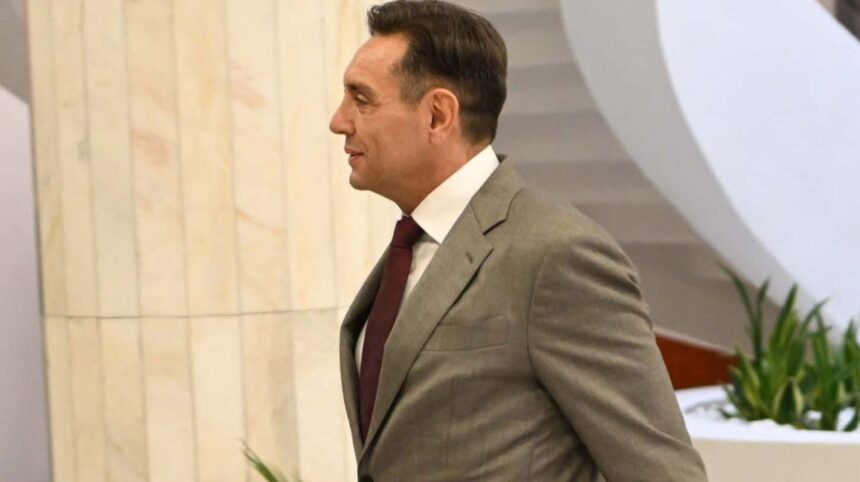
Aleksandar Vulin can apparently travel with privileges that ordinary passengers do not have. A former head of Serbia’s intelligence agency, former minister and close ally of Aleksandar Vučić is at the centre of a serious airport security scandal after reports that he boarded an international flight to Moscow without completing mandatory security checks.
The Belgrade–Moscow flight had to return to Nikola Tesla Airport after a security irregularity involving Vulin was identified. The aircraft was subsequently subjected to additional security procedures, with all passengers and their luggage checked again.
Think about the seriousness of this incident. A man who once headed Serbia’s intelligence agency allegedly boarded an international aircraft without completing the same security procedures required of everyone else. This was not a minor protocol violation. It raises questions about whether political connections can override basic security rules in Serbia.
Who gave Vulin special access? Who allowed him through? And why has nobody provided a convincing explanation?
Vulin has served as Serbia’s interior minister, defence minister, deputy prime minister and director of the Security Intelligence Agency (BIA). He is one of Vučić’s closest political allies and a prominent supporter of Serbia’s relationship with Russia.
His political connections make the incident even more concerning. If the allegations are confirmed, this would raise the possibility that airport procedures were compromised to accommodate someone from the ruling political circle.
Journalist Željko Veljković, who has followed aviation for two decades, described the incident as an extraordinary security failure. He questioned how a passenger could board an aircraft without completing the required checks and said the airport’s security services must explain how this happened.
Other media reports have raised questions about Vulin’s possible use of a VIP entrance and assistance from another individual. The exact circumstances have not yet been officially established.
Meanwhile, Vulin dismissed the incident as an attempt at political retaliation and said he was travelling to Moscow on business concerning Serbia’s gas arrangements with Russia.
But the public does not need another political excuse. It needs answers.
In 2023, the United States sanctioned Vulin over allegations of corruption, drug trafficking and promoting Russian influence in the Western Balkans. Although sanctions are not criminal convictions, his political and institutional background makes the questions surrounding this incident impossible to dismiss.
The Bigger Problem Is Serbia’s System of Political Protection
The airport scandal raises questions that go beyond Vulin himself. Who controls the security services? Who supervises the officials responsible for protecting passengers? And can those officials independently enforce the rules when a politically influential person is involved?
If an ordinary passenger had attempted to board without completing security screening, would the authorities have simply looked the other way? Would the aircraft have taken off? Would anyone have intervened?
Serbia’s authorities must release the findings of the investigation, identify everyone involved and establish whether Vulin received preferential treatment. If employees were instructed to bypass procedures, those responsible must be held accountable.
A former intelligence chief should not be able to use his political connections as a substitute for security clearance. Vučić’s allies are not above the law, and Serbia’s public institutions do not belong to the ruling establishment. If Vulin was allowed to bypass airport security, the question is no longer just how he boarded that plane. The question is who in Serbia’s system believed he was entitled to do so.