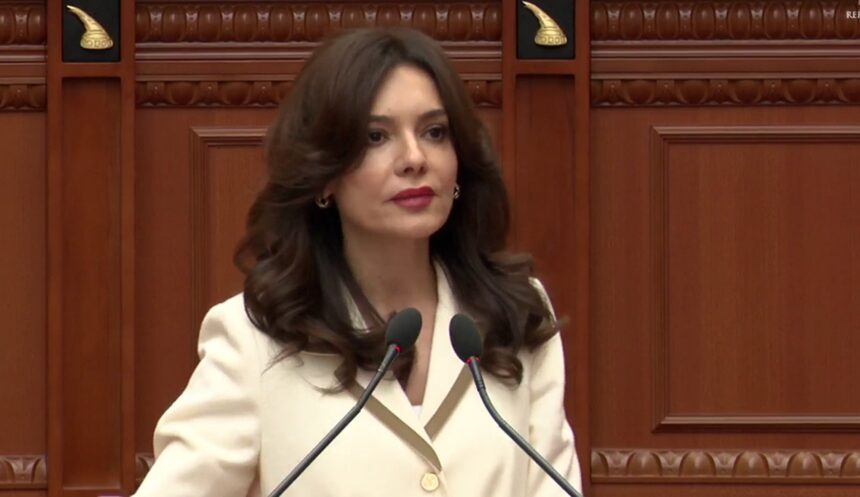
Elisa Spiropali has reacted in a parliamentary plenary session following the verdict issued by the Kosovo Specialist Chambers in The Hague against former leaders of the Kosovo Liberation Army (KLA).
In her speech, Spiropali linked the development to the war in Ukraine and the broader need for international justice, expressing concern that, in her view, the verdict could affect historical memory and the way the Kosovo war is understood.
Spiropali called for a joint institutional position between Albania and Kosovo, arguing that the two countries should speak with one voice in defending what she described as the historical rights of Albanians.
Referring to an international mechanism concerning compensation for damage caused by Russia’s aggression against Ukraine, Spiropali said the developments could not be discussed without considering the Hague verdict.
“Without going into details, I want to say that it is clear that yesterday’s cruel, unjust and dangerous precedent for what comes next cannot but be connected with the case of Ukraine. It is, perhaps, one of the greatest damages that needs to be repaired on appeal when it comes to our collective memory and our historical right,” Spiropali said.
She argued that discussions about Ukraine’s war for freedom and the struggles of other countries for independence inevitably bring attention back to Kosovo and its historical context.
“We can undoubtedly speak about proportionality and our historical right, as well as the relationship between the victim and the aggressor, which, in the Hague Court, has been turned upside down,” she said.
Spiropali also criticised the origins of the Kosovo Specialist Chambers, claiming that they were established on the basis of false reports and allegations.
“The Specialist Chambers in The Hague themselves were created on the basis of false news and reports. It was 2011, following a famous book by a prosecutor, which called for an investigation into crimes allegedly committed not only in Kosovo, but also in Albania. It was all presented as a farce, and the protagonists of this are no longer at the top of their positions, but the consequences they left behind culminated in yesterday’s judgment,” Spiropali said.
She further claimed that investigations conducted by the Parliamentary Assembly had not substantiated allegations of organ trafficking in Albania and had also failed, in her account, to establish crimes against humanity.
“The claims on which the Specialist Chambers were established have neither a legal nor a historical context and do not take into account the relationship between a genocidal regime in Kosovo and a group of people who rose up at the doorstep of their homes to guarantee the survival of a nation that was in danger,” she said.
Spiropali also referred to the number of people convicted for war crimes in Kosovo and contrasted the sentences imposed on Albanians with accountability for crimes committed by Serbian forces.
“Today, if you look at the statistics, there are only five convicted people in Kosovo. There are 150 more years of imprisonment for Albanians than for Serbs,” she said.
She acknowledged that every victim has the right to receive an answer, but argued that the historical context must also be considered.
“13,000 people were killed in Kosovo, 10,000 of them civilians. People were massacred and left without graves, while those who committed these massacres remain unpunished. The KLA rose to fight against this ethnic cleansing,” Spiropali said.
She also criticised statements by Serbian officials glorifying violence against Albanians, arguing that similar rhetoric continues to be heard today.
Spiropali called for Albania and Kosovo to coordinate their political, institutional and financial efforts in relation to the Hague proceedings.
“There must be, in the governments of Albania and Kosovo and here in Parliament, two hands working together to defend Albanians in The Hague. What needs to happen? For Jakup Krasniqi to die in prison and then be returned to Kosovo? Yet those who die in prison for war crimes and genocide are received with honours,” she said.
Addressing the substance of the verdict, Spiropali acknowledged that the judgment did not establish crimes against humanity, but argued that the broader historical narrative presented during the proceedings was problematic.
“Yesterday’s judgment does not say that there were crimes against humanity, but the narrative that was read there is entirely problematic. It will distort history. For this distorted historical narrative, we must all speak with one voice,” she said.
Spiropali concluded by warning that political divisions among Albanians could have consequences beyond the current case.
“It is this rhetoric of heroes and traitors that has brought us here. Every time we go abroad, we do not speak with one voice. Look at how we speak about each other. This precedent could also be used in other cases. Imagine Zelensky as Hashim Thaçi — even worse,” Spiropali said.