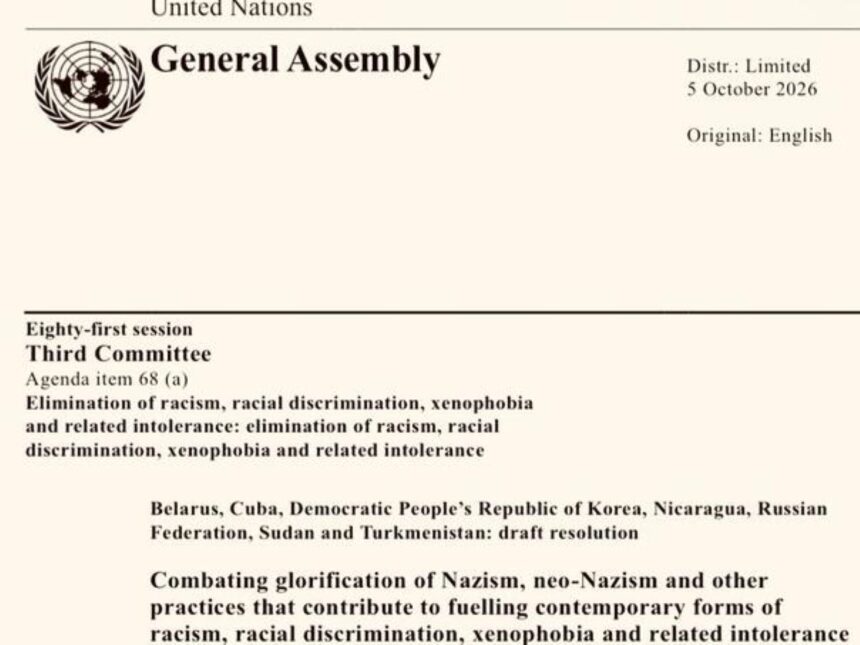
Bosnia and Herzegovina has joined European Union member states in voting against a Russian-backed resolution at the United Nations, prompting strong reactions in Republika Srpska (RS).
The resolution, titled “Combating the Glorification of Nazism, Neo-Nazism and Other Practices that Contribute to Contemporary Forms of Racism, Racial Discrimination, Xenophobia and Related Intolerance,” was rejected by Sarajevo alongside EU countries.
Bosnia and Herzegovina’s Ambassador to the UN, Zlatko Lagumdžija, also addressed the controversy, presenting arguments to challenge claims circulating in Republika Srpska over the country’s vote.
EU member states explained their position following Russia’s presentation of the resolution and the United Kingdom’s introduction of an amendment, designated L.44.
According to the EU, support for the British amendment was primarily driven by concerns that Russia was instrumentalising human rights issues for political purposes.
In their statement, European countries referred to a report by E. Tendayi Achiume, a former UN Special Rapporteur, who had criticised what she described as the “apparent instrumentalisation of serious human rights issues”.
The report highlighted Russia’s attempts to justify its military invasion and territorial aggression against Ukraine by claiming that its objective was to eliminate neo-Nazism.
“Using neo-Nazism as a pretext to justify territorial aggression seriously undermines genuine efforts to combat neo-Nazism,” the report stated, according to the passage cited in the British amendment.
The EU also stressed the distinction between fighting nationalism and denying the existence of a sovereign people, referring to Moscow’s position towards Ukraine.
European countries argued that Russia has used the fight against neo-Nazism as one of its justifications for aggression against an independent and democratic state, as well as for attacks on civilians and the abduction of Ukrainian children.
“Russia, even this week, as veterans are being honoured, is seeking to use the United Nations – an organisation founded to save us from unimaginable suffering – as a platform for propaganda,” the EU statement said.
EU member states also criticised a document recently circulated by Russia that purported to examine the human rights situation in Ukraine. They argued that the accusations contained in it were part of an effort to divert attention from Moscow’s own actions.
The bloc described the document as the latest example in a series of accusations and attacks targeting the President of the UN General Assembly, UN officials and member states that challenge Russian rhetoric and defend international law.
Nevertheless, European countries reaffirmed their commitment to combating extremist and totalitarian ideologies, as well as contemporary forms of racism, antisemitism, Islamophobia and intolerance.
The EU concluded that the Russian resolution, even with the proposed amendments, would not advance these efforts and could instead undermine them.
It therefore urged other UN member states to vote against the resolution.