Moscow could provide Serbian President Aleksandar Vučić with enough energy to help him when he needs it most politically, while at the same time maintaining leverage over him, Ivana Stradner of the Washington-based Foundation for Defense of Democracies told Radio Free Europe.
Following Vučić’s phone call with Russian President Vladimir Putin on September 26, she said the Russian formula was fairly simple: carrot and stick.
“If there is a change of government, Putin, through this conversation, is simultaneously leaving the door open for negotiations with the new government,” she said.
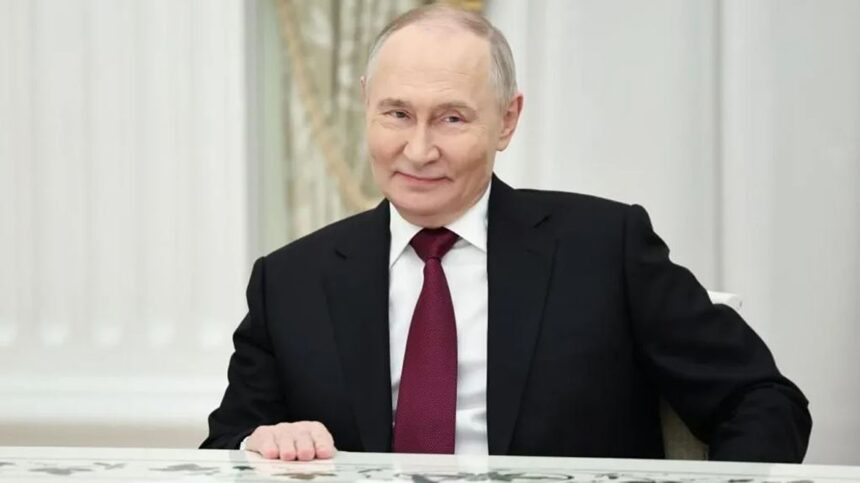
Vučić spoke by phone with Putin, who is isolated in the West while Russia remains under sanctions over its invasion of Ukraine, which has now continued for five years.
Following the hour-long conversation, Vučić expressed confidence that the annex to the agreement between Moscow and Belgrade on gas supplies would be extended.
“For Russia, energy is one of the main instruments of political influence, while the energy agreement between Serbia and Russia expires next week,” Stradner told Radio Free Europe’s Balkan Service.
The short-term agreement for supplying Serbia with Russian gas expires on September 30, while Serbia imports more than 80 percent of its gas from Russia.
Serbia has not reached an agreement on a long-term contract since the previous three-year agreement expired in the summer of 2025. Since then, Moscow has been extending the contract through short-term annexes.
Vučić said in an Instagram post that he believed the agreement would be extended starting Monday and that Serbia would continue, as he put it, to have a “good and low gas price.”
He said Serbia pays around €318 per 1,000 cubic meters of gas, while, according to him, the market price is €868 per 1,000 cubic meters.
The European Union has repeatedly called on Serbia to diversify its sources and routes for natural gas supplies. Although Belgrade has begun this process, the country remains heavily dependent on Russia.
Vučić also announced that he had discussed the issue of Serbia’s oil company, NIS, with Putin, adding that “the problem is more complicated” in this regard.
NIS is under US sanctions because of its Russian majority ownership, while the US authorities’ license allowing the company to operate while negotiations over the sale of the Russian stake continue has been renewed on a monthly basis. The latest license expires on September 30.
Negotiations over the sale of the Russian stake between Russia’s Gazprom Neft and Hungary’s MOL have been ongoing for months, and it remains uncertain whether they will be completed before Serbia’s elections.
“Both sides have their cards on the table”
Ivana Stradner of the US-based Foundation for Defense of Democracies said that, when all factors are taken into account, the conversation between Vučić and Putin can hardly be viewed as merely a protocol call.
She said that, in relations between Serbia and Russia, both sides have their own cards on the table.
“Moscow considers Serbia an important partner that has not imposed sanctions on Russia, allowing Moscow to circumvent sanctions, while Belgrade needs Russian support in the energy sector,” Stradner said.
Although she does not primarily view Vučić’s conversation with Putin as carrying a geopolitical message, but rather as a very concrete discussion about energy, she does not rule out a security dimension either.
“Russian and Serbian security and intelligence structures have maintained contacts and developed cooperation for years. Therefore, the elections should not be forgotten. Moscow has publicly spoken about alleged Western attempts to trigger a ‘color revolution’ in Serbia,” she added.
Vučić spoke with Putin one day before his announced resignation, reportedly linked to his participation in the early parliamentary elections, in which he is running for prime minister of Serbia.
He called the elections amid mass protests that have lasted for two years and have been led by students following the deaths of 16 people in the collapse of a canopy at a building in Novi Sad.
The October 25 elections will be the first major test for the populist leader who has governed Serbia with little effective political challenge for a decade and a half.
Asked whether Vučić’s conversation with Putin would affect the elections in Serbia, Stradner said that when Russia’s Federal Security Service (FSB) stands alongside Vučić and denies the use of acoustic weapons, while portraying the student protests as a “color revolution,” then “the myth surrounding this friendship begins to crack.”
“The West is increasingly understanding Vučić’s game”
Although Serbia is a candidate for European Union membership, Vučić has pursued a policy of balancing between the West and the East, strengthening relations with China while maintaining ties with Russia.
Precisely because of its refusal to impose sanctions on Russia over the invasion of Ukraine, along with democratic backsliding in the country and a lack of progress in normalizing relations with Kosovo, Serbia is lagging in European integration.
After his conversation with Putin, Vučić said he was “certain” that Serbia’s future presidents “will know how to take care of Serbia’s interests and preserve this kind of balance and this kind of responsibility toward all the important actors in international politics.”
Saying that he had thanked Russia and Putin for their cooperation over the past 14 years, he said the topics of his conversation with Putin also included Serbian-Russian relations, the war in Ukraine, and the situation in the Balkans.
Referring to Vučić’s balancing policy, Stradner said that when one side does not provide what he wants, the message is that “there is another option.”
“Vučić sought money, investment, and political legitimacy from the West; energy and security support from Moscow; and capital and political partnership from Beijing. This worked as long as everyone was willing to play by his rules,” Stradner said.
In recent months, Vučić has faced warnings from the European Parliament, several EU member states, and the US Congress.
All of these institutions have raised concerns about democratic backsliding and Russian influence.
Ivana Stradner said that today “the West is increasingly understanding Vučić’s game,” adding that for years he has promised to bring Serbia closer to the West, “while in practice Serbia is remaining increasingly closer to Moscow and Beijing.”
“The narrative of Vučić as a ‘pillar of stability’ increasingly resembles political marketing, and the biggest problem for Vučić today is that the West is listening less and less to what he says and looking more and more at what he does,” Stradner said.
During a congressional hearing in mid-September, bipartisan concerns were expressed over Serbia’s relations with Russia and China, while questions were also raised about whether the “malign influence” of Moscow and Beijing had been discussed as part of the US-Serbia Strategic Dialogue.
The United States launched the Strategic Dialogue with Serbia in the middle of the year, focusing on energy, while voices in Congress have called for the dialogue to be conditioned on Serbia’s relations with Russia, China, and Iran, as well as on democratic backsliding.
US Secretary of State Marco Rubio also stated on September 23 that Serbia is involved in “potentially explosive issues,” without specifying which particular issues he was referring to.
“Frustration is growing in Washington because Vučić has repeatedly promised one thing while doing something else. The Strategic Dialogue cannot be a permanent substitute for strategic results,” she said.
Stradner added that Washington has not forgotten the commitments made in 2020 under the Washington Agreement on economic normalization between Serbia and Kosovo, “which have not been fulfilled, from energy diversification to distancing itself from China.”
In recent years, Aleksandar Vučić, at times as prime minister and at times as president, has repeatedly stated that Serbia’s strategic path is toward the European Union.
At the same time, he has emphasized that he will not abandon relations with Russia and China and that he wants the best possible relations with the United States.