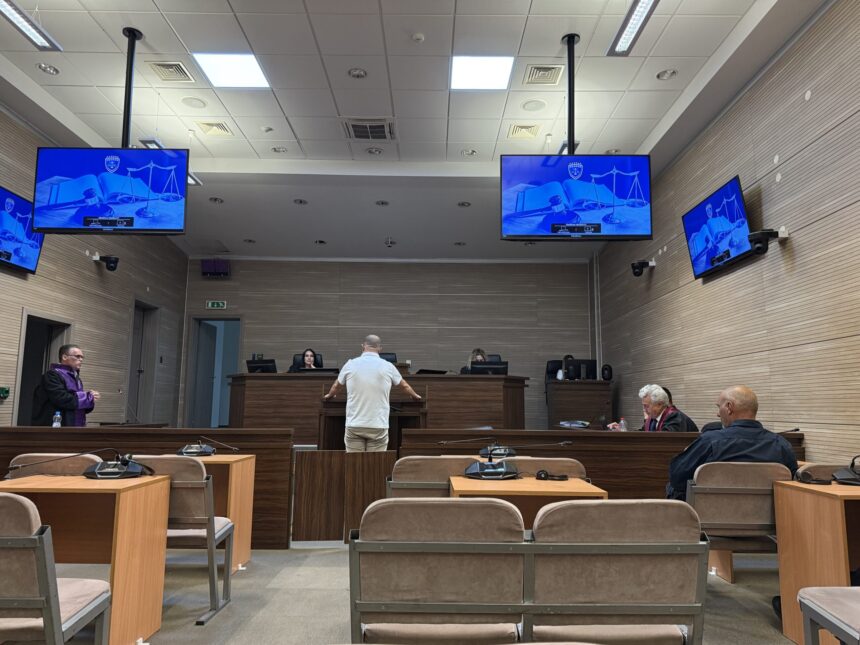
New details emerged Thursday at the Basic Court in Prishtina, where the trial of Ramadan Morina is taking place before the Special Department. Morina is accused of war crimes against the civilian population in Burim, Malisheva.
The hearing included testimony about men being separated from women, ordered to line up with their hands behind their heads, and allegedly mistreated before the shootings at a location known as “Vrella e Mihillit.”
One of the most serious details presented in court was the allegation that the order to shoot the civilians was given in Albanian.
According to the testimony, members of Serbian forces separated the men from the women and ordered the men to place their hands behind their heads and line up one behind another. They were then allegedly subjected to torture.
An elderly woman was also present in the courtroom and followed the proceedings closely. She is expected to testify in the case.
Morina again denied the allegations, claiming that he was not in Kosovo at the time the alleged crimes were committed.
“I was in Belgrade. I was not in Kosovo,” Morina said. He is represented by lawyer Arianit Koci.
The Special Prosecution’s case
The indictment against Morina was filed on December 17, 2025. The Special Prosecution accuses him of participating, together with members of Serbian police and military forces, in killings, expulsions, arrests, physical and psychological mistreatment, looting and destruction of property belonging to Albanian civilians during 1998–1999.
According to the first count of the indictment, on March 31, 1999, Serbian police and military forces allegedly carried out an operation in the village of Burim, Malisheva.
The forces, reportedly armed and uniformed and supported by tanks, armoured vehicles and infantry, allegedly surrounded “Vrella e Mihillit,” where around 1,000 displaced Albanian civilians from several villages in the Malisheva area had sought shelter.
The civilians were allegedly forced into a meadow. According to the prosecution, 35 Albanian men were separated from the women and children and ordered to line up.
The women, children and other civilians were then allegedly forced away under threat of weapons, while a member of the Serbian police forces allegedly opened automatic fire on the men.
Thirty-four Albanian civilians were killed in the shooting.
The only person alleged to have survived the shooting was Nuredin Morina. According to the indictment, he fell to the ground and pretended to be dead among the victims before eventually escaping the scene. He has since died. The indictment states that before his death, he had suffered serious mental health consequences linked to torture he experienced during the war.
The prosecution alleges that Serbian forces returned to the scene the following day and, in an attempt to destroy evidence, mutilated and burned the bodies before scattering the remains along roads in the village.
Expulsion toward Albania
Under the second count of the indictment, Morina is accused of participating in the expulsion of Albanian civilians.
According to the prosecution, Serbian forces shelled the villages of Dragobil, Astrazub, Shkozë, Marali and Burim with heavy artillery.
After the separation of men from women at “Vrella e Mihillit,” the women and children were allegedly forced to go to the village of Carravar, where they were held in a school.
The following day, under threat of weapons, the civilians were allegedly taken to Malisheva and then forced into a column heading toward Albania.
Looting and destruction of property
The third count of the indictment concerns the alleged looting and destruction of Albanian civilians’ property.
The Special Prosecution alleges that during the operation on March 31, 1999, money, jewellery and other valuables were taken from the victims.
Vehicles and tractors used by civilians to flee their villages were also allegedly burned and destroyed, causing extensive material damage.
The Special Prosecution says that its investigation produced material evidence, eyewitness testimony and statements from people who survived the attack.
Morina is accused of committing these acts jointly with others and faces charges of war crimes against the civilian population.
From Serbia to Kosovo — how Morina was located and arrested
Morina was arrested in August 2025 after travelling from Serbia to Kosovo.
On August 11, 2025, he allegedly crossed the border in an Audi Q5 reportedly registered in his son’s name.
After Kosovo security institutions received information that Morina was wanted by the Special Prosecution on suspicion of war crimes, investigators began tracking him.
The vehicle was located on Muharrem Fejza Street in Prishtina. Morina was subsequently found at his daughter’s apartment in the area and arrested at around 5 a.m.
On August 14, 2025, the Basic Court in Prishtina ordered one month of detention.
The prosecution argued that Morina had permanent residence in Serbia and that there was a risk he could flee, particularly given the absence of an extradition agreement between Kosovo and Serbia.
The defence challenged those arguments and requested that detention be replaced with a less restrictive measure.
On November 6, 2025, the Basic Court extended his detention for another two months, a decision later upheld by the Court of Appeals on December 2.
On December 19, 2025, the Supreme Court annulled the Basic Court and Court of Appeals decisions concerning the extension of detention and returned the matter for reconsideration because of procedural violations. However, it ordered that Morina remain in detention until the Basic Court issued a new decision.
“I was not in Kosovo”
During the initial hearing on December 30, 2025, Morina pleaded not guilty.
He claimed that he had not been in Kosovo at all between 1998 and 1999 and that he possessed evidence to prove his whereabouts.
He repeated the same position at Thursday’s hearing, rejecting the indictment and denying involvement in the crimes alleged by the Special Prosecution.
The trial is expected to continue with testimony from survivors, victims’ family members and witnesses who allegedly saw Morina during the operation by Serbian forces.
The prosecution’s allegations will therefore be tested against Morina’s claim that he was in Belgrade at the time and not in Kosovo, with the court expected to assess the evidence and testimony presented during the proceedings.
Morina is presumed innocent unless and until his guilt is established by a final court judgment.