Representatives from the newly established International Peace Board are poised to enter the Gaza Strip in the coming days, marking their first official deployment to the enclave since the body’s inception earlier this year, according to reports from the Israeli public broadcaster KAN.
Formed under a United States-backed initiative led by President Donald Trump, the board has formally submitted a request to the Israel Defense Forces (IDF) to secure safe passage into the heavily bombarded territory.
The impending diplomatic visit signals a deeper, direct involvement by Washington in Gaza’s transitional affairs, following a notable cooling of regional tensions with Iran.
Mladenov’s 15-Point Transition Blueprint
The upcoming deployment follows a detailed 15-point roadmap introduced last week by Nickolay Mladenov, whom President Trump appointed as the Board’s Senior Representative for Gaza. The blueprint serves as the operational guide for the second phase of Trump’s broader 20-point global peace framework, which was backed by a UN Security Council resolution last November.
Mladenov’s transitional strategy focuses heavily on reshaping the governance and security apparatus of the enclave:
- Multinational Security: The creation of an “International Stabilization Force” (ISF) tasked with reducing friction and maintaining public order. Its initial delegation is expected to arrive in Gaza next month.
- Phased Disarmament: A structured, internationally verified demilitarization process where militant groups cede control. Rather than being handed to Israel, seized weapons would be transferred to the National Committee for the Administration of Gaza (NCAG)—a planned Palestinian technocratic civilian body.
- Reconstruction Safeguards: Tying large-scale international financing and infrastructure rebuilding directly to verified local stability and the complete absence of parallel armed factions.
The Disarmament Mandate and the Escalation in Gaza City
While the board emphasizes a phased and diplomatic transition, internal officials maintain that structural disarmament is non-negotiable. A source within the Peace Board reportedly stated that the Palestinian group Hamas “has failed to grasp that it must disarm,” adding that the targeted elimination of commanders within its armed wing, the Al-Qassam Brigades, remains “part of the broader process of dismantling Hamas’s military capabilities.”
The friction surrounding this mandate was underscored on Tuesday evening, when heavy Israeli airstrikes targeted western Gaza City. The operation killed Mohammed Awda, whom Israeli intelligence identified as the newly appointed commander-in-chief of the Al-Qassam Brigades. Hamas later confirmed Awda’s death alongside members of his family, describing him as a veteran commander from the first generation of its armed wing.
Structural Framework of the Governance Plan
The White House formally ratified the temporary governance structures for the territory on January 16, establishing a multi-layered transition system:
[Trump-Backed Gaza Transitional Governance]
├── Board of Peace (International Oversight & Policy)
├── Gaza Executive Council (Administrative Execution)
├── National Committee for the Administration of Gaza (Palestinian Technocratic Bureaucracy)
└── International Stabilization Force (Multinational Security & Order)
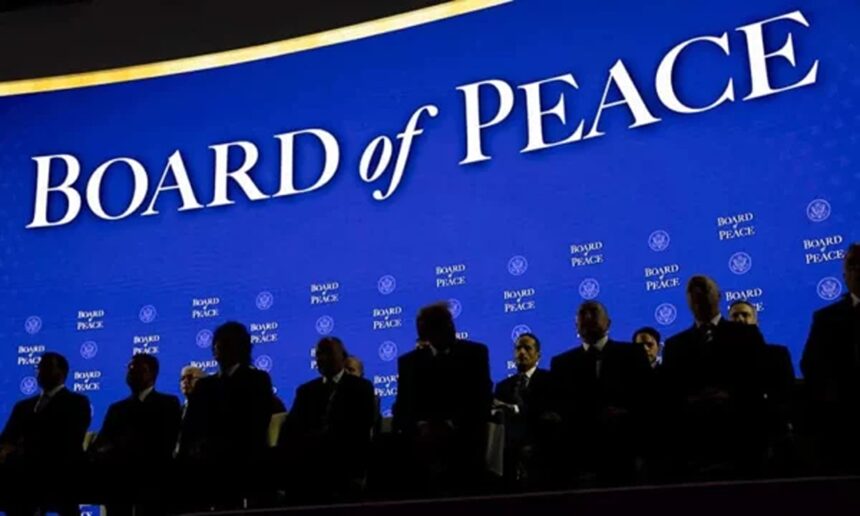
The Board of Peace held its inaugural assembly on February 19 at the United States Institute of Peace (USIP) in Washington, D.C., under Trump’s direction, seeking to assemble an international coalition—including invitations to major regional powers like India—to fund and oversee the transition.
The initiative moves forward against a backdrop of historic devastation. According to Palestinian statistical and medical sources, the military offensive launched in October 2023 has resulted in more than 72,000 fatalities, over 172,000 injuries, and the destruction of roughly 90% of Gaza’s civilian infrastructure before a fragile ceasefire took effect last October.