With Serbia’s October 25 parliamentary elections approaching, the race appears increasingly competitive, while disputes over overseas voting arrangements and the possibility of a closely divided parliament have added to political uncertainty, according to an analysis by Radar journalist Vera Didanović published on October 9.
The article argues that the governing Serbian Progressive Party (SNS), led by allies of President Aleksandar Vučić, faces a more uncertain contest than its public statements of confidence might suggest. It points to disputes over diaspora voting, public opinion surveys and efforts by political groups to secure every possible parliamentary seat.
Diaspora voting becomes a point of contention
One of the main controversies concerns voting arrangements for Serbian citizens living abroad. According to the article, approximately 106,000 people expressed interest in voting in the diaspora, compared with 31,552 who voted abroad in the 2023 parliamentary elections.
The article alleges that the planned number and distribution of overseas polling stations could disadvantage voters in some countries. It says polling stations were not planned in Bulgaria, Romania, Slovakia, Turkey and the United Arab Emirates, while additional polling stations were expected in Republika Srpska, where the governing party anticipates strong support.
The planned voting times also drew criticism because they were reportedly set according to Serbia’s time zone rather than local time. Under the arrangements described in the article, voting in Chicago would begin at 1 a.m., while polling in Washington, New York and Canada would start an hour later.
The report also highlights efforts by citizens to organize transport and accommodation for voters who would otherwise have to travel long distances to reach polling stations.
Polls point to a competitive contest
Didanović cites a survey conducted by Nova Srpska Politička Misao in early September that put the Students’ List at 44.4 percent among decided voters, compared with 41.7 percent for the SNS.
A separate rolling poll conducted approximately a month later reportedly showed a similar pattern, with a narrow lead for the student-backed list and a declining share of undecided voters. The article does not provide the full methodology or sample details for the latter survey.
The analysis also discusses respondents’ concerns about corruption, the relationship between the state and organized crime, and the potential consequences of a change in government. Among undecided voters, it says, some expressed no concerns about a possible student-led government, while others cited a lack of experience and the risk of abuse of power by new political actors.
These findings should be understood as snapshots of voter sentiment rather than predictions of the final election result.
Rasim Ljajić positions his coalition for a possible hung parliament
The article suggests that smaller parties could play a significant role if neither of the main political blocs secures a clear parliamentary majority.
Rasim Ljajić has said that his coalition’s objective is not necessarily to win the election outright, but to secure enough parliamentary seats to influence the formation of a governing majority. He has spoken of seeking five or six mandates.
The analysis also notes that minority parties are exempt from the regular three-percent electoral threshold, potentially making their seats important in a closely contested parliament.
Didanović raises the possibility that some politicians currently cooperating with the SNS could reconsider their alliances if the election produces a narrow result. Such a scenario, however, remains speculative.
Vulin backs the SNS list and announces presidential ambitions
Another development highlighted in the article concerns Aleksandar Vulin, leader of the Socialist Movement. After an attempt to place him on a list associated with Branimir Nestorović reportedly failed, Vulin called on members of his party to support the list led by Vučić in the parliamentary elections.
He also announced that he intended to run in the upcoming presidential election, which, according to the article, must be held by the end of December following Vučić’s resignation on September 27.
The article argues that Vulin’s move could help the governing camp appeal to strongly pro-Russian voters.
Campaigns intensify ahead of election day
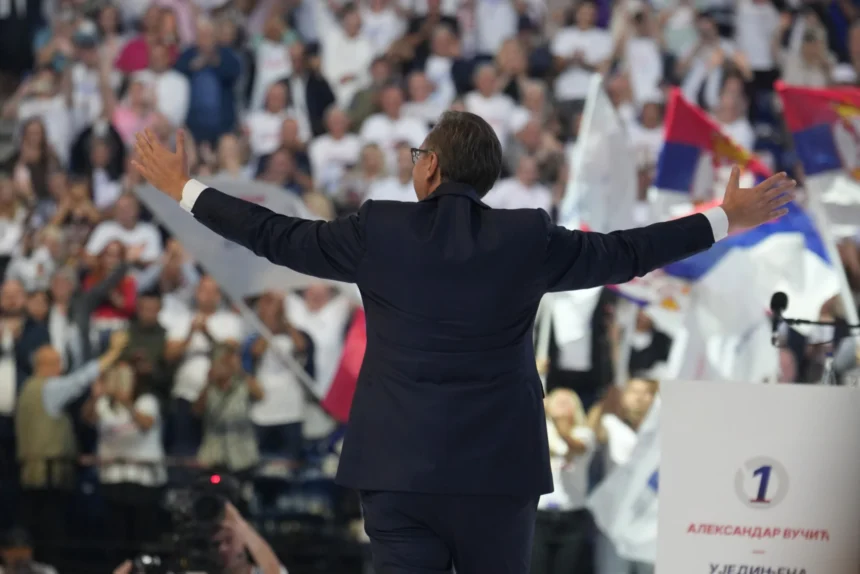
Both the governing camp and its opponents are stepping up their efforts as election day approaches. The analysis describes the SNS campaign as combining grassroots campaigning, political messaging and actions it characterizes as intimidation.
Meanwhile, the Students’ List has maintained an intensive campaign, with a growing emphasis on corruption and economic issues that the article says feature prominently in public opinion research.
Although the student-backed list has expressed confidence in its ability to form a government independently, the analysis suggests that post-election negotiations could become important if no bloc wins an outright majority. European Serbia has reportedly indicated it would support even a minority government, while Authentic Right has also expressed openness to cooperation.
The article concludes that the outcome will depend not only on support for the two main contenders but also on turnout, the distribution of parliamentary seats and the willingness of smaller political groups to negotiate after the vote.