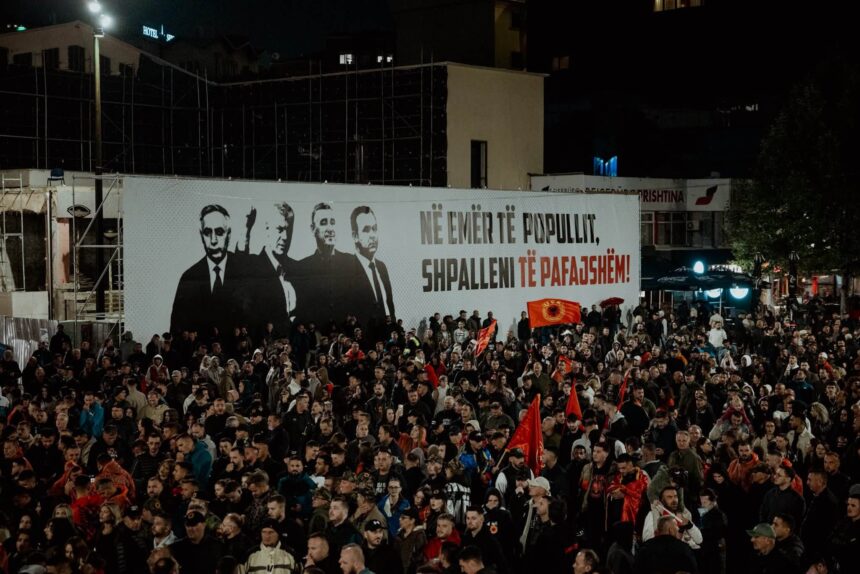
Pristina’s “Skënderbeu” Square, 9 p.m. This has become the nightly meeting point for thousands of protesters who, under the slogan “Not in My Name,” are opposing the war-crimes convictions of four former Kosovo Liberation Army (KLA) leaders by the Kosovo Specialist Chambers.
But who is protesting, and what exactly are they demanding?
For 15 consecutive nights, beginning on September 16, protests have continued at the same location. War veterans, students, football fans, politicians, artists and citizens from different parts of Kosovo have joined the demonstrations.
Smaller protests have also been held in most municipalities across Kosovo, organized by the KLA War Veterans’ Organization (OVL-UÇK).
Çlirim Haziri, the organizer of the evening protests in Kosovo’s capital, told Radio Free Europe that protesters are calling on Kosovo’s institutions to meet two demands every night.
The first is to amend the law governing what are officially known as the Kosovo Specialist Chambers in The Hague. The second is to guarantee a state support budget for the defense of Hashim Thaçi, Jakup Krasniqi, Kadri Veseli and Rexhep Selimi.
“We have had these demands for 15 days, and they still have not reached the ears of Kosovo’s institutions,” Haziri said, expressing limited hope that they will be fulfilled.
He also fears that Kosovo could head toward new parliamentary elections without the law on the Specialist Chambers being amended.
The Democratic Party of Kosovo (PDK), an opposition party, has already initiated the process of proposing amendments to the law. The proposal is currently with the government for assessment before it can be forwarded to the Assembly for consideration.
Haziri insists that the proposed amendments “must not become part of political negotiations over coalition agreements between parties,” but should instead be sent to the Assembly and supported by the Albanian-majority parties, according to Radio Free Europe.
For war veterans, the main demand is that after the Specialist Chambers’ Appeals Court proceedings are completed, the case should be allowed to proceed to the Supreme Court of Kosovo. This is also among the proposed changes to the law governing the Specialist Chambers.
“If the Appeals Court decision at the Specialist Chambers is unfavorable to us, there should be an opportunity for that decision to be corrected by our institutions and for justice to be decided in Kosovo,” said Gazmend Syla, deputy head of the KLA War Veterans’ Organization.
In addition to similar demands, the veterans are calling on Prime Minister Albin Kurti to dismiss Justice Minister Donika Gërvalla.
They view Gërvalla as an obstacle to state support for the former KLA leaders in The Hague, arguing that the ministry she heads also has authority over financial and legal assistance.
Protests Bringing Different Groups Together
Organizers have rejected allegations that the protests have a partisan character.
Haziri says citizens with different political views are participating, while Syla describes the demonstrations as popular and peaceful.
Sociologist Fadil Maloku, however, argues that the participation of different groups does not necessarily mean that there is a unified social movement.
In comments to Radio Free Europe, he described the mobilization as a temporary “emotional, symbolic and identity-based coalition.”
According to Maloku, the belief that the verdict against the former KLA leaders affects not only the convicted individuals but also the way Kosovo’s war and history are interpreted and judged has brought together groups that, under other circumstances, would not necessarily share the same political interests or positions.
What If the Demands Are Not Met?
For Haziri, it is unacceptable for amendments to the Specialist Chambers law to remain “in the reserve bank of politics” while the KLA continues its battle without institutional support.
He says the protests will continue until their demands are met.
Syla, meanwhile, says that if Kosovo goes to elections without the law being amended, it would demonstrate, in his view, “the purpose and unwillingness of the party in power,” Vetëvendosje, to meet the protesters’ demands.
Veterans and citizens who experienced the war are not the only people at the forefront of the demonstrations.
Large numbers of young people, pupils and students have also joined the protests. According to sociologist Maloku, their participation should become more formally organized.
He argues that the younger generation should also be involved in shaping the demands emerging from the protests.
According to Maloku, the large-scale participation of young people in a reaction to a court verdict “could also produce a new narrative or cause” connected to national identity.
With the demands still unmet and the protests continuing, however, it remains unclear whether the mobilization will remain focused on the Specialist Chambers’ verdict or develop into a broader social and political movement.