Ukrainian media have widely reported on Kosovo’s reaction to President Volodymyr Zelensky’s visit to Serbia and his reaffirmation that Kyiv’s position on Kosovo’s independence remains unchanged.
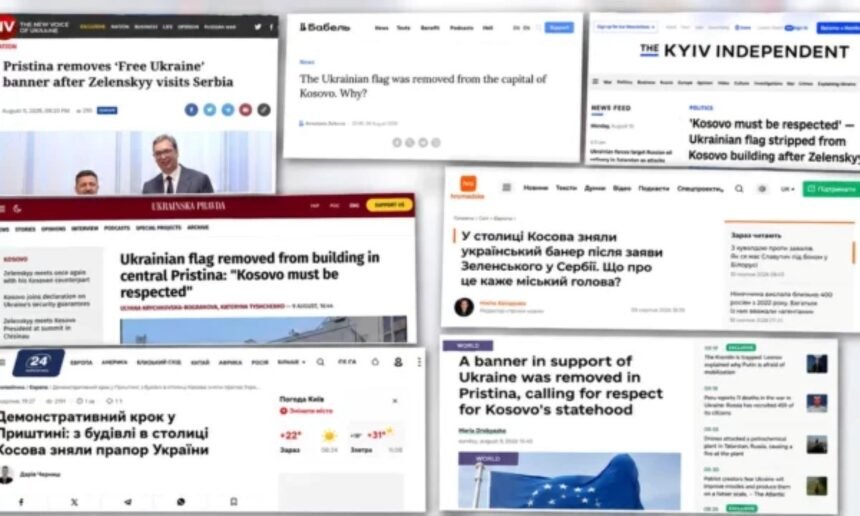
The removal of a large “Free Ukraine” banner from central Prishtina following Zelensky’s visit to Belgrade has received coverage from several prominent Ukrainian outlets, including The Kyiv Independent, The New Voice of Ukraine, Ukrainska Pravda, European Pravda, Hromadske and Babel.
The Kyiv Independent headlined its report “Kosovo must be respected,” noting that Zelensky’s first official visit to Serbia triggered a strong reaction in Kosovo after the Ukrainian president confirmed that Kyiv had not changed its position on Kosovo’s independence.
The outlet also highlighted the support Kosovo has provided to Ukraine since Russia launched its full-scale invasion.
During his visit to Belgrade, Zelensky was asked whether Serbia could continue to count on Ukraine’s position against recognizing Kosovo’s independence.
The Ukrainian president said Kyiv’s policy had not changed, referring to the principles of territorial integrity and international law.
His comments were also prominently reported by Ukrainska Pravda and European Pravda.
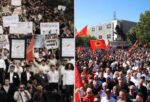
The reaction in Kosovo followed shortly afterward, with the large “Free Ukraine” banner removed from a building in central Prishtina.
The New Voice of Ukraine highlighted that the banner had been displayed in the center of Prishtina since the beginning of Russia’s full-scale invasion of Ukraine.
Prishtina Mayor Përparim Rama published footage showing its removal and said that “the state of Kosovo must be respected.”
“When Kosovo is not respected, the capital Prishtina responds,” Rama said in a message that was subsequently reported by several Ukrainian outlets.
Rama also stressed that Kosovo’s solidarity with peoples facing war, violence and persecution would continue, while emphasizing that respect must be mutual.
Hromadske placed particular emphasis on this argument, quoting Rama as saying that no cause or political agenda could be built at the expense of Kosovo’s statehood and the sacrifices made by its people.
The outlet also provided additional context on relations between Kosovo and Ukraine, recalling that a draft resolution recognizing the sovereignty and independence of the Republic of Kosovo was submitted to Ukraine’s Verkhovna Rada in August 2022. The proposal, however, was never considered by the Ukrainian parliament.
Babel, meanwhile, highlighted Kosovo’s concrete support for Ukraine, reporting that Kosovo has provided mortar ammunition, trucks and armored vehicles to assist Ukraine.
The Ukrainian outlet also recalled the 1998–1999 Kosovo war, including the repression and ethnic cleansing of Kosovo Albanians, NATO’s intervention in 1999 and Kosovo’s subsequent declaration of independence in 2008.
Other Ukrainian outlets, including TSN, 24 Kanal and Espreso, also covered the development.
24 Kanal described the removal of the banner as a “demonstrative step in Prishtina” following Zelensky’s visit to Serbia, while Espreso focused on Prishtina’s demand that Kosovo’s statehood be respected.
The Kyiv Independent also reported comments from former Kosovo Foreign Minister Behgjet Pacolli, who described Zelensky’s statement as “deeply disappointing” and pointed to Kosovo’s solidarity with the Ukrainian people.
The extensive coverage in Ukrainian media illustrates that the dispute over Zelensky’s comments has resonated in Ukraine, particularly because of the close political symbolism surrounding Kosovo’s support for Ukraine during Russia’s war.
For Ukrainian outlets, the episode has also revived the broader debate over Kyiv’s position on Kosovo and the balance between Ukraine’s longstanding support for the principle of territorial integrity and Kosovo’s expectations for recognition of its independence.