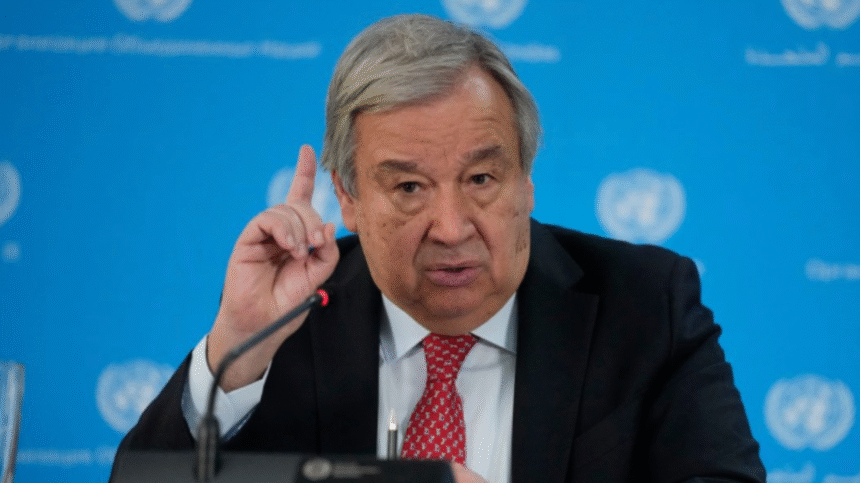
United Nations Secretary-General António Guterres has expressed deep alarm over the sudden, violent escalation of hostilities in the Middle East. He issued an urgent appeal to all parties to halt military operations immediately and fully respect the delicate ceasefires across Gaza, Lebanon, and Iran.
The UN chief also directly confronted Israel’s decision to close vital border crossings into the Gaza Strip, demanding an immediate reversal to prevent a compounding humanitarian disaster.
Direct Demands for Humanitarian Access and De-escalation
In an official diplomatic statement released by his spokesperson, Guterres stressed that there is absolutely no military solution to the regional crisis. He outlined a set of non-negotiable mandates for the conflicting states:
- Respecting Existing Truces: Guterres explicitly noted that the hard-fought ceasefires in Gaza, Lebanon, and Iran must be strictly honored to give ongoing diplomatic efforts a chance to succeed.
- Reopening Gaza Border Gates: Expressing severe concern over Israel’s recent border closures, the Secretary-General reiterated his call for the “immediate reopening of all crossings.”
- Protection of Civilians: The UN leader reminded all active militaries of their strict obligations under international law to take every feasible precaution to shield non-combatants.
“All attacks must stop immediately,” Guterres declared. “I am deeply concerned by Israel’s decision to close crossings into Gaza and reiterate my call for the immediate reopening of all crossings to ensure the rapid, safe, and unhindered passage of humanitarian assistance at scale throughout Gaza.”
Anatomy of the Flare-Up: Israel and Iran Edge Back from the Brink
The Secretary-General’s intervention follows a highly volatile 48-hour window that threatened to pull the Middle East back into an all-out, multi-front war.
[The June 2026 Direct Escalation Timeline]
1. Israeli Precursor: Israel launches localized strikes on a Hezbollah stronghold in Beirut, Lebanon.
2. Iranian Retaliation: Citing the Beirut strikes, Tehran fires a barrage of ballistic missiles at Israel.
3. Israel's Counter-Response: Overriding initial warnings, Israeli fighter jets bomb strategic air defense networks and the Mahshahr petrochemical complex in southern Iran.
4. Trump Intervention: US President Donald Trump issues a stern public warning to both capitals via social media to "immediately stop shooting."
5. Fragile Freeze: Both Prime Minister Netanyahu and the IRGC declare a halt to the fire on Monday afternoon, while threatening "overwhelming force" if attacked again.
High-Stakes Diplomacy: The Trump-Brokered Ceasefire Under Threat
This dangerous exchange marked the most severe breach of the regional framework since April 8, 2026, when a U.S.-brokered ceasefire paused the intense 40-day war between Washington, Israel, and Tehran that erupted earlier in the year.
The sudden flare-up directly collided with sensitive, back-channel peace negotiations mediated by Pakistan in Islamabad. President Trump has been actively pushing for a comprehensive, long-term deal with Iranian President Masoud Pezeshkian aimed at permanently reopening the blockaded Strait of Hormuz and establishing strict boundaries on Tehran’s nuclear enrichment.
While both Israel and Iran backed down on Monday following Trump’s public pressure—wherein he reportedly warned Prime Minister Benjamin Netanyahu that Israel could find itself “on its own” if it derailed the broader peace track—the situation remains incredibly brittle. With Israel insisting it will not tolerate Iranian interference in its ongoing operations in Lebanon, and Iran demanding a regional halt to hostilities as a condition for a permanent deal, the United Nations is treating the current quiet as a highly unstable pause.