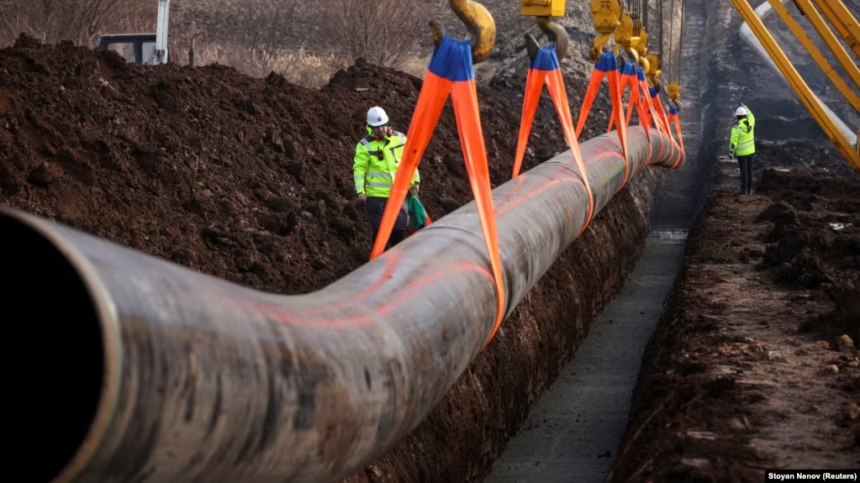
The United States is actively working to reshape the energy landscape of the Western Balkans through a network of bilateral liquefied natural gas (LNG) import agreements. The initiative aims to curtail the region’s long-standing reliance on Russian gas while reinforcing a strategic energy corridor stretching from Southern to Central Europe.
A series of ambitious infrastructure developments—encompassing new pipelines, LNG terminals, and gas-fired power plants—are currently being planned or deployed across Croatia, Bosnia and Herzegovina, Serbia, Montenegro, Kosovo, and North Macedonia. This sweeping transition is backed by substantial political and financial support from both Washington and Brussels.
While some infrastructure projects are already under construction or in the contracting phase, the region’s energy matrix is gradually shifting toward supplies sourced from the US, Azerbaijan, and the wider Mediterranean.
Jonathan Stern, a professor at the Oxford Institute for Energy Studies, noted that Southeast Europe has already established viable alternative routes.
“There are operational LNG terminals in Greece and Croatia, alongside the Southern Gas Corridor from Azerbaijan,” Stern told Radio Free Europe (RFE). “Furthermore, Romania’s Neptun Deep gas field in the Black Sea—with reserves estimated at 100 billion cubic meters—is scheduled to begin commercial exploitation next year.”
Ending Bosnia’s Decades-Long Reliance on Russian Supply
Bosnia and Herzegovina has emerged as a central focal point due to the proposed Southern Interconnection pipeline with Croatia. The project would grant the Federation of BiH entity direct access to Croatia’s Krk LNG terminal, providing a critical alternative to Russian supplies.
Concurrently, authorities in the country’s other entity, Republika Srpska, are moving forward with separate gas links to Serbia, including the Eastern Interconnection project running from Bijeljina toward Banja Luka.
For nearly five decades, Bosnia and Herzegovina has been entirely dependent on Russian gas delivered via the TurkStream pipeline. However, its overall consumption remains relatively low compared to neighboring Serbia, with the resource primarily used for seasonal heating in the capital, Sarajevo.
In April, a pivotal agreement to connect the pipeline from Dalmatia (Croatia) toward central Bosnia—with planned branches extending to Herzegovina and the northwest—was signed in Dubrovnik. The signing ceremony featured the participation of US Secretary of Energy Chris Wright, following months of diplomatic backing from Washington, which labeled the pipeline “strategic for regional energy security.”
While Croatia’s state-owned Plinacro is managing its side of the project, the designated operator within Bosnia and Herzegovina is a private American firm, AAFS Infrastructure and Energy, whose directors belong to the close circle of US President Donald Trump.
The involvement of a private US entity via a proposed special law (lex specialis) in the Federation of BiH has drawn sharp criticism from the European Commission and the Energy Community regarding compliance with EU regulatory frameworks.
“The project must be executed within a framework that is fully aligned with the Energy Community acquis and EU energy policy principles,” Hanna Claeson, spokesperson for the European Energy Community (EnC), told RFE.
While Bosnia currently consumes up to 250 million cubic meters of gas annually, the new pipeline is designed for an annual capacity of 1.5 billion cubic meters. This surplus has sparked discussions regarding the construction of new gas-fired power plants capable of supplying electricity to approximately 400,000 households. Currently, 80% of the country’s electricity is generated by coal-fired thermal plants, some of which are over 50 years old.
Professor Stern, however, expressed skepticism regarding the estimated €1 billion investment required for the pipeline, arguing that while it is vital for Bosnia, its broader regional utility is limited.
“Croatia does not have spare LNG capacity for transit through Bosnia. And where would it go? Serbia can now acquire gas via Bulgaria,” Stern remarked.
Serbia’s Balancing Act: US Strategic Partnership vs. Russian Infrastructure
Serbia is rapidly expanding its gas infrastructure to preserve its role as a regional energy hub while simultaneously opening the door to American LNG and Western investments.
In February, Serbian Energy Minister Dubravka Đedović Handanović signed a joint energy declaration with the US and several Central and Eastern European nations during a summit in Washington. Following the summit, Srbijagas Director Dušan Bajatović stated that Serbia “will have to purchase American gas,” though specific volumes and formal contracts have yet to be finalized.
A 2024 strategic energy agreement between Belgrade and Washington outlines supply diversification, but binding LNG purchase contracts remain absent. If secured, American gas could be routed to Serbia via Croatia’s Krk terminal or Greece’s Alexandroupolis terminal, utilizing new interconnections currently being developed toward Bulgaria and North Macedonia.
Serbia currently manages a 2,500-kilometer pipeline network, plans further expansions, and is increasing the capacity of its Banatski Dvor underground storage facility.
Despite these diversification efforts, Serbia still receives over 80% of its gas from Russia via TurkStream. Key domestic energy facilities, including the modern TE-TO Pančevo cogeneration plant, remain deeply tied to Russia’s Gazprom and Naftna Industrija Srbije (NIS).
Montenegro Plots Entry via Bar LNG Terminal
Despite currently lacking a domestic gas network, Montenegro is positioning itself within the US-backed LNG framework. Plans are underway for an import terminal at the Port of Bar alongside future gas-fired power plants.
Montenegro participated in the Transatlantic Dialogue on Energy and Climate Security in Washington this February, aligning itself with the joint regional declaration. Although US firms Enerflex and Wethington Energy Innovation signed a memorandum of understanding with the Montenegrin government in 2023 to develop the project, definitive supply volumes and commercial contracts have not yet been inked.
Podgorica has long voiced support for the Ionian Adriatic Pipeline (IAP), which intends to link the Trans Adriatic Pipeline (TAP) in Albania to Croatia, though the project remains in the conceptual phase.
Feasibility studies conducted by Japan’s JERA and Switzerland’s SS&A Power Consultancy for the state utility Elektroprivreda Crne Gore (EPCG) indicate that several gas plant options ranging from 50 to 400 megawatts in Bar, Podgorica, and Pljevlja are technically and economically viable. Estimated investment costs range between €233 million and €362 million, depending on plant capacity and gas sourcing.
Kosovo Bypasses Gas to Focus on Renewables
Kosovo remains an outlier in regional gas infrastructure plans, continuing to rely entirely on aging coal-fired thermal power plants for its electricity.
A proposed gas interconnection with North Macedonia was initially included in the European Union’s Economic and Investment Plan for the Western Balkans. However, the government in Pristina halted the project, citing prohibitive costs and a strategic pivot toward renewable energy sources. The pipeline would have granted Kosovo access to Aegean LNG terminals via Greece, with subsequent links envisioned toward Albania.
“If and when market circumstances shift and the business environment becomes more attractive, the [US] Department of Energy stands ready to assist in connecting American companies with partners in Kosovo,” Joshua Volz, special envoy for the US Department of Energy, told RFE.
Kosovo previously declined to allocate approximately $200 million in US funding through the Millennium Challenge Corporation (MCC) for gas infrastructure, opting instead to reallocate those funds into battery energy storage systems.
North Macedonia as the Southern Corridor’s Linchpin
Backed by Washington and Brussels, North Macedonia is aggressively building out its gas infrastructure to break its total dependence on Russian gas and establish itself as a new transit hub. As a NATO member and EU candidate country, Skopje views energy diversification as a critical geopolitical imperative.
Currently, the capital’s primary cogeneration plant, TE-TO Skopje, relies on Russian gas and is controlled by the Russian Sintez Group. While Skopje has signed a memorandum with US suppliers for LNG procurement, the specific details remain confidential.
Construction is currently underway on the Gevgelija-Negotino pipeline, which will connect North Macedonia to Greek LNG terminals with an initial annual capacity of 1.5 billion cubic meters. EU institutions are financing the project through a combination of loans and grants, while a separate interconnection linking North Macedonia to Serbia is slated to begin construction in 2027.
According to North Macedonia’s Ministry of Energy, Mining, and Mineral Resources, the country plans to construct 67 new energy facilities with a total installed capacity of 4,416 megawatts, including a major cogeneration plant near Negotino.
Albania’s $6 Billion Adriatic LNG Hub
Albania took a major step toward becoming a regional energy gateway in April 2026, signing a strategic $6 billion agreement with US-based Venture Global and Greece’s Aktor LNG USA. The deal secures long-term deliveries of US-sourced LNG starting in 2030.
The master plan involves developing an energy hub in Vlora featuring an LNG import terminal and a 380-megawatt gas-fired power plant. The hub will connect directly to the Trans Adriatic Pipeline (TAP), which has been transporting Azerbaijani gas to Italy since 2020.
The US administration strongly supports the Vlora project, viewing Albania as a primary entry point for distributing American gas to Kosovo, North Macedonia, and the wider Western Balkans. Albania currently lacks a functional domestic gas grid, as its socialist-era infrastructure is entirely obsolete.
For a country that generates nearly all of its electricity from hydropower, the new gas plant will serve as a vital strategic reserve during periods of drought and surging peak demand.
“The ultimate solution for Albania’s gasification lies in constructing the Ionian Adriatic Pipeline (IAP) to link with Croatia’s LNG terminal, connecting to TAP for Caspian gas, and building LNG storage facilities in Dumrea,” said Stavri Dhima, an energy expert at the European University of Tirana. Dhima noted that the Vlora terminal could effectively supply Albania, Montenegro, North Macedonia, and Kosovo, while sending surplus volumes to Bosnia and Italy via the IAP and TAP networks.
However, international energy experts urge caution regarding the rapid build-out of infrastructure.
“Infrastructure alone does not guarantee energy security,” warned Anne-Sophie Corbeau from the Center on Global Energy Policy in Paris. Corbeau emphasized that Western Balkan nations seeking to successfully displace Russian gas must prioritize securing reliable, long-term supply contracts with a highly diversified portfolio of global providers.