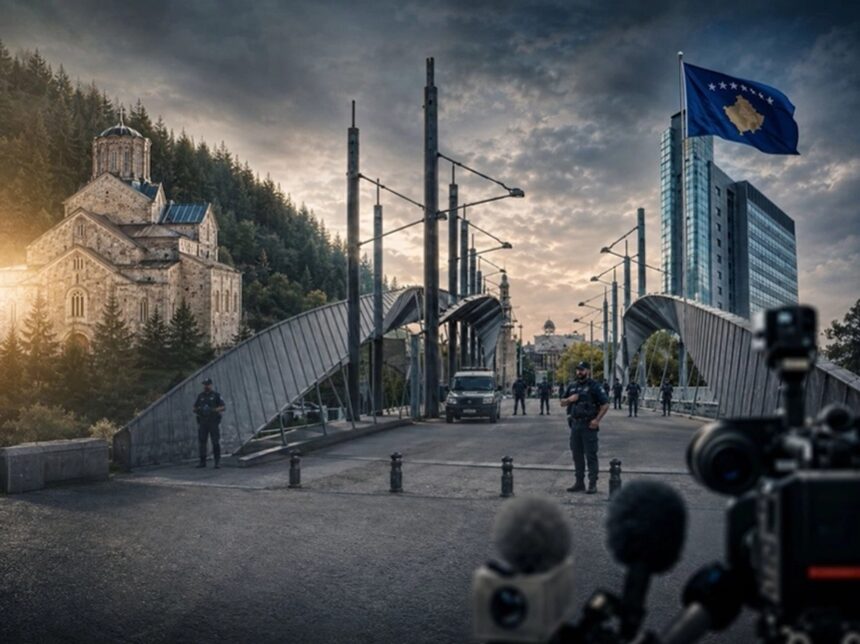
Serbian President Aleksandar Vučić has written to NATO Secretary General Mark Rutte, asking KFOR to intervene to prevent the main bridge over the Ibër River in Mitrovica from being opened to vehicle traffic. Vučić now says he expects a response by Monday or Tuesday and even hopes Rutte will call him personally.
In his statements, Vučić has framed the issue in alarmist terms, referring to alleged “terror against Serbs” and calling on KFOR to act. This rhetoric fits into a broader narrative repeatedly promoted by Belgrade, in which virtually every action by Kosovo’s institutions in the north is portrayed as a threat to the Serbian community.
But beneath the political rhetoric lies a much simpler issue: a bridge that has symbolized the division of Mitrovica for more than two decades is being discussed in the context of reopening it to vehicle traffic. And that prospect appears to be treated by Belgrade as yet another crisis.
The propaganda follows a familiar pattern: developments in Kosovo are presented as “attacks,” “provocations” or “threats to Serbs,” while Serbia consistently casts itself as the victim and the protector. In this narrative, even an issue concerning infrastructure and freedom of movement can be transformed into another diplomatic emergency.
The irony is difficult to miss. Vučić repeatedly claims that Kosovo is part of Serbia, yet he continues to appeal to NATO to influence what happens inside Kosovo. If Belgrade truly considers Kosovo Serbian territory, why does every development in the north require NATO intervention before it can be accepted?
NATO, meanwhile, has reiterated that KFOR continues to fulfil its mandate of maintaining a safe and secure environment for all communities and that any decision concerning the bridge should take into account the needs of local communities.
Vučić’s letter may therefore serve another round of political messaging, but it does not change the reality on the ground.
A bridge connecting two parts of a city is not a threat. What threatens Belgrade’s narrative is the possibility that a symbol of division could finally become a symbol of normalisation.
And perhaps that is why Vučić is waiting so eagerly for that phone call from Rutte.