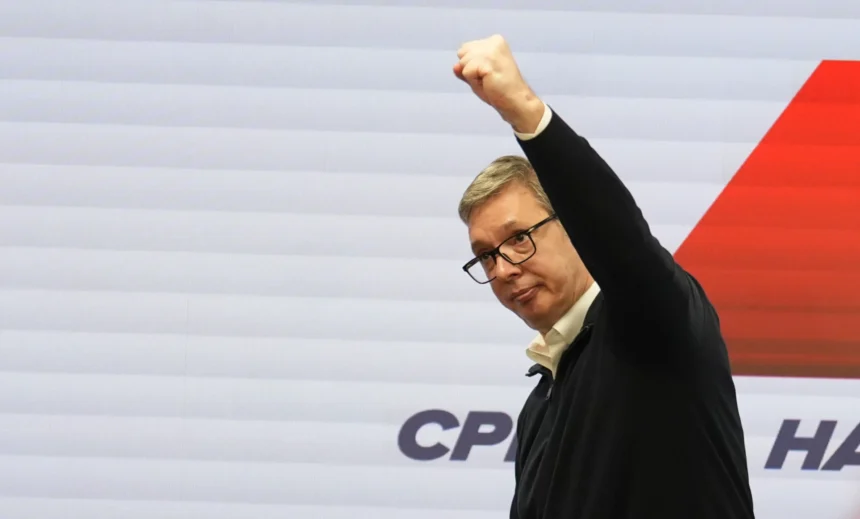
Serbian President Aleksandar Vučić said Wednesday that countries across the region had been “united in hatred” toward Serbs for years, while insisting that Serbia would continue to seek dialogue with its neighbors regardless of their positions.
Speaking to the public from the Serbian Presidency in Belgrade following the first-instance verdicts against former Kosovo Liberation Army (KLA) leaders, Vučić said the reactions to the ruling had demonstrated what he described as widespread disregard for Serbian victims.
“Today showed well what many in the region think about Serbs and how little they care about Serbian victims, because historically they are not allowed to exist,” Vučić said.
He criticized what he described as the “silence and hypocrisy” of the international community, after citing statements from regional officials who had reacted to the convictions of Hashim Thaçi, Jakup Krasniqi, Kadri Veseli and Rexhep Selimi.
Vučić specifically criticized Croatia’s response to the verdict, quoting the Croatian Ministry of Foreign and European Affairs as saying that the ruling did not alter the historical context of the Kosovo war or the fact that Kosovo’s population had been subjected to repression under the regime of Slobodan Milošević.
Vučić argued that Serbian victims were insufficiently acknowledged in regional political statements.
“Serbs in the countries of the region do not exist as victims,” he said, arguing that they are instead portrayed as perpetrators in statements and public discourse.
He then said this demonstrated, in his view, why countries in the region had developed what he described as common anti-Serb positions.
“And now you understand why everyone in the region has been united for years in hatred against Serbs and how they have common goals,” Vučić said.
Despite his criticism, the Serbian president said Belgrade would continue to pursue dialogue with neighboring countries.
“We will always want to talk to everyone in the region, whatever they say or think about us,” he said, adding that Serbia would seek to improve relations through what he described as civilized dialogue and mutual respect for each side’s interests.
“Serbia will always extend its hand to everyone,” Vučić said.
He also compared reactions to the Specialist Chambers verdict with international criticism surrounding the recent funeral of former Bosnian Serb military commander Ratko Mladić, who was convicted by the International Criminal Tribunal for the former Yugoslavia of genocide and other war crimes.
Vučić argued that the different reactions reflected what he described as double standards concerning Serbian and non-Serbian victims.
He said Serbia should continue developing a culture of remembrance for its own victims while respecting the victims of other communities.
“If we do not remember our victims, no one will remember them,” Vučić said.
The Specialist Chambers convicted Thaçi, Krasniqi, Veseli and Selimi at first instance of several war crimes. The verdicts are subject to appeal.
Asked about comments by Russian Foreign Minister Sergei Lavrov concerning the possibility of Russia-Ukraine negotiations being held in Belgrade with U.S. mediation, Vučić said there was currently no such proposal under discussion.
“We have not discussed it, nor does such an idea exist,” Vučić said, adding that Serbia was willing to host talks but believed an Arab country could instead host lower-level negotiations.