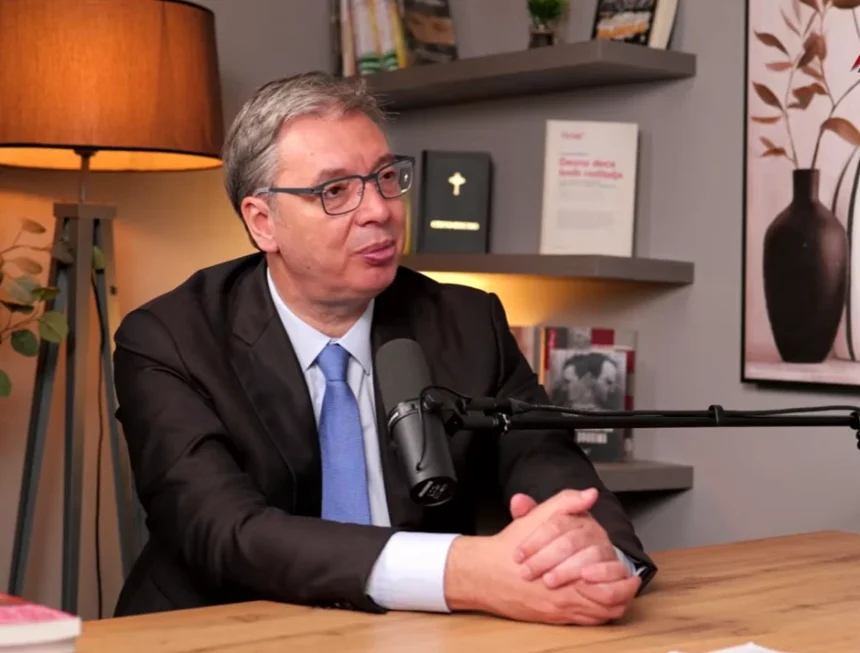
Serbian President Aleksandar Vučić has warned that the country could face a period of political retaliation and purges following the electoral victory of the student movement, arguing that its representatives lack a clear political programme and a coherent vision for governing.
In an interview with Swiss publication Weltwoche, Vučić said he expected the new political forces to focus on pursuing their opponents because they had little else to offer the public.
Asked whether the European Union had played an active role in supporting the student movement, Vučić said Brussels had largely welcomed its electoral success. He singled out European Commissioner for Enlargement Marta Kos, claiming that she had openly supported the student list, while adding that EU officials may now be less enthusiastic because the movement’s actual political direction remains unclear.
Vučić described the student movement’s positions as political slogans rather than a developed programme, arguing that its representatives were not prepared to address the country’s domestic and foreign policy challenges. He also alleged that wealthy business figures were seeking senior government positions after investing in the movement.
He said the political situation remained uncertain, adding that even Russia had reportedly asked the movement to establish a government and functioning institutions before engaging with its representatives.
Vučić criticises Europe’s position on Ukraine
A significant part of the interview focused on the war in Ukraine and the European Union’s approach to Russia. Vučić argued that European governments should have pursued diplomatic engagement with Moscow much earlier and criticised what he described as Europe’s reluctance to seek negotiations.
He said the United States and Russia were attempting to limit Europe’s involvement in discussions on the war, while Ukraine was seeking greater European participation. In his view, European countries should be involved in the diplomatic process if a lasting settlement is to be achieved.
Vučić maintained that even limited agreements, including prisoner exchanges and security guarantees, could represent progress towards a broader settlement. However, he acknowledged that major disagreements over territorial issues would be difficult to resolve.
He also argued that the continuation of the war was damaging Europe economically and politically, claiming that the continent had weakened its global position by failing to prioritise negotiations.
Defends Trump’s foreign policy and criticises Iran war
Discussing US politics, Vučić offered a different assessment of the recent midterm election results, arguing that the outcome could ultimately strengthen President Donald Trump’s political position by allowing him to present himself as a leader facing opposition from Democrats.
Vučić also described the US military campaign against Iran as a mistake from the perspective of American domestic politics. He argued that higher energy costs and the loss of economic advantages could undermine public support for the administration.
He suggested Trump had underestimated the difficulty of confronting Iran, particularly after what he described as the relative ease of the operation in Venezuela.
Says he is prepared for political pressure
Turning to Serbia’s domestic political situation, Vučić said he expected a prolonged period of political pressure against him and his allies, comparing the anticipated developments to a political witch hunt that could last between six and nine months.
Asked whether he feared imprisonment, he said he did not know what his opponents might attempt but insisted he was prepared to defend his political ideas and remain active in Serbian politics.
He called on his political camp to remain united while removing arrogant figures from its ranks and strengthening its efforts to defend its programme.
Vučić concluded by saying that Serbia and Europe should prioritise stability, peace and long-term planning rather than focusing solely on daily political disputes and social media debates.