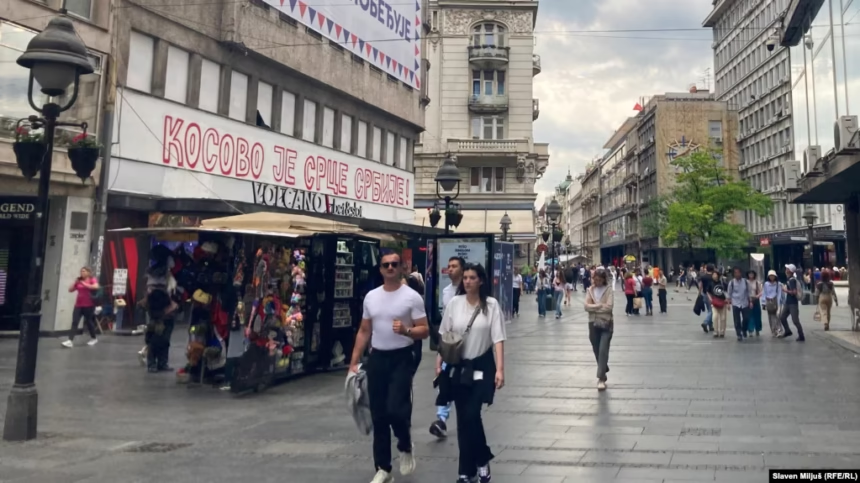
In the heart of Belgrade’s central pedestrian zone, a continuous ideological war is being waged with spray paint and rollers. Thousands of tourists walking down Knez Mihailova Street daily now pass a freshly painted facade reading “Kosovo je srce Srbije” (Kosovo is the heart of Serbia).
The nationalist slogan, which rejects Kosovo’s 2008 independence declaration, did not appear by chance. It serves as the latest layer in a structural game of “wall dominoes,” replacing a previous graffiti installment that denied the Srebrenica genocide.
For nearly two years, civil rights activists led by the prominent NGO KROKODIL have continually painted over these chauvinistic displays, only to watch ultradesnick (far-right) networks systematically restore them within hours.
The Cyclic Evolution of Nationalistic Imagery
The localized visual landscape reflects the macro-political shifts within Serbian society. The timeline of this specific wall at the former “Beograd” Department Store illustrates how different nationalist scripts are layered over public infrastructure:
[The Visual Lifecycle of a Belgrade Wall]
  June 2024: "The only genocide in the Balkans was against Serbs"
  (Appeared after the UN Srebrenica Resolution; authored by the far-right 'Narodna Patrola')
                             │
                             ▼
  April 2026: Activists execute a coordinated paint-over (20th clean-up campaign)
                             │
                             ▼
  May 2026: "Kosovo je srce Srbije" (Kosovo is the heart of Serbia)
  (Unsigned; deployed immediately following the removal of the previous installation)
“They create these graffiti with the explicit goal of spreading propaganda, fear, hatred, and nationalism,” explained Filip Jovanović, a 23-year-old psychology student who regularly travels 100 kilometers from Valjevo to Belgrade to participate in the cleanups.
The physical hazard of civic resistance has escalated significantly. During an action on April 11, activists discovered that far-right groups had coated the base of the wall in industrial machine oil and hidden fragments of barbed wire beneath the debris, intentionally designed to cause volunteers to slip and suffer severe lacerations.
Public Polarization: From Folk Art to Military Recruits
The presence of nationalist iconography dividing the capital has deeply fractured public opinion among Belgrade residents:
- The Nationalist Acceptance: “It’s our history, and tourists walking through the city center should see it,” stated Marko (26). “I think there should be even more murals like this.”
- The Aesthetic Alternative: “This is the city core; it would be best if there were no graffiti at all,” countered Ljubica (43). “If we must have something, it should be tied to our folklore, like a traditional Pirot rug pattern.”
Just one hundred meters away in Sremska Street, another ideological battleground exists. Activists recently targeted the ubiquitous slogan “Kad se vojska na Kosovo vrati” (When the army returns to Kosovo).
The phrase is widely recognized by anthropologists like Ivan Čolović as a politically manipulated verse, adapted in 2011 by the late Serbian Orthodox Church Metropolitan Amfilohije Radović from an old folk poem.
Despite being painted over with white coats by civil groups, the wall was rapidly re-painted with a Serbian tricolor flag by masked men acting under the protection of local fan groups associated with Red Star Belgrade.
Two Laws, Two Standards: The Selective Action of Communal Authorities
The persistent survival of these nationalist murals highlights systemic imbalances within Serbian law enforcement and the judiciary. Under municipal statutes, any mural or alteration to a residential or historic facade requires explicit tenant consent and authorization from the Institute for the Protection of Cultural Monuments.
| Actor Category | Actions Taken | Legal & Administrative Consequences |
| Far-Right Authors (Narodna Patrola, Navijači) | Paint illicit, unsigned military and genocide-denial murals in broad daylight on historic buildings. | Zero misdemeanor citations or arrests recorded by the Belgrade Communal Milicija over the past five years. |
| Civil Activists (KROKODIL, YIHR) | Use white paint to remove unauthorized graffiti and restore public walls to their original state. | Frequently targeted with misdemeanor property damage charges by communal police. |
| Independent Educators (Dejan Petrović, Niš) | Personally painted over a “When the army returns” mural scrawled across his school’s courtyard. | Formally fined €25 by a local magistrate for unauthorized structural alteration. |
Defending their cleanup operations, KROKODIL activists note that the Belgrade Misdemeanor Court has ultimately issued several acquittals, ruling that restoring a wall to its blank state does not constitute property damage.
Furthermore, the state’s political leadership has actively taken sides. High-ranking members of the ruling Serbian Progressive Party (SNS), including Prime Minister Miloš Vučević, have publicly condemned the anti-graffiti volunteers, accusing civil rights defenders of “hating everything that is Serbian.”
[State Legal Disparity]
  Writing Nationalist Slogans ──► Protected by political silence / Zero prosecution
  Erasing Nationalist Slogans  ──► Labeled as "Anti-Serbian" / Target of municipal fines
The Legacy of Ratko Mladić on Belgrade Facades
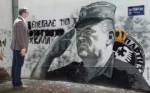
The weaponization of walls reached a tipping point in late 2021 following the final life sentence handed down to wartime Bosnian Serb military commander Ratko Mladić by the International Criminal Tribunal for the former Yugoslavia (ICTY) for genocide and war crimes.
A massive, multi-story mural honoring Mladić in central Njegoševa Street became a fortified site, guarded around the clock by far-right youths who coated the artwork in a protective, scratch-resistant clear chemical resin to prevent activist paint bombs from sticking.
While the Youth Initiative for Human Rights (YIHR) submitted over 300 formal complaints across ten Serbian municipalities demanding the removal of war-criminal iconography, the Njegoševa mural was only permanently neutralized in May 2023 after sustained civil interventions.
As long as the political establishment continues to leverage nationalist grievances for domestic legitimacy, the battle lines of Belgrade will remain written on its walls.