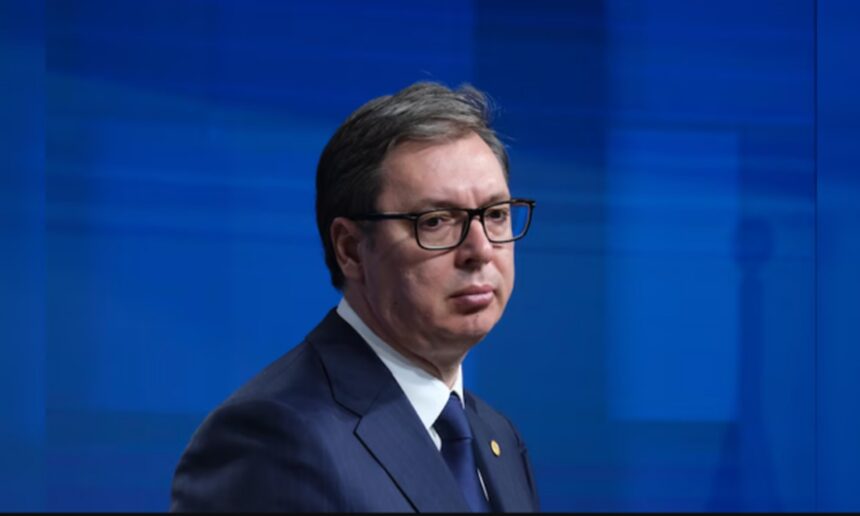
In an op-ed published by security analyst Drizan Shala, a critical deconstruction of Serbian President Aleksandar Vučić’s recent address to Radio Television of Serbia (RTS) from Shanghai exposes a deeper, more calculated geopolitical signaling underlying Belgrade’s defense procurement strategy.
Vučić’s standard rhetorical shield—asserting that a militarily neutral Serbia is stronger than ever and arms purely to defend itself against the “aggressors of 1914, 1941, and 1999″—is analyzed not as mere domestic folklore or historical trauma, but as a deliberate enumeration of contemporary adversaries wrapped in the vocabulary of past conflicts.
Decoding the Dates: The Modern Capitals Behind the Historical Labels
The crux of Shala’s analysis lies in translating Vučić’s historical milestones into modern geopolitical realities. By invoking these specific years, the Serbian presidency effectively categorizes the very entities it formally seeks partnerships with as historical and civilizational threats:
- 1914 (Austria-Hungary): Today represented by the Republic of Austria and Hungary. Notably, Austria is a core European Union member, and Hungary is an immediate neighbor.
- 1941 (The Axis Powers): Today represented by Germany and Italy. Germany stands as the economic engine of the European Union, while Italy is one of its founding members. These are the very capitals whose economic and political bloc Serbia has petitioned to join as an EU candidate country.
- 1999 (The NATO Bombing): Represented by the North Atlantic Treaty Organization, spearheaded by the United States. This directly targets Washington, which currently views its Strategic Dialogue with Belgrade as a foundational bilateral pillar, and labels the alliance that intervened to halt ethnic cleansing in Kosovo as a permanent aggressor.
[Vučić's Geopolitical Target Inversion]
  Historical Label              Modern Diplomatic Entity
  1914 (Austria-Hungary)  ───►  EU Members / Regional Neighbors
  1941 (Axis Powers)      ───►  EU Founding Capitals (Berlin/Rome)
  1999 (NATO)             ───►  United States & Transatlantic Alliance
The Strategy of the Multi-Vector “Hedge”
The commentary emphasizes that the grievance and the procurement arrive together because they serve the same structural logic. While navigating candidate status with the EU, Belgrade has consistently refused to align with Brussels’ Common Foreign and Security Policy, declined to implement sanctions against the Russian Federation, and continuously deepened its infrastructure, energy, and military ties with Beijing.
| Strategic Domain | Component / Procurement Asset | Geopolitical Signaling |
| Air Defense | Chinese FK-3 medium-range surface-to-air missile systems (inducted into the Serbian Air Defense Brigade). | Serbia became the first European nation to field a Chinese medium-range missile system, consciously diversifying away from sole Western or Russian dependence. |
| Diversified Supply | Active defense acquisition lists spanning France (Rafale jets), Russia, Israel, and China. | Avoids systemic integration into any single security umbrella, treating non-alignment as a civilizational posture. |
| Energy & Infrastructure | Procurement of Chinese-backed reactors and gas turbines negotiated during the Shanghai summit. | Anchors Serbia’s critical infrastructure firmly within Beijing’s long-term economic orbit. |
The Spatial Contradiction: Arming Against an Empty Map
From a purely military and geographic standpoint, the analysis notes that Serbia’s borders are entirely encircled by Euro-Atlantic architecture: Hungary, Romania, Bulgaria, and Croatia are full NATO members; North Macedonia and Montenegro are integrated into the alliance; while Bosnia and Herzegovina and Kosovo host active international stabilization mandates (EUFOR and KFOR).
Because there is no conventional military threat preparing to cross any Serbian frontier, the massive scale of Belgrade’s re-armament is interpreted not as a reaction to a present danger, but as a calculated preparation for a shifting regional order.
The brief concludes that Serbia’s multi-vector procurement is fundamentally a hedge against the potential weakening of the Western monopoly on Balkan stability. By sourcing strategic defense hardware from global powers that would benefit from a retraction of Washington and Brussels, Belgrade is positioning itself for a future where it can re-assert its long-standing geopolitical ambitions regarding Kosovo and Bosnia. Vučić’s historical list is a clear declaration of which future he expects to outlast the present.