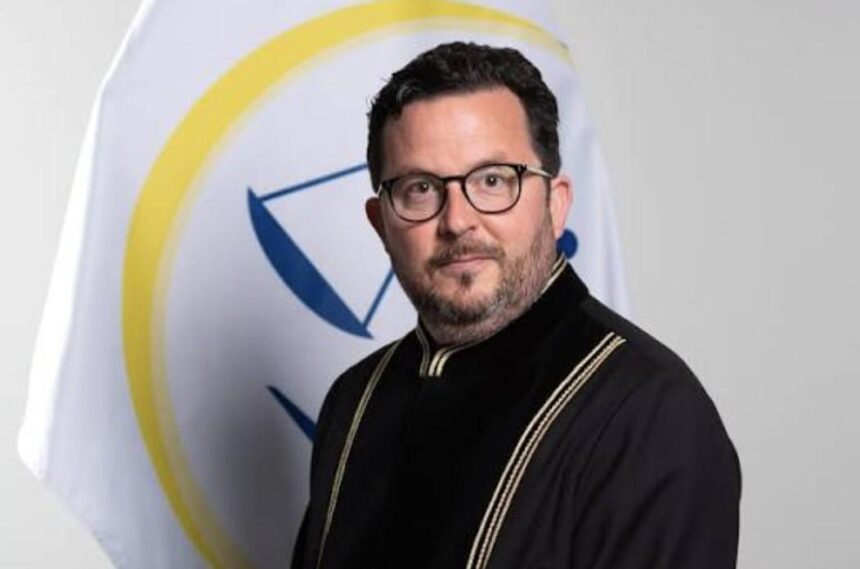
PRISHTINA, September 18, 2026 — Swiss jurist Guénaël Mettraux is one of the international judges serving on the Kosovo Specialist Chambers in The Hague and a member of the trial panel in the case against former Kosovo President Hashim Thaçi and other former senior Kosovo Liberation Army (KLA) figures.
Mettraux has drawn increased public attention following criticism of the September 16, 2026 first-instance verdict by former U.S. presidential envoy Richard Grenell, who specifically singled out the Swiss judge in his reaction to the ruling.
Mettraux is a specialist in international criminal law and human rights. He was appointed as a judge of the Kosovo Specialist Chambers on February 7, 2017, and has served on the Trial Panel in the Thaçi et al. case.
Grenell sharply criticized the verdict and claimed that Mettraux had been the “real leader” of the Trial Panel. He further alleged that the judge had placed a political approach ahead of legal considerations. These statements represent Grenell’s assessment and allegations and are not findings by a judicial institution or the result of an independent investigation.
Who Is Guénaël Mettraux?
According to his official biography, Mettraux has an extensive background in international criminal justice.
He studied law at the University of Lausanne, completed an LL.M. in international law at University College London and earned a doctorate from the London School of Economics and Political Science.
Throughout his legal career, Mettraux has advised states, individuals and non-governmental organizations in proceedings before the International Criminal Court and in cases involving the investigation and prosecution of international crimes.
He has also worked as defense counsel and a legal consultant in high-profile cases before the International Criminal Tribunal for the former Yugoslavia (ICTY), the Special Tribunal for Lebanon, the Extraordinary Chambers in the Courts of Cambodia and the International Criminal Court.
Mettraux has also served as president and a member of the Human Rights Review Panel established under EULEX.
Experience in Cases Related to the Former Yugoslavia
Before becoming a judge at the Kosovo Specialist Chambers, Mettraux had significant professional experience involving cases connected to conflicts in the former Yugoslavia.
As a lawyer and legal consultant, he worked on cases involving individuals of different nationalities from the region, including Serbian, Bosniak, Croatian and Macedonian defendants.
Such professional engagements are part of the work of lawyers specializing in international criminal law and, in themselves, do not establish political or personal links with the parties they have represented.
Publicly available information does not establish that Mettraux has personal or political ties to Serbian institutions. His documented record reflects professional engagements as an international lawyer and judge.
One of the Judges in the Thaçi Case
Mettraux is one of the judges on the Trial Panel hearing the case against Thaçi and his co-accused.
The September 16 verdict was issued by the Trial Panel as a judicial body and was not an individual decision by Mettraux.
In the first-instance judgment, Thaçi was sentenced to 25 years in prison after being convicted of war crimes. The Trial Panel acquitted him on six counts of crimes against humanity. Thaçi has denied the charges and is expected to appeal the judgment.
The verdict against the four former KLA leaders has prompted protests and renewed debate in Kosovo over the work and mandate of the Specialist Chambers.
Grenell has also called for the institution’s funding to be cut and urged Kosovo’s institutions to take steps toward closing the court.
Mettraux, meanwhile, remains officially listed as a Swiss international judge of the Kosovo Specialist Chambers.
The September 16 judgment remains subject to appeal, meaning the first-instance findings and sentences are not necessarily the final outcome of the proceedings.