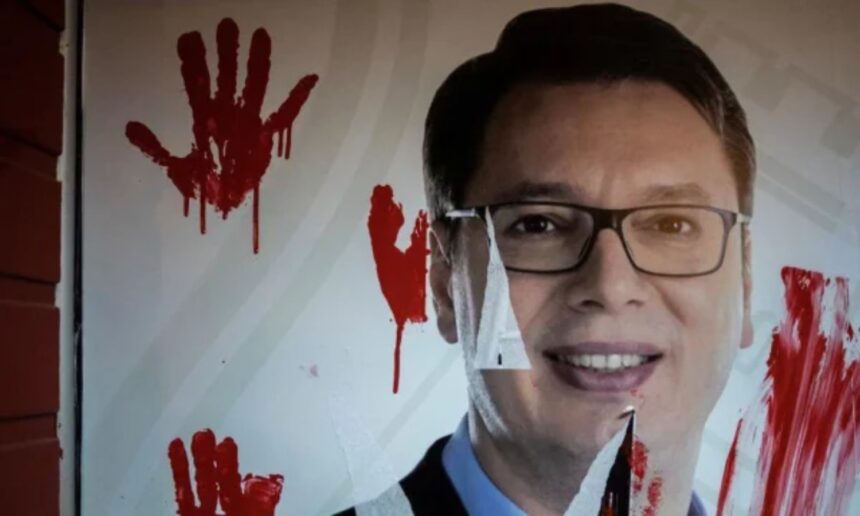
Serbian President Aleksandar Vučić, who is heading the ruling Serbian Progressive Party (SNS) electoral list, has challenged Ilija Srdanović, the lead candidate on the student-backed list, to a televised debate, but has not extended the invitation to leaders of other opposition lists.
The move has prompted discussion among political analysts and opposition figures over Vučić’s approach to televised debates ahead of the upcoming parliamentary elections.
Miloš Jovanović, leader of the New Democratic Party of Serbia (Novi DSS) and head of the Authentic Right list, said he would have no problem participating in a debate with Vučić or any other electoral-list leader.
Jovanović said, however, that he would participate only if Vučić were no longer serving as president, arguing that the head of state should not participate in television debates in that capacity.
Zdravko Ponoš, one of the leaders of the European Serbia list, also said he would accept an invitation to debate Vučić. He described televised debates as a standard campaign format in democratic electoral systems, giving voters an opportunity to hear candidates’ positions and compare their arguments.
Analysts Debate Vučić’s Strategy
Sociologist Ivan Živkov told Danas that Vučić’s invitation to Srdanović could be interpreted as an attempt to focus political attention on an individual candidate from the student-backed movement.
Živkov argued that a debate with established opposition leaders could present a different challenge because of their greater experience in political communication and televised debates.
Political scientist Ognjen Gogić offered another interpretation, saying that Vučić’s decision not to invite leaders of traditional opposition parties could indicate that he does not regard them as his principal challengers in the election.
Gogić also argued that inviting Srdanović could serve to personalize a movement that has largely operated through a decentralized structure rather than around a single political leader.
According to Gogić, the format of a one-on-one debate could also favor an experienced national political figure, while parliamentary elections would more conventionally involve debates among representatives of competing electoral lists under equal conditions.
Opposition Leaders Say They Are Ready
The opposition figures quoted by Danas said they were prepared to participate in a televised confrontation with Vučić, although Jovanović attached his participation to Vučić no longer holding the presidency.
Ponoš argued that debates would allow voters to compare the proposals and positions of the competing political forces during the campaign.
Meanwhile, Vučić has previously said that candidates with relatively low levels of support may be more willing to accept debates, while those with stronger support may be less inclined to do so.
Debate Over the Student-Backed List
The student-backed electoral list has emerged as a significant focus of the campaign, and analysts cited by Danas have offered different assessments of why Vučić singled out Srdanović for a potential debate.
Marko Vujić, a professor at the Faculty of Political Sciences, argued that the invitation could have several political objectives, including bringing a prominent individual to the forefront of a movement that has emphasized collective rather than personalized leadership.
Vujić also suggested that the debate could allow Vučić to challenge an opponent with less experience in electoral politics and public political appearances.
At the same time, he said that the campaign’s political dynamics could change as election day approaches and that debates with other opposition representatives could become another component of the campaign.
The discussion comes roughly five weeks before the election, with competing parties and electoral lists continuing to shape their campaign strategies and public appearances.
Whether televised debates will take place between Vučić and representatives of the various electoral lists remains dependent on the candidates, broadcasters and agreed debate formats.