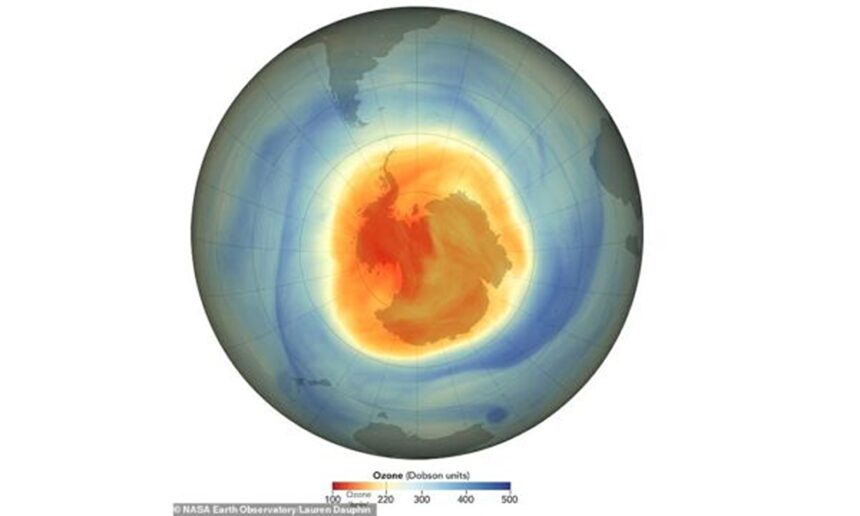
The ozone hole over Antarctica has reached its largest size in the past decade, covering an area of 27.1 million square kilometers at its peak — nearly three times the size of the United States. Scientists from NASA and the National Oceanic and Atmospheric Administration (NOAA) say the expansion was driven by unusual atmospheric conditions and an exceptionally strong polar vortex. However, experts emphasize that the long-term recovery of the ozone layer remains on track.
A new report published on November 4, 2026, by NASA and NOAA reveals that the Antarctic ozone hole expanded significantly this year, reaching dimensions not recorded over the past decade.
According to scientific data, between September 7 and October 13, the average area of the region with depleted ozone was approximately 25 million square kilometers.
This makes the 2026 ozone hole the seventh-largest in 48 years of monitoring, based on its average area during the period analyzed.
Although the expansion has raised concerns, scientists explain that it does not necessarily indicate a reversal of the long-term recovery trend of the ozone layer.
Ozone Hole Reached Its Peak on September 18
NASA and NOAA measurements show that the ozone hole reached its largest extent of the year on September 18, 2026.
On that date, the area with reduced ozone concentrations expanded to approximately 27.1 million square kilometers, or 10.5 million square miles.
This represents approximately 90 percent of the largest extent ever recorded, which occurred on September 9, 2000.
Scientists emphasize that the unusual expansion was primarily driven by atmospheric conditions prevailing over Antarctica in recent months.
However, the large size of the ozone hole does not necessarily mean that ozone depletion was as severe as during the years with the most significant damage on record.
Powerful Polar Vortex Behind the Expansion
According to researchers, the main factor behind this year’s ozone hole expansion was an exceptionally strong polar vortex.
The polar vortex is a large system of winds circulating around the polar regions, keeping extremely cold air concentrated over these areas.
Over Antarctica, this phenomenon plays an important role in creating the conditions that favor ozone destruction in the stratosphere.
Amy Butler, a scientist at NOAA’s Chemical Sciences Laboratory, explained that the polar vortex was exceptionally large this year.
According to Butler, planetary-scale atmospheric weather systems, which typically rise from the lower layers of the atmosphere and help weaken the vortex, were particularly weak during August and September.
As a result, the polar vortex’s stronger winds remained farther from the South Pole, creating a wider area with conditions favorable for ozone depletion.