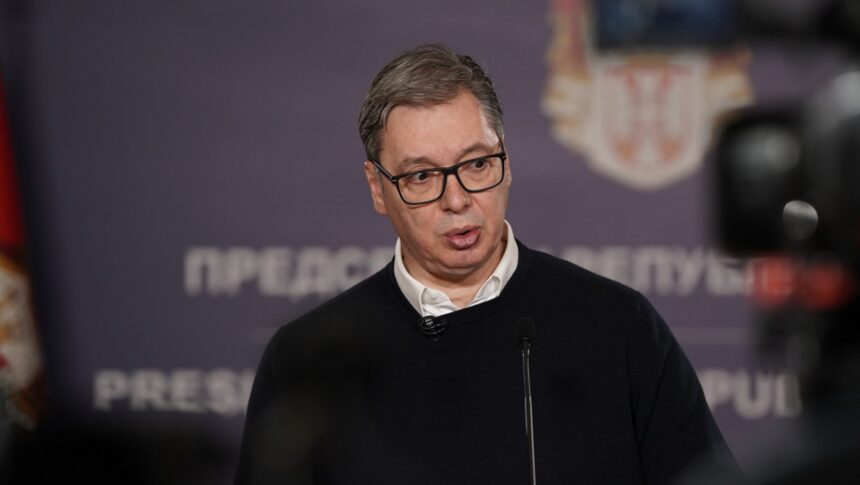
Serbian President Aleksandar Vučić appears to be relying on a familiar tactic: portraying himself as the victim. Recently, he voiced concern over the military cooperation between Kosovo, Albania, and Croatia, presenting himself as threatened by an alliance that, according to the countries involved, is not directed against Serbia.
In an interview with RTS, Vučić said he remains worried about regional developments and framed his anxiety around the Kosovo‑Tirana‑Zagreb military partnership. “I am not Donald Trump or Vladimir Putin… Nothing is easy for me, and naturally, I am afraid. I want peace, not war or conflict,” the Serbian president said, highlighting his sensitivity to any regional moves.
Vučić went further, warning of a potential attack from a possible Kosovo‑Albania‑Croatia alliance, while emphasizing that Serbia has “enough deterrent power for two states and one entity.” The statement reads less like a strategic analysis and more like an attempt to cast himself as a victim.
During the same interview, Vučić revisited historical figures, commenting on former Serbian President Slobodan Milošević and Bosnian commander Ratko Mladić, placing their legacies in the context of his current political narrative. “I will always leave it to history to judge. Each of us has our good and bad sides,” he said, reminding the public that he, too, has faced the “weight of history.”
It is clear that Vučić continues to use a well-known strategy: portraying Serbia as perpetually threatened while emphasizing his own precarious position, even when regional partners have clarified that the Kosovo‑Albania‑Croatia cooperation is not aimed at his country.