The United States is reportedly relocating parts of a missile defense system from South Korea to the Middle East, according to officials cited by the Washington Post and South Korean media.
This reported move comes 12 days after the start of the U.S.-Israel conflict with Iran and follows reports suggesting that Iran had destroyed a key radar used by the Terminal High-Altitude Area Defense (THAAD) system in Jordan.
THAAD was first deployed in South Korea in 2017 to protect against threats from North Korea’s nuclear-armed missiles.
The relocation has sparked concern and protests among South Koreans, who fear it could make them a larger target, while China warned that the move could destabilize the region.
What is THAAD and Why Is It Being Moved?
Earlier this week, The Washington Post reported that parts of the THAAD system are being moved to the Middle East, citing two officials. The reports come as the U.S. and Israel continue airstrikes against Iran, while Iran responds with a barrage of drones and ballistic missiles targeting U.S. and Israeli military bases in the region.
It is unclear exactly how many missiles Iran has, but so far it has fired more than 500 ballistic missiles, according to a New York Times estimate. Most were intercepted, but the volume of fire may be straining Washington’s military inventory, analysts say.
This situation is expected to continue, as Iran appears to be preparing for a protracted conflict involving multiple Middle Eastern countries, including U.S. allies.
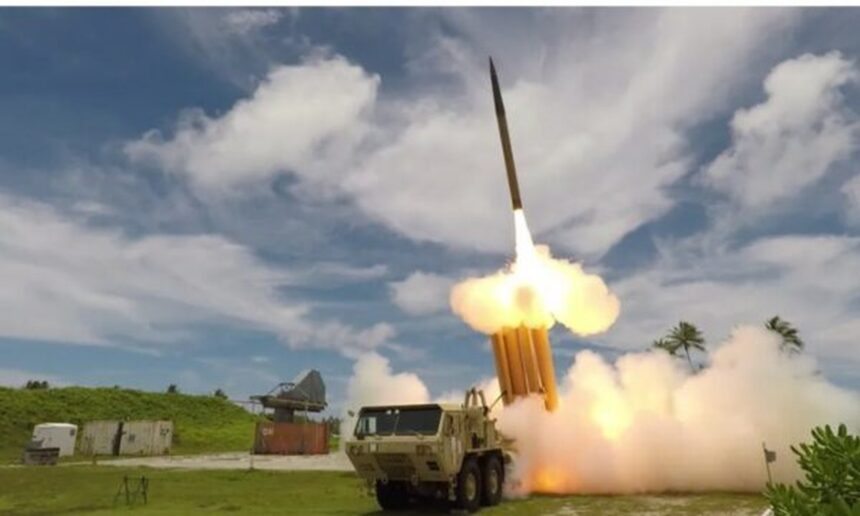
This explains why the THAAD system, designed to intercept missiles at high altitudes, is critical for strengthening U.S. missile defenses. Earlier reports this month claimed that an Iranian strike destroyed a $300 million radar of an existing THAAD system in Jordan.
Manufactured by Lockheed Martin, the system includes six launchers with eight interceptors per launcher and a radar detection system. It can shoot down short- and medium-range ballistic missiles using “hit-to-kill” technology, meaning the kinetic energy destroys the incoming warhead. It operates at high altitudes, even outside Earth’s atmosphere, which is particularly useful in South Korea to intercept nuclear-capable missiles.
A single battery costs approximately $1 billion (766 million pounds) and requires a crew of around 100 personnel to operate. The U.S. operates only eight batteries globally, two of which are in the Middle East—in Jordan and Israel. The United Arab Emirates and Saudi Arabia operate three additional systems.
The possible redeployment from South Korea is described by a U.S. official as a “precautionary measure,” but analysts warn it signals a heavily stretched system.
“This action strongly suggests the need for the U.S. to compensate for the intensive use of its existing missile defense capabilities in the Middle East,” said Professor John Nilsson-Wright of the University of Cambridge to the BBC.