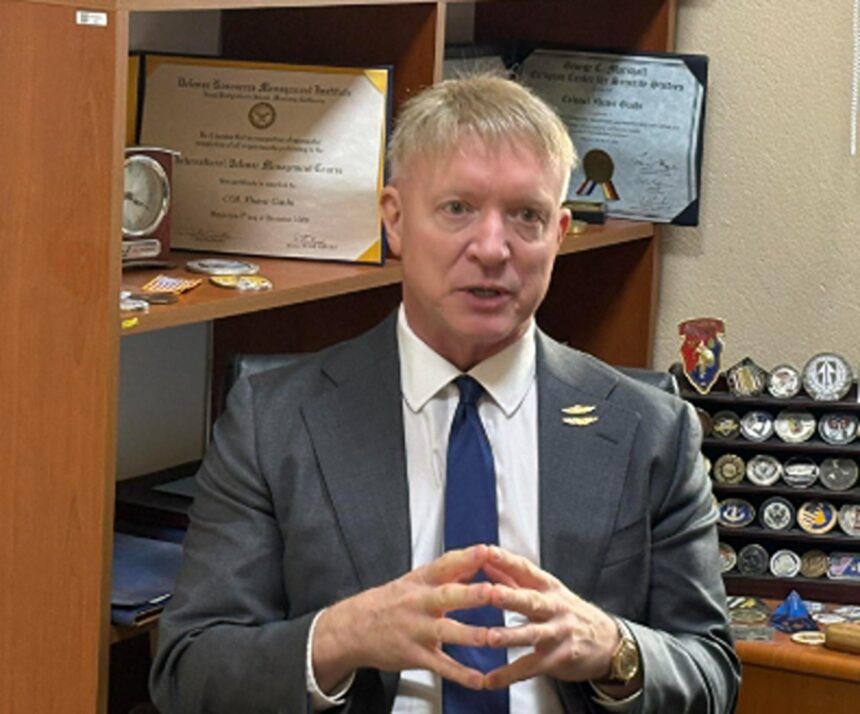
Former U.S. Colonel Philippe Rogers, who worked for 10 years at NATO headquarters, has assessed Kosovo’s progress in relation to the alliance, emphasizing that the country is seen as a very important partner, even though it is not yet a member.
During a lecture, Rogers said he has long-standing ties with Kosovo, as he participated in combat missions during the 1999 war and has visited the country several times. He noted that Kosovo has made visible progress in its development and in cooperation with NATO.
“This is a complicated issue, but at the same time it is a very possible outcome. Of course, there are many obstacles and things that must be overcome. In today’s lecture I will talk about my relationship with NATO. I worked at NATO headquarters for 10 years, so I am very familiar with Kosovo as a country. I flew combat missions in 1999 during the war and have visited Kosovo several times,” Rogers said.
He mentioned that the main obstacles Kosovo must overcome to become a NATO member are largely diplomatic.
“First of all, I must say that you have a beautiful country and it has been wonderful to see how it has developed. People are very positive toward Kosovo. It is a fantastic partner. Of course, it is not yet an ally, but it is a very good partner. Kosovo contributes to many missions and is very willing to contribute to others. However, there are four countries within NATO that do not recognize Kosovo: Spain, Slovakia, Romania and Greece. These are some of the obstacles Kosovo must overcome. This is mainly a matter of diplomatic relations with those countries. Beyond that, Kosovo is doing a very good job in increasing its importance within NATO, the European Union and the wider European alliance,” Rogers said.
He added that an important step toward NATO membership is obtaining the Membership Action Plan, which serves as a kind of roadmap for countries seeking to join the alliance. However, Kosovo currently does not have this plan, although it maintains a positive presence within NATO through cooperation with countries that recognize it.
“There is no clear roadmap at the moment. What we call a ‘roadmap’ is actually the Membership Action Plan. When a country receives this plan, it is on a path toward membership. This is not necessarily a fast process, because for some countries it has taken a long time. For example, North Macedonia needed more than 15 years to finally join NATO, largely because of the name dispute it had with Greece. Kosovo does not have a Membership Action Plan, but it does have a very positive presence within the alliance with the countries that recognize it. Even the countries that do not recognize Kosovo will need time to explain their positions to Kosovars. I have seen delegations from Kosovo come to NATO and they have been received very positively. The challenge is that Kosovo needs a state to sponsor its participation in these meetings. Usually that has been the United States; sometimes it has also been the United Kingdom and other countries. For now there is no specific plan, although this could change in the future,” Rogers said.
From a technical perspective, Rogers emphasized that everything will depend on whether Kosovo is eventually offered a Membership Action Plan.
“Technically, it will depend greatly on the Membership Action Plan if it is one day offered to Kosovo. At that point, there will be several things Kosovo must do. Delegations will go to NATO, ministers will report to the alliance on progress regarding the rule of law, democratic institutions and other areas. Then things can begin to move forward.
I will say something else: I am very impressed. Today I spent some time at the Ministry of Defense and I must say that I have been closely involved with Kosovo for many years. In some cases, the Kosovo Security Force is many years ahead of some countries that are already NATO members. This relates partly to the size of the army, but what I see from the cooperation between the Kosovo Security Force and the Iowa National Guard, as well as with the United States through IMET programs that allow personnel to attend universities and military academies, shows that Kosovo has done a fantastic job. I want to emphasize again that their willingness to help in NATO and EU missions is excellent, because that is how you become an operational partner, which can sometimes lead to a clearer path toward membership,” Rogers added.
He also said that the Kosovo Security Force is viewed more positively than some other countries that are candidates for NATO membership.
“There are many countries that help the Kosovo Security Force during this process, both bilaterally and multilaterally. From NATO’s perspective, there is an institution called NALT, the NATO Advisory Liaison Team, which helps determine what is expected from the Kosovo Security Force in terms of NATO standards. Questions arise such as whether the army is too large or too small, or whether it is capable enough. But I can say that currently, according to NALT and other institutions I work with, as well as the bilateral relations I know, the Kosovo Security Force is viewed very positively, even more positively than some other countries that are candidates to join NATO,” Rogers said.