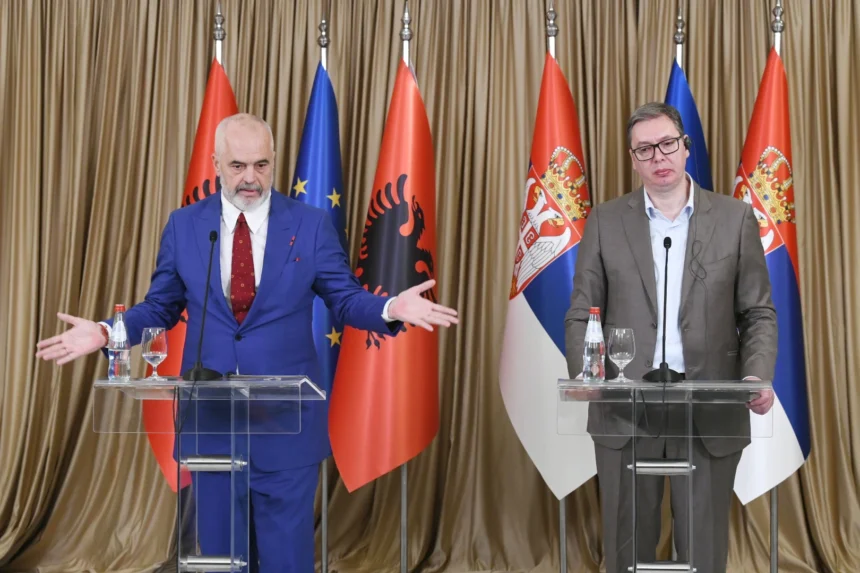
Legal expert Vladimir Medović has warned that the true purpose of the joint initiative by Serbian President Aleksandar Vučić and Albanian Prime Minister Edi Rama is not to accelerate EU integration, but to consolidate political control over the judiciary in their countries.
In a joint article published in the German newspaper Frankfurter Allgemeine Zeitung (FAZ), Vučić and Rama propose fast-tracking Serbia and Albania into the EU’s internal market and the Schengen zone, while forgoing political membership and voting rights. Their argument rests on the assumption that EU internal reforms—such as changes to decision-making procedures and elimination of veto powers—are prerequisites for Western Balkan enlargement.
However, Medović emphasizes that substantive political reforms, which would ensure judicial independence and respect for democratic principles, are politically unacceptable to Vučić and Rama. In Serbia, the so-called “Mrdić Laws” have been used to reassert government control over the judiciary, particularly the High-Tech Crime Prosecutor’s Office and the Organized Crime Prosecutor’s Office (TOK).
The legislative changes effectively reduce the independence of prosecutors and interfere with ongoing investigations of politically sensitive cases, including “Nadstrešnica,” “Balkan Cartel,” and multi-ton drug seizures in Konjuh. In the High Council of Prosecutors, decisions to extend the mandates of key prosecutors have been blocked by the Minister of Justice and his allies, undermining the independence of investigations.
Moreover, the reforms interfere with Serbia’s cooperation with Eurojust, the EU agency responsible for coordinating cross-border investigations and prosecutions of serious and organized crime. Under the new rules, the Supreme Public Prosecutor’s Office must obtain the Ministry of Justice’s approval before participating in international investigations, placing politically sensitive cases firmly under government control.
Medović argues that these “reforms” are not genuine steps toward European integration, but a strategy for consolidating political power. Even if the reforms trigger criticism from the Venice Commission, their legal effects could remain in force, further undermining judicial independence and jeopardizing Serbia’s EU accession process.
In practice, the initiative allows Vučić to maintain political dominance while appearing committed to EU reforms. By prioritizing control over the judiciary rather than genuine compliance with EU democratic standards, Serbia risks isolating itself within Europe and undermining its credibility as a candidate for membership.