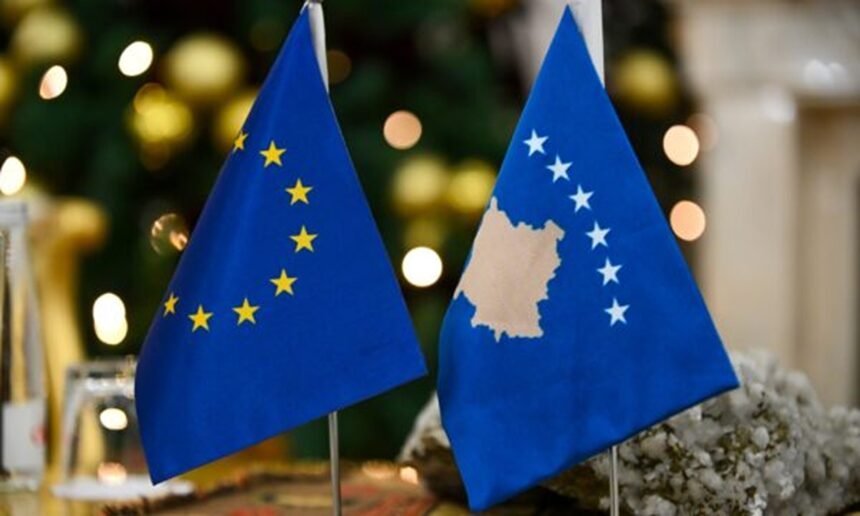
The European Union has expressed regret that political parties in Kosovo failed to identify a unifying figure as a candidate for the country’s president, resulting in the country heading toward its third election in less than a year and a half.
An EU spokesperson stated that the bloc has continuously called on all political actors to ensure institutional stability.
“It is urgent for Kosovo to strengthen inter-party dialogue to ensure the efficient functioning of institutions and to avoid missing opportunities that bring benefits to citizens, including those from the Growth Plan,” the spokesperson told Radio Free Europe.
Members of the Kosovo Assembly failed to elect a new president within the constitutional deadline and, based on the latest ruling of the Constitutional Court, the Assembly was dissolved on April 28.
Now, the Acting President, Albulena Haxhiu, following consultations with political parties, is expected to announce the election date, which must be held within 45 days.
There are only two possible dates for the elections: May 31 or June 7.
On the night of April 27, the ruling Vetëvendosje Movement withdrew its two party candidates—Glauk Konjufca and Fatmire Mulhaxha Kollçaku—and less than an hour later presented two new candidates for president, both human rights activists: Feride Rushiti and Hatixhe Hoxha.
However, opposition parties did not participate in the plenary session that began on the evening of April 27 and concluded at midnight on April 28—the final deadline for electing the president.
Prime Minister Albin Kurti, who is also leader of Vetëvendosje, said he had made efforts to reach an agreement with opposition parties, but without success.
The Democratic Party of Kosovo (PDK) had requested the right to propose its own presidential candidate, while it was criticized by Vetëvendosje for a lack of transparency.
The Democratic League of Kosovo (LDK), on the other hand, opposed the idea of one party—in this case Vetëvendosje—controlling the three main state institutions: the Government, the Assembly, and the Presidency.
Kurti stated that he had offered the LDK participation in government or the position of Speaker of Parliament, but the offer was rejected. A similar offer was made to the PDK, but its leader, Bedri Hamza, described it as unserious, saying no formal invitation for a meeting had been extended.
Subsequently, Kurti asked both PDK and LDK to propose three non-partisan candidates for president, offering Vetëvendosje’s support, but the opposition rejected this proposal as well, calling it unserious and unacceptable.
The April 28 deadline followed an earlier attempt on March 5, when Vetëvendosje initiated a session to vote for Konjufca and Kollçaku, but it was suspended due to a lack of quorum.
A day later, former President Vjosa Osmani issued a decree for new elections, but the decision was sent to the Constitutional Court by the Kosovo Government. The Court ruled that MPs had 34 days to elect a successor.
Osmani’s five-year mandate ended on April 4, and under the Constitution, Speaker Albulena Haxhiu assumed the role of Acting President.
According to the Constitution, the President of Kosovo is elected by a two-thirds majority in the first two rounds or by 61 votes in the third round, while at least 80 MPs must be present for the session to proceed.