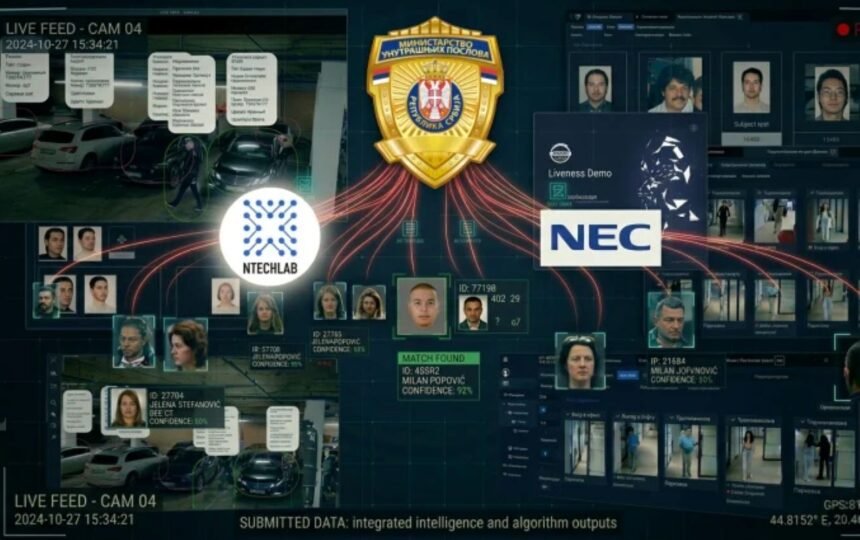
An investigation by the Balkan Investigative Reporting Network (BIRN), published on May 28, 2026, has revealed that the Serbian Ministry of Internal Affairs (MUP) possesses two advanced, previously undisclosed facial recognition software systems. These platforms enable the real-time processing of massive biometric data and the automated mapping of citizens’ social contacts.
This revelation comes shortly after a secretive public debate in April 2026 regarding the new Draft Law on Police. Provisions legally authorizing biometric surveillance were entirely scrubbed from that draft due to political risks, meaning the technology is actively deployed in the field without any legal or constitutional framework.
1. The Russian “FindFace” System: Threat Intelligence and Three Degrees of Separation
The most intrusive addition to MUP’s arsenal is FindFace Multi, developed by the Moscow-based company NtechLab (funded in part by the Russian state tech conglomerate Rostec and the Emirati sovereign wealth fund Mubadala). In Russia, this software has been widely used to track independent journalists, political activists, and draft evaders. It currently faces strict sanctions from the US, the European Union, and several international treasury departments.
According to data compiled by the non-profit technology organization Qurium, active servers for this program were detected in Serbia as early as December 2019, hosted by the Serbian provider mCloud (the same host previously caught routing the NoviSpy spyware utilized by Serbia’s Security Intelligence Agency, BIA).
[FindFace Multi: Mass Surveillance Architecture]
  Public Video Feeds (City Cameras, Dashcams, Drones) ──► Real-Time Analytics (13.4M comparisons/sec)
                                             │
      ┌──────────────────────────────────────┼──────────────────────────────────────┐
      ▼                                      ▼                                      ▼
 Biometric Face Match                   Silhouette Analysis                    Vehicle Identification
(Age, sex, emotions, and               (Clothing, accessories,                (License plates for 27 countries,
 built-in "liveness" tests)             aggression detection)                  make, model, color, weight)
The “Clustering” and “Interaction Tracking” Features
The software indiscriminately scrapes video feeds of ordinary citizens and automatically maps social circles based on behavioral algorithms (e.g., calculating the probability of a relationship if two individuals leave a camera frame at the exact same second). The system automatically maps out social networks to a depth of three circles of connection, allowing analysts to retroactively trace who meets whom, where, and when.
2. The Japanese “NeoFace Watch” System: Millions of Scans Per Second
The second facial recognition software confirmed to be installed within MUP is NeoFace Watch, a flagship biometrics product of the Japanese NEC Corporation. Although MUP planned the procurement of an “NEC face recognition system” through amendments to its public procurement plan in 2019, an official public tender was never published. Well-placed sources within MUP have now confirmed to BIRN that the software was purchased and covertly deployed.
- Operational Capacity: The system is capable of executing over three million searches per second, ingesting live video streams from city cameras, traffic monitors, drones, and even integrated private security systems.
- Precision Specs: The algorithm boasts an accuracy rate of 99.2% on high-quality images and retains a highly effective 85.5% accuracy rate under uncontrolled environments or poor lighting. This exact software platform is currently utilized by select police forces in the United Kingdom as well as US immigration agencies.
3. The Institutional Vacuum: Surveillance Outpaces the Law
The SHARE Foundation and the NGO Partners Serbia have warned that utilizing these technologies constitutes a direct violation of the Serbian Constitution and the Law on Personal Data Protection, as biometric signatures are processed indiscriminately without targeted court orders.
| Technology Platform | Country of Origin / Vendor | Current Status & Function in Serbia |
| FindFace Multi | Russia (NtechLab) | Installed (active since 2019). Behavioral analysis, vehicle tagging, emotion indexing, and contact tracing networks. |
| NeoFace Watch | Japan (NEC) | Installed (hidden procurement). Live mass streaming, real-time alerting, and retrospective tracking across municipal grids. |
| Griffeye | Sweden | Procured in 2022. Face-matching, metadata analysis, and reverse-image web-scraping capabilities. |
| Huawei (Project 1000 Cameras) | China | The foundational “smart camera” hardware infrastructure across Belgrade. |
| DSS Pro | China (Dahua) | Broadly procured by local municipalities across various towns throughout Serbia. |
“Biometric surveillance was omitted from the new draft law because it was assessed as too much of a political risk at this moment. Inside MUP, they are well aware that currently no domestic institution has the capacity or the political will to conduct effective oversight and prove that prohibited technologies are being used.” — Ana Toskić, Executive Director of Partners Serbia
4. Domestic Intermediaries: The Rise of “Mercury AI Solutions”
The biometric surveillance market in Serbia is also expanding rapidly through the domestic private sector. Beyond local firms reselling Israeli software from AnyVision (which the Montenegrin MUP has already installed in Podgorica, Bar, and Budva), a domestic player named Mercury AI Solutions was established last year.
The company is owned by Veljko Simić, who also owns Atlas Security—a private security firm that has secured millions of euros in contracts from the City of Belgrade and public administration entities over recent years. Mercury AI Solutions develops its own algorithms for facial, weapon, and violence recognition, and its website claims plans to construct a massive smart-camera manufacturing facility near Jagodina, aiming to employ hundreds of local engineers. The firm had a prominent display at Belgrade’s Partner 2025 defense exhibition and openly seeks partnerships with state institutions.
To date, the Serbian Ministry of Interior, NtechLab, and NEC Corporation have all declined to respond to BIRN’s official inquiries regarding the secretive procurement and deployment of these mass tracking networks.