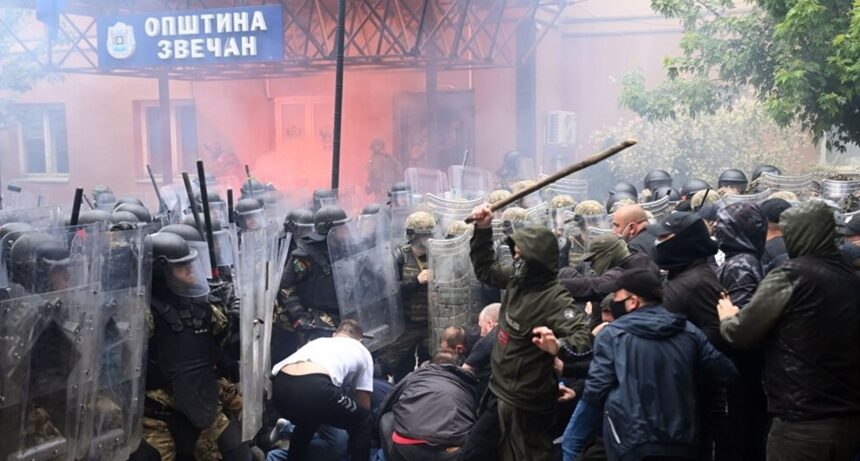
Gurakuç Kuçi, external associate of the Octopus Institute, has assessed that the events of May 29, 2023, in Zvečan constituted a direct test of NATO by Serbia, long before Russia intensified its use of drones and aerial provocations against the Alliance’s eastern flank. According to him, the attack against KFOR soldiers was not a spontaneous protest, but part of an organized operation directed by structures linked to Belgrade.
In his analysis, Kuçi describes Zvečan as a “human drone” deployed by Serbia against KFOR, arguing that the violent crowds involved in the incident were part of an asymmetric warfare tactic. He recalls that 30 KFOR soldiers were injured during the clashes that day, while several suffered severe wounds.
Kuçi directly links the events in Zvečan to the terrorist attack in Banjska in September 2023, describing them as two phases of the same destabilization scenario. According to him, Zvečan served as a testing ground for violence through coordinated crowds, while Banjska represented the armed phase, involving logistics, heavy weaponry, and organized terrorist structures.
He emphasizes that the main challenge for the international community remains the lack of accountability from Belgrade for the events in northern Kosovo, calling on NATO and the European Union to increase diplomatic and legal pressure on the actors who, according to him, continue to fuel regional destabilization.
Kuçi’s Full Text:
While the airspace of NATO’s eastern flank is being tested and violated by aggressive Russian drone flights and strikes, on the Western Balkans front, Moscow’s ally Serbia had already carried out a coordinated physical attack against Alliance troops on the ground three years ago.
Zvečan: Serbia’s “Human Drone” Against KFOR
On May 29, 2023, in northern Kosovo, Belgrade did not deploy flying technology; instead, it applied the same tactic of asymmetric warfare by launching a “human drone” — a well-prepared, armed crowd remotely directed by Serbian intelligence (BIA) and Milan Radoičić’s network.
What Aleksandar Vučić’s regime attempted to disguise as a “citizens’ protest” in Zvečan was, in fact, the first phase of a military-destabilization operation. The result of this action was 30 injured KFOR soldiers, at least two of whom suffered amputations due to their injuries.
Zvečan was designed to create the tactical chaos necessary to make an invasion of the north appear inevitable. It was the precise warning of what was later executed four months afterward, on September 24, 2023, during the terrorist attack in Banjska.
The Failure of the “Crimea Scenario” in Banjska and the Exposure of Belgrade
However, it was precisely the failure in Banjska that exposed Serbia’s entire strategy. The clear refusal of local Serb citizens to become cannon fodder and join terrorist cells demonstrated a significant reality: there was neither widespread nor organic dissatisfaction in northern Kosovo with the constitutional order of the Republic. What existed instead was a regime of fear, intimidation, and blackmail imposed by criminal structures protected by official Belgrade.
Today, the cause-and-effect relationship is undeniable: Zvečan and Banjska are two acts of the same scenario. In Zvečan, asymmetric violence was tested through crowds directed like political drones, while in Banjska the final phase of violence emerged through heavy weapons, uniforms, state-backed logistics, and a fully developed terrorist structure.
Three years after Zvečan and following the failure of the Banjska scenario, the question facing the international community today is not whether Belgrade has abandoned its efforts to destabilize Kosovo and the region, but rather what the next attempts will be and in what form they will appear. Security history in the Balkans demonstrates a clear rule: appeasing an aggressor does not produce stability; it merely provides time for rearmament and tactical adaptation.
From a geopolitical perspective, this attempt to create a “second Crimea” in northern Kosovo failed, primarily due to the professionalism of Kosovo’s security institutions, KFOR, and the refusal of local Serb citizens to become part of terrorist scenarios. Nevertheless, the principal challenge for Euro-Atlantic diplomacy remains the lack of accountability on Belgrade’s side. The fact that Milan Radoičić and his structures continue to move freely in Serbia, protected and financed through public tenders, demonstrates that Belgrade still believes the political cost of destabilization remains manageable.
Therefore, this anniversary should serve not only as a historical reminder but also as a moment of reflection regarding our alliance with the West. To ensure that the security architecture of the Western Balkans remains resilient, it is essential that the European Union and NATO increase diplomatic and legal pressure on the true sources of destabilization, preventing Belgrade from using controlled tensions as instruments of geopolitical blackmail.
If the current strategy of accommodation toward Belgrade is not urgently revised, the question is not whether another hybrid crisis will occur, but where and in what form Serbia’s next political drone will emerge.