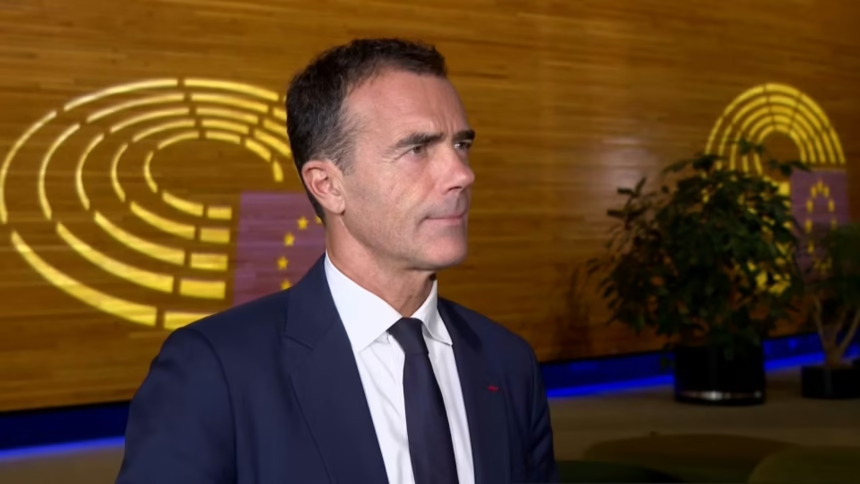
The Secretary-General of the European Democratic Party (EDP) and Member of the European Parliament, Sandro Gozi, delivered a scathing critique of Serbian President Aleksandar Vučić on Wednesday, flatly rejecting his proposal for a block-wide entry of Western Balkan nations into the European Union.
The diplomatic clash follows a high-profile interview Vučić granted to The Financial Times, in which the Serbian leader urged Brussels to abandon its traditional merit-based enlargement policy.
The Contested “Joint Entry” Proposal
In his interview, President Vučić called on the EU to integrate the Western Balkans as a single unified bloc, rather than assessing nations on individual progress:
“If we all enter together… there will be no borders between Pristina, Belgrade, and everyone else… The region needs to be united. It must not become a new conflict zone between people who enter the EU and those who are still far from it.”
— Aleksandar Vučić, President of Serbia
Gozi’s Rebuttal: Meritocracy Must Prevail
Sandro Gozi strongly criticized Vučić’s suggestion, labeling it a strategic maneuver designed to shield Serbia’s domestic regression behind the reform progress of its neighbors.
Gozi re-emphasized that the European Union’s enlargement process is built on individual merit—a principle meant to reward countries that undertake difficult judicial, economic, and political reforms.
                  [ Divergent Paths in the Western Balkans ]
                                      |
         +----------------------------+----------------------------+
         |                                                         |
         v                                                         v
 [ Leading Candidates ]                                   [ Serbian Stagnation ]
 Montenegro and Albania are making                        Belgrade is moving in the opposite direction
 significant progress by passing                          by eroding democratic institutions, targeting
 reforms in line with EU standards.                       opposition, and bypassing EU foreign policy.
The Accusation of “Hostage-Taking”
Gozi argued that frontrunners like Montenegro and Albania must not have their European integration halted due to Serbia’s democratic backsliding:
“We want the Western Balkans to join the EU as soon as possible. But Montenegro, Albania, and any other candidate genuinely advancing on the reform path must not be stopped because Vučić’s Serbia is moving in the opposite direction—eroding democratic institutions, intimidating political opponents and independent media, tolerating political violence, and refusing to align with the EU’s common foreign and security policy.”
— Sandro Gozi, MEP and EDP Secretary-General
Blaming the Regime, Not the Citizens
Gozi concluded his statement by distinguishing between Serbia’s current ruling coalition and its populace. He emphasized that the primary obstacle to Serbia’s European future is its political leadership.
“President Vučić and his regime are the ones failing the European test—not Serbia, and certainly not the Serbian people,” Gozi concluded.
The dispute highlights growing tensions between Brussels and Belgrade over democratic standards, press freedom, and geopolitical alignment in the Western Balkans.