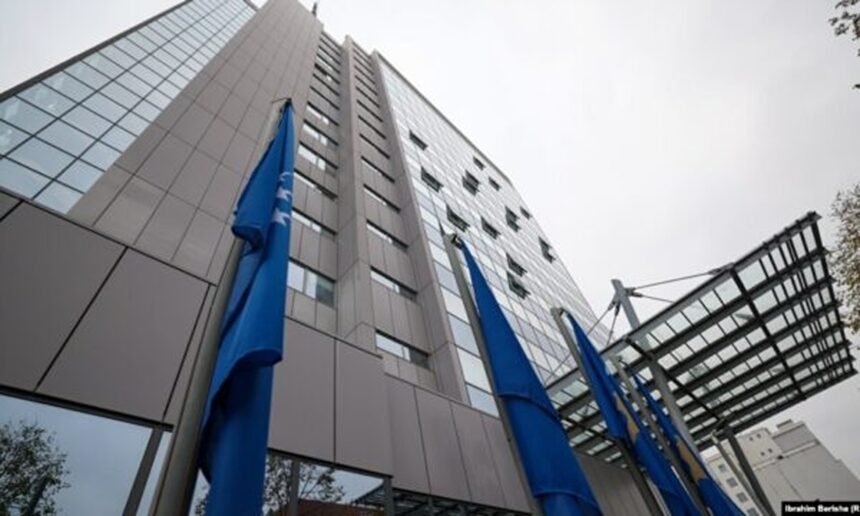
The Kosovo Agency of Statistics (ASK) released its official fiscal report for the first quarter (Q1) of 2026 on Monday, June 1, showing that the general government consolidated revenues reached €841.8 million.
The macroeconomic data indicates a robust collection period, with state expenditures trailing at €792.0 million, yielding a positive quarterly fiscal surplus of approximately €49.8 million before long-term capital deductions.
Revenue Analysis: Heavy Reliance on Product Taxes
The state treasury’s funding structure continues to depend heavily on indirect taxation. Taxes on products—primarily driven by Customs duties and Value Added Tax (VAT) collected at border crossings and domestic retail hubs—remain the undisputed engine of the national budget.
The revenue components for Q1 2026 are broken down as follows:
- Taxes on Products (Indirect): 68% of total revenue (~€572.4 million).
- Current Taxes on Income (Direct): 17% of total revenue (~€143.1 million).
- Financial Assets and Liabilities: 7% of total revenue (~€58.9 million).
- Miscellaneous Categories: 8% of total revenue (~€67.4 million).
Expenditure Breakdown: Public Salaries and Social Benefits Dominate
Total general government expenditures during the first three months of the year reached €792.0 million. According to economic classification, fixed operational expenditures—specifically public sector wages and social safety net transfers—accounted for more than two-thirds of all outlays.
| Expenditure Type (Economic Classification) | Percentage Share | Estimated Value |
| Compensation of Employees (Public Salaries) | 38% | €300.9 million |
| Social Contributions and Benefits | 31% | €245.5 million |
| Intermediate Consumption (Operational Goods/Services) | 12% | €95.0 million |
| Other Consolidated Sectors | 19% | €150.6 million |
Functional Classification (COFOG): Where the Money Went
When analyzed via the Classification of the Functions of Government (COFOG), the social sector received the overwhelming majority of public funding, highlighting the state’s ongoing focus on pension systems, social welfare schemes, and structural public services.
[Q1 2026 Budget Distribution by Sector]
   ├── Social Protection: 32% (Primary Sector)
   ├── Public Education: 15%
   ├── Economic Affairs: 13%
   ├── General Public Services: 11%
   └── Remaining Sectors: 29%
Economic analysts note that while the high collection rate reflects increased formal economic activity and effective tax enforcement, the fiscal allocation structure remains heavily consumption-oriented. The high concentration of funds dedicated to wages and social transfers continues to limit the fiscal space available for major capital investments in national infrastructure.