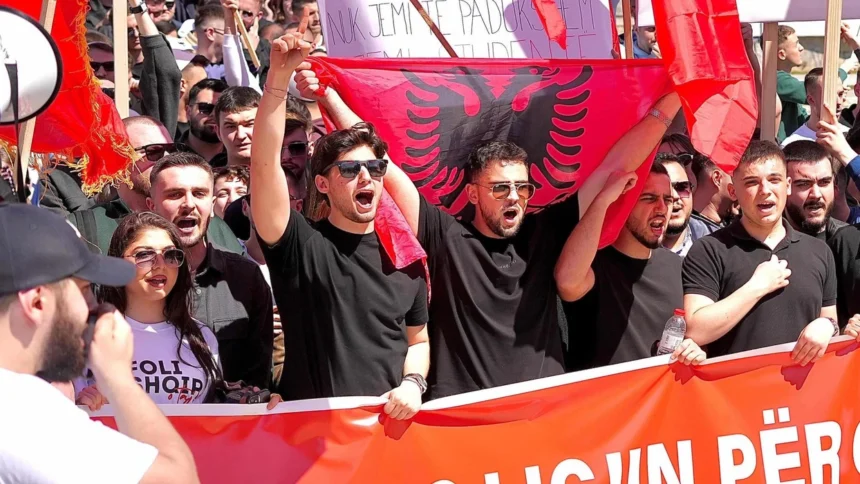
The ongoing student movement in North Macedonia has reached a critical bottleneck following the government’s attempt to compromise on a highly contentious linguistic policy. Student protest leader Mevlan Ademi publicly issued an ultimatum on Tuesday, June 2, 2026, explicitly rejecting a newly proposed “half-solution” regarding the administration of the national jurisprudence (bar) exam in the Albanian language.
The friction intensified less than 24 hours after First Deputy Prime Minister Bekim Sali announced an interim dual-language framework, which student groups claim actively undermines the country’s constitutional guarantees.
The Government’s Compromise: Theory in Albanian, Practice in Macedonian
In an effort to quell spreading university demonstrations and institutional accountability demands, Deputy PM Bekim Sali unveiled a structural split for the bar exam:
- The Theoretical Phase: Aspiring lawyers would be legally permitted to request and sit for the written, theoretical segment of the jurisprudence exam entirely in the Albanian language.
- The Practical Phase: The simulation of court filings, oral arguments, and case-law analysis would remain strictly restricted to the Macedonian language.
The government justified the preservation of Macedonian for the practical application segment by arguing that the vast majority of official case files, evidence logs, and judicial archives submitted to the national court system are processed exclusively in Macedonian. According to Sali, testing practical skills in a language not universally utilized by the active judiciary would create systemic administrative dysfunction.
The Activist Ultimatums: Law Implementation Over Negotiation
Mevlan Ademi, one of the central organizers of the youth-led protest movement, sharply dismantled the state’s rationale. He stated that the student coalition will refuse any partial amendments or administrative bypasses to the country’s formal Law on the Use of Languages.
[The Jurisprudence Exam Split Dispute]
       ├── Government Proposal: Theory in Albanian 📝 | Practice in Macedonian ⚖️
       └── Student Demand:     100% Comprehensive Exam Administration in Albanian 🛑
“Even without seeing an official draft, one thing is abundantly clear. Any attempt to offer a partial solution, a ‘semi-solution,’ or a detour around the Law on the Use of Languages is unacceptable,” Ademi declared in a widely circulated public statement. “The Albanian language is not a matter of negotiation. It is not a favor. It is not a compromise. It is a constitutional and legal right.”
Ademi argued that creating separate linguistic rules for different phases of a single state licensing exam constitutes active discrimination and bureaucratic stalling.
Broader Political Strains on the Ohrid Framework
The student deadlock has rapidly transformed into a broader political crisis, intersecting with concerns raised by regional groups like the Albanian-American Relations Council (AARC) in Washington regarding the preservation of ethnic rights in North Macedonia.
Activists note that the Law on the Use of Languages—deeply rooted in the tenets of the 2001 Ohrid Framework Agreement—mandates that public institutions fully accommodate the native language of any ethnic community comprising over 20% of the national population. By bifurcating the bar exam, students argue the Ministry of Justice is setting a dangerous legal precedent that compromises the systemic equality of Albanian-speaking legal professionals.
Organizers have warned that university walkouts and street blockades will expand across Skopje and Tetovo if the government attempts to codify the split exam model into law, reiterating their baseline demand: “The solution does not need to be invented. It already exists. Implement the law. Period.”