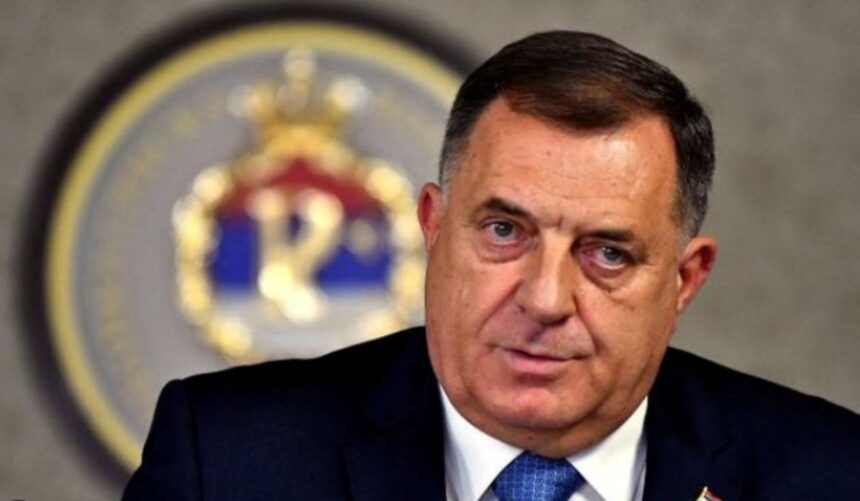
The United States government is carefully evaluating whether recent actions by SNSD leader Milorad Dodik have crossed the threshold to land him back on the Washington sanctions list. The move comes just months after his conditional removal from the US blacklist.
The United States Embassy in Sarajevo has confirmed to the local news portal Klix.ba that Washington is closely monitoring political developments in Bosnia and Herzegovina, with a specific focus on the destabilizing behavior of Milorad Dodik, the leader of the Alliance of Independent Social Democrats (SNSD).
In an official statement, the Embassy underscored that the US reserves the right to deploy targeted economic and visa restrictions to safeguard regional stability:
“The United States continues to monitor the behavior of all actors and parties, including the former President of Republika Srpska, Milorad Dodik, and reserves the right to impose sanctions on individuals when necessary, in accordance with executive orders and laws, when they engage in actions that undermine stability and heighten tensions.”
A Short-Lived Delisting
The warning marks a sharp diplomatic turn, considering the US Treasury’s Office of Foreign Assets Control (OFAC) had only recently lifted sanctions against Dodik, his family, and his inner circle in October 2025.
The initial delisting was a direct response to concrete concessions made by the Republika Srpska (RS) leadership to de-escalate a major constitutional crisis. Specifically, Dodik complied with a ruling by the Court of Bosnia and Herzegovina that banned him from holding public office, prompting his formal resignation as President of RS and allowing an interim successor to take over. Concurrently, the RS National Assembly annulled a series of unconstitutional laws that had originally triggered the American penalties.
However, since his removal from the blacklist, Dodik has aggressively resumed his secessionist rhetoric, repeatedly questioning the sovereignty and long-term viability of Bosnia and Herzegovina while openly advocating for the independence of the Serb-run entity.
Crucial Transition Ahead for the Office of the High Representative
The intensifying friction coincides with a major institutional transition in Sarajevo. The Peace Implementation Council (PIC) Steering Board is meeting to elect a successor to the international envoy, High Representative Christian Schmidt, who announced his resignation.
- Outgoing Envoy: The US Embassy expressed deep gratitude to Christian Schmidt for his years of dedicated service, recognizing him as the second longest-serving High Representative since the inception of the role under the Dayton Peace Agreement.
- Decisive Court Battle: During his tenure, Schmidt effectively utilized the sweeping executive “Bonn Powers,” enacting criminal code amendments that ultimately led to Dodik’s criminal conviction, his removal from the RS presidency, and his current six-year ban from public office.
- The Succession: The PIC Steering Board is expected to select Schmidt’s replacement during its high-level session, with the new High Representative poised to officially assume the mandate later this month.
Washington emphasized that the incoming international envoy will maintain a strict monitoring mandate over all political representatives and parties across Bosnia and Herzegovina to neutralize any coordinated attempts to unravel the country’s constitutional order.