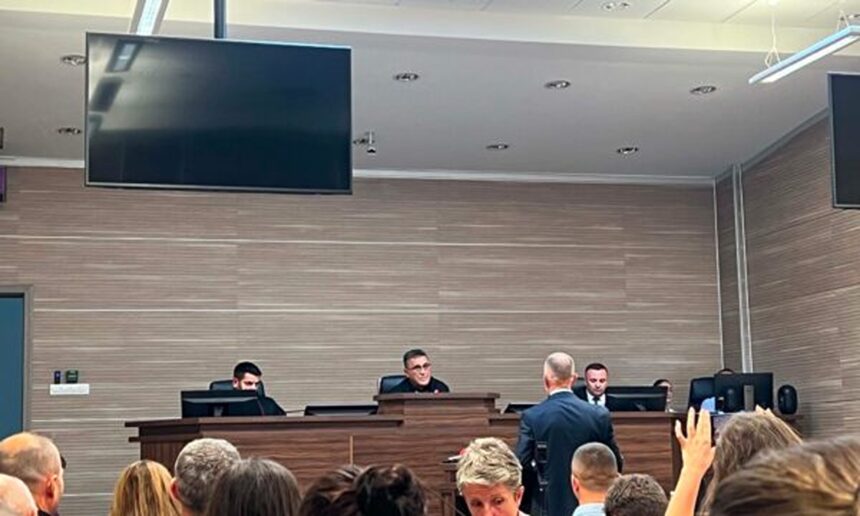
The trial of Dragisha Vićentijević, Jovan Vićentijević, and Igor Dimović, who are charged over the attack on the Ibër-Lepenc canal, continued today at the Basic Court in Pristina.
DNA expert Fatmir Ademi rejected the defense’s claims that the forensic examination had been conducted in Italy.
During cross-examination, defense attorney Nebojša Vlajić questioned why the DNA analysis had allegedly been carried out in Italy rather than Kosovo, suggesting it may have been due to a lack of equipment or technical capabilities.
Ademi clarified that the DNA analysis itself was conducted at the DNA Laboratory in Pristina, while only the interpretation of the results was performed in Italy because Kosovo’s laboratory lacked the required software.
“First of all, the forensic analysis was carried out at the DNA Laboratory in Pristina, not in Italy. As for the interpretation, it was necessary because we lacked the required software. Nevertheless, we completed our own analysis even without that software and compared the results before the Italian experts conducted their interpretation. I disagree with that characterization because the decision to send the results to Rome for interpretation was made by the Prosecutor’s Office, not by us,” Ademi said.
He added that the results generated by the DNA Laboratory were later forwarded for interpretation and emphasized that all evidence had been received through official legal procedures.
“The evidence was received through official channels in accordance with procedures for criminal cases. Investigators delivered it under the Prosecutor’s Office’s order. It did not arrive directly at the DNA Laboratory but first went through the evidence intake sector. The procedures are clear. We verify that the evidence is properly sealed, signed, and that the chain of custody is intact. Once it reaches the laboratory, it is checked again before any analysis begins, and every step is carried out under strict procedures,” Ademi explained.
Presiding Judge Vesel Ismaili then asked the expert what evidence, besides the ignition fuse, had been collected from the crime scene for forensic examination.
Ademi stated that, according to the official documentation, a total of seven items of evidence had been submitted for analysis. These included a synthetic rope, burned and wet fragments of a bag, a cap, an approximately nine-meter-long ignition fuse cable, part of a bag zipper, another ignition fuse, and a torn black piece of the bag.