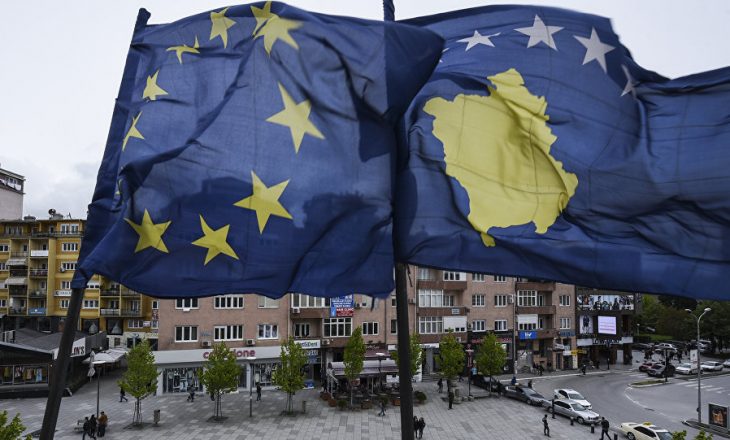
The European Parliament’s Committee on Foreign Affairs (AFET) is scheduled to vote today on the annual progress report for Kosovo. Drafted by Estonian MEP Riho Terras, the document solidifies European support for Kosovo’s statehood while raising a sharp alarm over millions in endangered EU funds due to ongoing domestic political paralysis.
The European Parliament is poised to adopt a crucial report on Kosovo today, striking a delicate balance between unwavering geopolitical backing and severe criticism of the deep political polarization paralyzing Pristina.
While the main political groups in the EP have already finalized compromise amendments—reaffirming a solid European majority that supports Kosovo’s euro-atlantic integration—the text takes a critical tone toward domestic governance, explicitly characterizing 2025 as a lost year due to institutional gridlock.
EU Integration and the Push for Non-Recognizing States
In the newly agreed-upon text, the European Parliament provides a strong diplomatic push for Kosovo’s stalled accession process:
- Accession Application: The report formally backs Kosovo’s EU membership application, which was originally submitted in December 2022.
- The EU Questionnaire: It urges the Council of the European Union to instruct the European Commission to send the standard accession questionnaire to Pristina “without further delay” and to deliver a merit-based opinion.
- Candidate Status: The Council is called upon to act swiftly, including granting candidate status to Kosovo as soon as the relevant baseline criteria are fulfilled.
The report reiterates its firm call to the five EU member states that have not yet recognized Kosovo’s independence—Spain, Slovakia, Romania, Greece, and Cyprus—to do so immediately to allow the country to advance on an equal footing with other candidates. Furthermore, the text invokes the International Court of Justice’s (ICJ) historic July 22, 2010 advisory opinion, which concluded that Kosovo’s declaration of independence did not violate international law.
Political Impasse Puts EU Growth Plan Funds at Risk
Beyond support for sovereignty, the report drafted by Riho Terras expresses deep regret over the domestic political deadlock holding the country back. Following the failure to elect a new president within constitutional deadlines, Kosovo is headed toward another snap general election—making it the country’s third parliamentary vote in just 18 months.
The European Parliament warns that this chronic instability carries direct economic consequences:
- Endangered Financial Aid: Kosovo risks entirely losing significant funding allocated under the EU’s Growth Plan for the Western Balkans.
- Stalled Reforms: Due to the prolonged institutional paralysis, the caretaker government will be unable to fulfill the required democratic benchmarks and reform timelines within the strict windows dictated by Brussels.
Dialogue with Serbia and Regional Defense Alliances
Parallel to the Kosovo document, the AFET committee will also vote today on the progress report for Serbia (compiled by Tonino Picula). In both reports, the EP demands urgent progress in the EU-facilitated dialogue for the normalization of relations, which remained completely stagnant throughout 2025.
According to the European Parliament, the dialogue must ultimately lead to a comprehensive agreement based on mutual recognition under international law. Key security and foreign policy mandates in the report include:
- International Bodies: Serbia is explicitly demanded to stop obstructing Kosovo’s bids to join the Council of Europe and other international organizations, noting that such behavior directly violates its obligations under the Ohrid Agreement.
- The Banjska Attack: The EP strongly regrets that Milan Radoičić, the leader of the September 2023 terrorist attack in Banjska, has still not been brought to justice by authorities in Belgrade.
- Regional Security: The report welcomes the recently signed tripartite trilateral defense cooperation agreement between Kosovo, Albania, and Croatia, praising it as a constructive step to counter hybrid security threats in the region.