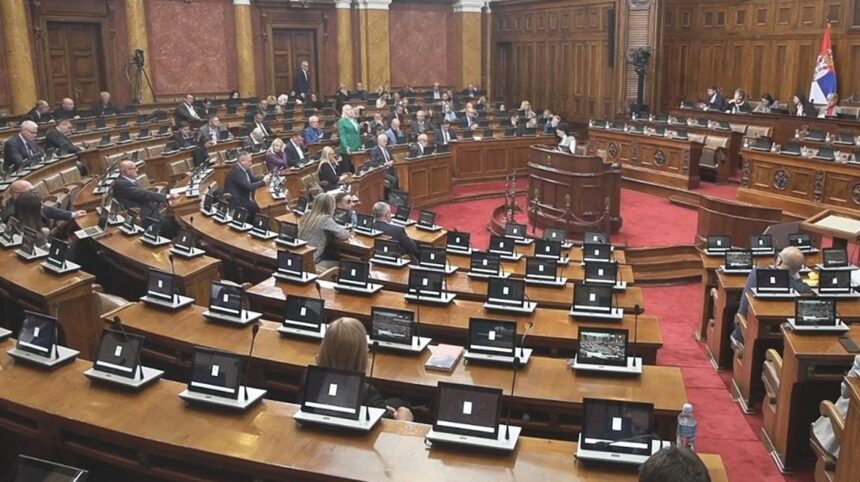
Serbia’s National Assembly has opened debate on a no-confidence motion against the government of Prime Minister Đuro Macut, with the prime minister and members of his cabinet attending the parliamentary session.
The motion was submitted by 62 opposition lawmakers in February following an investigation by Serbia’s Prosecutor’s Office for Organized Crime into Culture Minister Nikola Selaković and three other officials.
According to prosecutors, the officials are suspected of falsifying documents to remove the protected cultural monument status of the former Yugoslav General Staff complex in Belgrade, which was heavily damaged during NATO’s 1999 bombing campaign.
The removal of the site’s protected status paved the way for a planned luxury residential and commercial development in one of Belgrade’s most valuable locations. However, Jared Kushner, the son-in-law of U.S. President Donald Trump, later withdrew from the investment project.
Miroslav Aleksić, head of the parliamentary group of the People’s Movement of Serbia (NPS), said the no-confidence motion was primarily prompted by the “General Staff” affair and the alleged role of Minister Selaković in the case.
The parliamentary session was scheduled on July 24 at the request of 109 lawmakers from the ruling coalition, after the governing majority had previously declined on several occasions to provide the quorum needed to hold the debate.
If the National Assembly approves the no-confidence motion, a 30-day constitutional deadline will begin for the formation of a new government. Should lawmakers fail to establish a new cabinet within that period, parliament will be dissolved and early parliamentary elections will be called.
President Aleksandar Vučić has previously indicated that parliamentary elections could take place in October or November, with presidential elections expected several months later.
Calls for early elections have intensified following months of anti-government protests led by students after the collapse of a concrete canopy at the Novi Sad railway station, which killed 16 people. Student organizers have demanded snap parliamentary elections for nearly a year, a request that authorities have so far rejected.