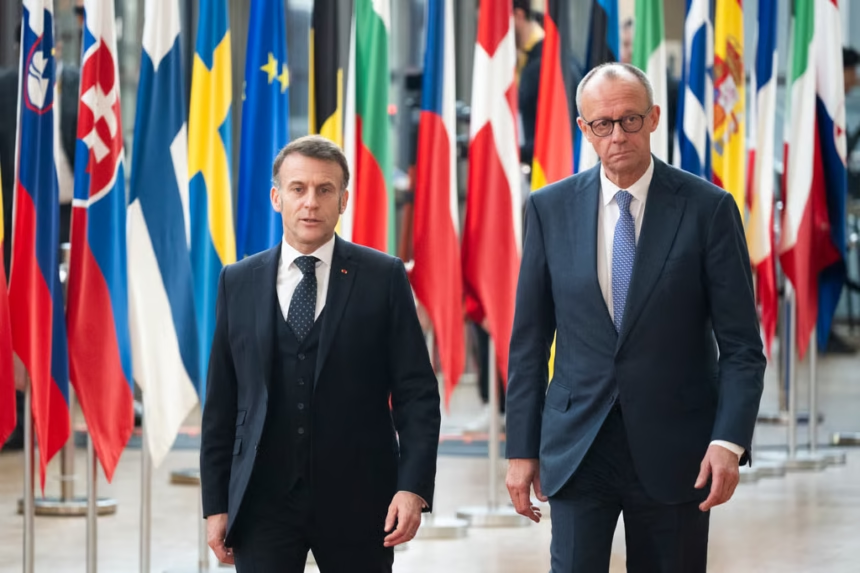
The diplomatic initiative designed by Chancellor Friedrich Merz and President Emmanuel Macron introduces structural “staged accession” rewards, granting early single-market access and institutional observer status tied to rigorous domestic reforms.
In a powerful diplomatic move ahead of the upcoming EU–Western Balkans summit, Germany and France have jointly submitted an informal policy document (non-paper) outlining a fundamental overhaul of the European Union’s enlargement architecture. The new strategy advocates for the “gradual integration” of candidate nations in the Western Balkans alongside Moldova directly into EU programs, policies, and institutional structures long before they achieve formal full membership.
The document, engineered directly within the cabinets of German Chancellor Friedrich Merz and French President Emmanuel Macron, acknowledges that the current accession model has grown mechanically stale and requires a sharp political impulse.
This marks the first major joint enlargement initiative from the EU’s primary Franco-German executive engine under Chancellor Merz, expanding on his previous call for “creative solutions” to unblock the stagnation across Southeastern Europe.
The Architecture of “Gradual Integration”
The Franco-German non-paper is designed to transform the accession journey from an “all-or-nothing” legal marathon into a dynamic, multi-tier system of rolling incentives. Rather than waiting decades for full structural rights, candidate states will unlock practical layers of European integration as they clear specific reform thresholds.
┌────────────────────────────────────────────────────────────────────────┐
│             The Franco-German Staged Accession Roadmap                 │
├───────────────────────────────────┬────────────────────────────────────┤
│ CORE SYSTEM ADVANTAGES            │ STRINGENT RULE-OF-LAW DEFENSES      │
├───────────────────────────────────┼────────────────────────────────────┤
│ • Streamlines negotiations by     │ • All early privileges remain fully│
│   cutting bureaucratic hurdles.   │   reversible (*reversibility*).    │
│ • Accelerates cluster openings    │ • Deliberate democratic backsliding│
│   upon European Commission nod.   │   triggers automatic suspension.   │
│ • Shifts the core focus from administrative │ • Complete compliance with basic European │
│   checklists to substantive reform.│  values is non-negotiable.         │
└───────────────────────────────────┴────────────────────────────────────┘
Important Clarification from the Document: The authors stress that this model is not a substitute for full EU membership, nor is it designed to prolong the accession timeline. Instead, it serves as a mechanism to accelerate domestic reforms by offering tangible, everyday economic and institutional benefits to citizens and businesses prior to formal accession.
Concrete Proposals: Single Market Access & Observer Rights
To anchor these concepts, Berlin and Paris have asked the European Commission to immediately draft operational proposals translating the non-paper into active policy. The document highlights several groundbreaking concessions:
- Observer Status in Brussels: High-performing candidate nations would gradually integrate into the daily work of EU institutions, gaining permission to send representatives with observer status to targeted ministerial meetings and committees.
- Privileged Market Access: Progressive alignment with European frameworks will grant businesses early, privileged access to parts of the lucrative EU Single Market.
                     [Candidate Reform Milestones]
                                   │
                                   ▼
              [Temporary Closure of Key Negotiation Chapters]
                                   │
                                   ▼
             [Full Access to the EU Single Market Model]
             (Operating as an Expanded European Economic Area)
The highest tier of this phased pathway would grant a candidate country full integration into the European Single Market—modeled after an expanded European Economic Area (EEA)—on the condition that the nation fully adopts and enforces EU legislation across all core economic chapters.
By tying economic survival directly to democratic accountability, the Franco-German engine hopes to breathe new life into a strategic region caught between European integration and competing geopolitical influences.