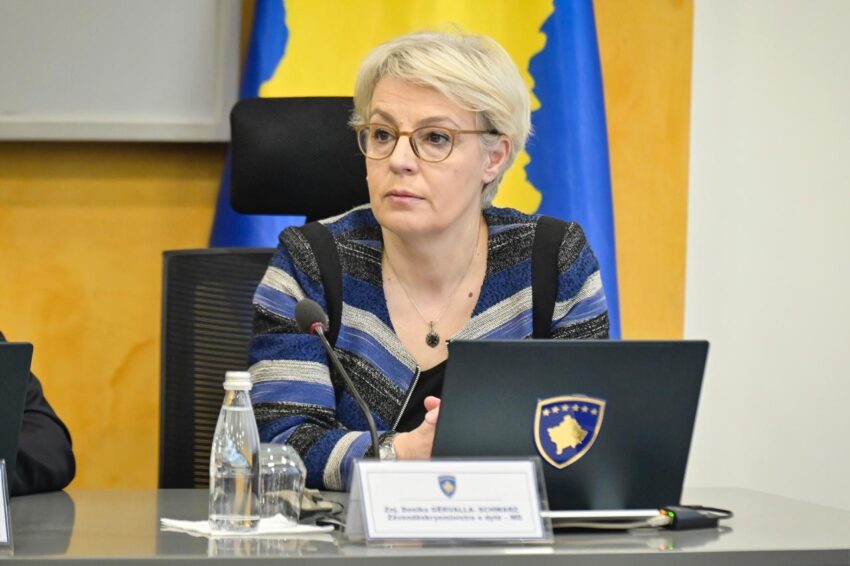
Donika Gërvalla, Kosovo’s acting Minister of Justice, has announced the official opening of a 15-day public consultation window for the controversial Draft Law on the State Bureau for the Verification and Confiscation of Unjustified Assets.
The legislative framework, which has served as a central anti-corruption cornerstone for Prime Minister Albin Kurti’s administration, will remain open on the government’s digital consultation platform for civil suggestions, legal input, and critique until June 26, 2026.
“Nobody is Above the Law”
In an announcement broadcast across institutional networks, Gërvalla framed the draft law as an essential mechanism to dismantle entrenched corruption among high-level public functionaries. She issued a direct appeal to judicial professionals, civil society organizations (CSOs), and international legal experts to scrutinize and submit commentary on the text.
“In the Republic of Kosovo, nobody—absolutely nobody—stands above the law,” Gërvalla declared. “Public office is not a vehicle for personal enrichment but a profound responsibility that must be executed in strict adherence to legal provisions.”
The Legislative Hurdles and Civil Confiscation Concept
The draft law outlines the establishment of a specialized State Bureau tasked with auditing, analyzing, and verifying the asset portfolios of active and former public officials. If the Bureau detects a profound imbalance between an official’s verified luxury assets and their legally documented income, the file will be passed directly to the judiciary.
[The Wealth Verification Workflow]
  1. Whistleblower Input / Institutional Red Flags (Tax Admin, Customs, Intelligence)
  2. State Bureau Verification (Auditing asset trails against legal income registries)
  3. Evidentiary Audit Case Built (Bureau demonstrates severe wealth disproportion)
  4. Judicial Trial Pipeline ──> Formal Court Decision (Civil Asset Forfeiture)
Gërvalla clarified that the Bureau itself does not hold judicial power. “The Bureau does not confiscate, it does not pass judgment, and it does not replace the courts. The Bureau collects, verifies, and analyzes information, while asset forfeiture is carried out exclusively by a court of law.”
The draft law has undergone an exhaustive legal odyssey to reach this phase. According to the Ministry of Justice, the civil asset forfeiture concept has been reshaped by three separate advisory opinions from the Venice Commission and two extensive constitutional reviews by the Constitutional Court of Kosovo, both of which verified that civil-based asset forfeiture is a legitimate legal instrument, provided strict proportionality is maintained.
Boycotts and Opposition Backlash
Despite the ministry’s push, the bill continues to provoke severe institutional and political friction. While the Assembly of Kosovo successfully passed the draft law in its first reading on April 17, 2026 (with 81 votes in favor and 25 abstentions), opposition parties and independent legal watchdogs have expressed deep reservations.
The Democratic Party of Kosovo (PDK) chose to abstain during the initial vote, vocally criticizing the executive branch for rushing a highly sensitive, far-reaching statute through parliament without adequate professional oversight.
[Timeline of the Bill's Inception]
• March 30, 2026: Approved by the Cabinet of the Kurti Government.
• April 14, 2026: Sparked heavy physical/verbal clashes in the Committee on Legislation.
• April 17, 2026: Passed the First Reading in the Assembly of Kosovo.
• June 8, 2026: 15-day formal public consultation window opened by Ministry of Justice.
• June 26, 2026: Closing deadline for stakeholder and civic review.
The friction reached a critical point when the Kosovo Law Institute (IKD), a prominent judicial watchdog, announced a total boycott of the public hearings organized by the parliamentary Committee on Legislation. IKD slammed the review process as an insincere, accelerated “formality,” pointing out that invitations for expert hearings were released less than 24 hours before assemblies met, violating the parliament’s internal rules requiring a minimum five-day notification.
Watchdogs remain highly concerned that pushing the legislation through in a rushed manner ahead of impending parliamentary reshuffles serves a purely political campaign narrative rather than building a durable, bulletproof legal framework capable of surviving its third inevitable challenge before the Constitutional Court.