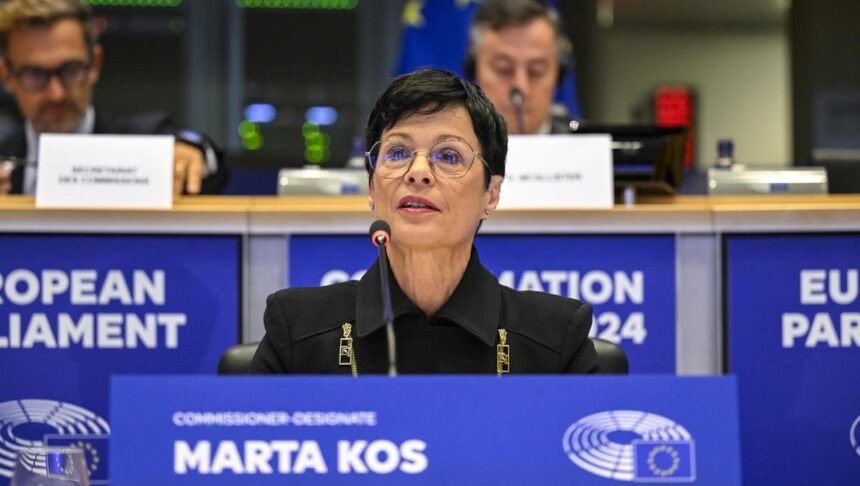
European Commissioner for Enlargement Marta Kos has declared that the full integration of the Western Balkans is a fundamental geopolitical necessity to safeguard the long-term security and stability of the European continent.
Speaking on Tuesday, June 9, 2026, at the 18th Annual Meeting of the Regional Cooperation Council (RCC) in Skopje, North Macedonia, Kos emphasized that the European Union’s enlargement pipeline is an active meritocracy, where access remains wide open to nations that demonstrate authentic commitment to rule of law and democratic reforms.
The strategic high-level summit was co-chaired by the RCC and Bulgaria, the current rotating chair of the South-East European Cooperation Process (SEECP).
The Common Regional Market: A Launchpad to the EU
Commissioner Kos highlighted the Common Regional Market (CRM) as a vital, practical vehicle designed to lift economic barriers within the Balkans while aligning local infrastructure with strict European standards.
“The expansion opportunity is available to those who implement reforms, and the Common Regional Market is an important part of that process,” Kos stated. “It helps the region prepare for deeper integration into the EU single market while facilitating a better life for everyday citizens. The place of the entire Western Balkans is inside the EU.”
[The Strategic Path to EU Single Market Integration]
• Phase 1: Structural Reforms — Aligning local judiciary, media laws, and electoral codes with EU baselines.
• Phase 2: Common Regional Market (CRM) — Enhancing intra-regional connectivity, trade, and workforce mobility.
• Phase 3: Single Market Access — Gradual economic absorption before formal full-fledged EU membership.
“Cooperation Is No Longer an Option—It Is a Shield”
The sentiment of geopolitical urgency was echoed by RCC Secretary General Amer Kapetanović, who warned that the rapidly shifting global security matrix leaves the Western Balkans no room for internal division. In a world shaped by financial inflation, severe climate instability, demographic decline, and mass brain-drain, Kapetanović argued that close regional ties are survival mechanisms.
“In a world shaped by uncertainty, regional cooperation is no longer a matter of a convenient diplomatic choice—it is one of our strongest assets,” Kapetanović noted. “The focus must now entirely shift toward tangible implementation, solid results, and long-term investments that directly benefit citizens, businesses, and public institutions.”
   ┌────────────────────────────────────────────────────────┐
   │         THE SEECP REGIONAL COOPERATION FRAMEWORK       │
   └───────────────────────────┬────────────────────────────┘
                               │
               Current Matrix & Future Pipeline
                               │
               ┌───────────────┴───────────────┐
               ▼ CURRENT CHAIR                 ▼ INCOMING CHAIR
┌──────────────────────────────┐┌──────────────────────────────┐
│          BULGARIA            ││           ROMANIA            │
│ • Focus: Regional Trust      ││ • Focus: Green Transition    │
│ • Setting core SEECP guides  ││ • Cross-border connectivity  │
│ • Hosting the Sofia Summit   ││ • Deepening single-market   │
└──────────────────────────────┘└──────────────────────────────┘
Bulgarian Foreign Minister Velislava Petrova re-asserted Sofia’s dedication to these principles, stating that regional ties built on trust are a non-negotiable prerequisite for a shared European future.
Following the approval of the RCC’s comprehensive annual report, the summit confirmed that Romania will officially succeed Bulgaria as the rotating chair of the SEECP later this month, maintaining the institutional momentum required to unlock multi-billion-euro financial packages tied to the EU’s Western Balkans Growth Plan.