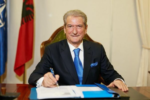
Speaking with Euronews, Albanian Prime Minister Edi Rama delivered a candid assessment of the European Union’s current integration strategy, warning that the outdated, strictly bureaucratic accession methodology no longer functions in a rapidly shifting geopolitical landscape.
Rama argued that the Western Balkans do not require institutional shortcuts that would compromise the rule of law. Instead, he demanded an immediate change in the integration paradigm: a physical seat at the decision-making table in Brussels before formal, full-fledged membership is officially finalized.
The “Shared Table” Model and the Franco-German Non-Paper
Rama’s remarks follow intense diplomatic speculation surrounding a newly surfaced French and German “non-paper” detailing a gradual integration strategy for candidate nations. Far from viewing the document as a Western European imposition, Rama noted that it closely mirrors a concept he co-authored in a joint op-ed with Serbian President Aleksandar Vučić.
The Gradual Integration Pipeline (The Rama-Vučić Concept)
[ Candidate Countries (Western Balkans / Moldova) ]
                        │
                        ▼ (Step 1: Immediate Institutional Placement)
         [ Joint Table in Brussels ] ──► Full inclusion in dialogues & data exchange
                        │
                        ▼ (Concession: Temporary Wave of Specific Rights)
         [ Voluntary Forfeiture of Veto Powers & Full Voting Rights ]
                        │
                        ▼ (Step 2: Gradual Structural Convergence)
         [ Complete Alignment with the EU Single Market ]
The core of this strategy dictates that candidate nations sit at the ministerial table in Brussels to help shape continental policies, while voluntarily waiving certain high-level execution rights—such as full voting rights or the power to veto EU decisions—during a designated transitional phase.
The Missing “Helmut Kohl Piece of the Puzzle”
According to the Albanian Prime Minister, contemporary European integration is bogged down by technical over-regulation, completely losing its overarching strategic vision.
“The old approach no longer works. The process is missing what I call the ‘Helmut Kohl piece of the puzzle.’ This means that vision and high politics must lead first, and all technical, bureaucratic procedures must follow that core political direction.”
The “Family Table” Analogy
To illustrate his point, Rama used a highly personal analogy centered on European Commission President Ursula von der Leyen:
- The Analogy: “She has six children. Those children are gathered around the dinner table; they go through exams and school, but they participate actively in family life. You don’t tell your children to stay out in the neighborhood and that they can only enter the house once they are completely mature. No—they are already inside the family, and the family helps them grow and get ready.”
- The Reality: Rama stressed that the Western Balkans are currently left out in the neighborhood, lacking a true sense of community belonging while undergoing painfully slow institutional reforms. Annual high-level summits, he warned, are no longer a sufficient mechanism to maintain regional trust.
Geopolitical Realities: Foreign Policy and Russia
| Regional/Geopolitical Challenge | Rama’s Strategic Assessment | Proposed Structural Solution |
| Srbija’s Sanctions Holdout | Acknowledged that Belgrade’s continuous refusal to impose sanctions on Russia remains a significant point of diplomatic friction for the EU. | The “Shared Table”: It is structurally easier to demand foreign policy alignment when regional leaders are already part of the internal Brussels information-sharing pipeline. |
| Erosion of Public Trust | Long waiting periods risk weakening the region’s faith in the European idea, allowing hostile alternative narratives to gain ground. | Formalizing a clear political declaration that the Western Balkans belong to the European family to counter the spread of disinformation. |
| Shifting EU-Russia Dynamics | Noted that direct communication with Moscow—previously a total taboo in Western capitals—is now being openly discussed in diplomatic circles. | Democratic nations must continuously pursue peace, even when dealing with a state operating as an active adversary. |
Rama concluded by reiterating that for Albania, there is absolutely no “Plan B” or alternative to European integration, describing his citizens as “fanatics of the EU faith.” However, he warned that the bloc must remain politically unified and strategically bold to survive, beginning with the practical integration of its immediate neighbors.