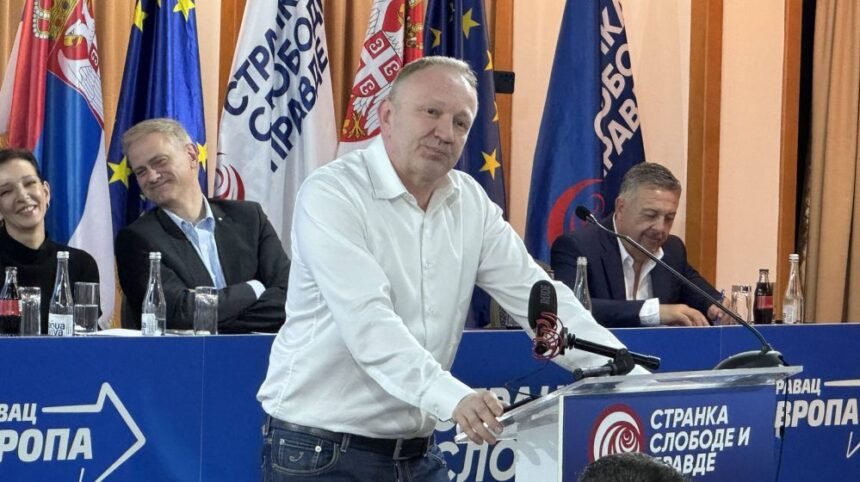
In a revealing interview with the weekly magazine Radar, Dragan Đilas, the president of the Freedom and Justice Party (SSP), asserted that the primary reason Serbia’s highly anticipated parliamentary elections have not yet been scheduled is because President Aleksandar Vučić knows his political standing has severely deteriorated, particularly across the nation’s major urban centers.
Đilas disclosed that during the recent EU–Western Balkans Summit in Tivat, European leadership delivered a blunt, uncompromising message directly to Vučić: the European Union will fundamentally refuse to recognize the legitimacy of any future undemocratic or irregular elections in Serbia.
The Tivat Summit and the German Non-Paper
According to the opposition leader, the diplomatic climate in Europe has drastically hardened against the current regime in Belgrade. Đilas pointed heavily to the public stance taken by German Chancellor Friedrich Merz during the Adriatic summit as a definitive turning point.
Pressure Points on the Belgrade Regime (Tivat Summit Outcomes)
[ European Union / Chancellor Merz ]
                  │
                  ├──► 1. Election Integrity: Irregular votes will NOT be recognized.
                  ├──► 2. Strategic Ultimatum: Serbia can no longer "sit on two chairs."
                  │
                  ▼
[ The Reversible Non-Paper Framework ] ──► Threat of pulling back previous EU integration steps.
“If the Chancellor of Germany, a country currently facing a million domestic challenges, takes the time to explicitly state that they collectively warned Vučić he can no longer sit on two chairs—while simultaneously releasing a non-paper that introduces the concept of reversible EU integration—it is completely clear that the fuse has burned out,” Đilas stated.
The introduction of this Franco-German diplomatic non-paper signifies that if Serbia continues to drift from Western standards or compromise democratic processes, the EU now reserves the structural right to actively roll back and freeze previous integration milestones and funding pipelines.
The Strategy of the Serbian Opposition: A Multi-List Calculus
Addressing the domestic political front, Đilas clarified the SSP’s organizational path forward. While he personally championed a completely unified opposition front, the lack of timely structural coordination means the opposition will split across distinct, complementary voter tracks to maximize turnout.
| Ballot Option | Target Electorate | Strategic Function |
| Pro-European Opposition Coalition (Including SSP) | Formally aligned pro-EU voters demanding explicit institutional reform, foreign policy synchronization, and democratic checks. | Capturing traditional, structured anti-regime blocs in major cities. |
| The Student List | Politically disillusioned youth, non-aligned voters, and citizens skeptical of traditional political party setups. | Mobilizing previously dormant voter segments who refuse to back the establishment opposition. |
Đilas emphasized that running on separate tracks is not an internal failure, provided all factions keep their eyes on the absolute mathematical objective: ensuring that the combined total of anti-regime ballots exceeds the crucial 50% threshold to break the ruling progressive coalition’s monopoly on power.
Ultimately, while the EU’s refusal to validate stolen elections provides vital diplomatic backing, Đilas concluded with a grounded message to the electorate: “The citizens of the EU will not be voting in these elections—the citizens of Serbia will. We are the only ones who can dismantle this dictatorship.”