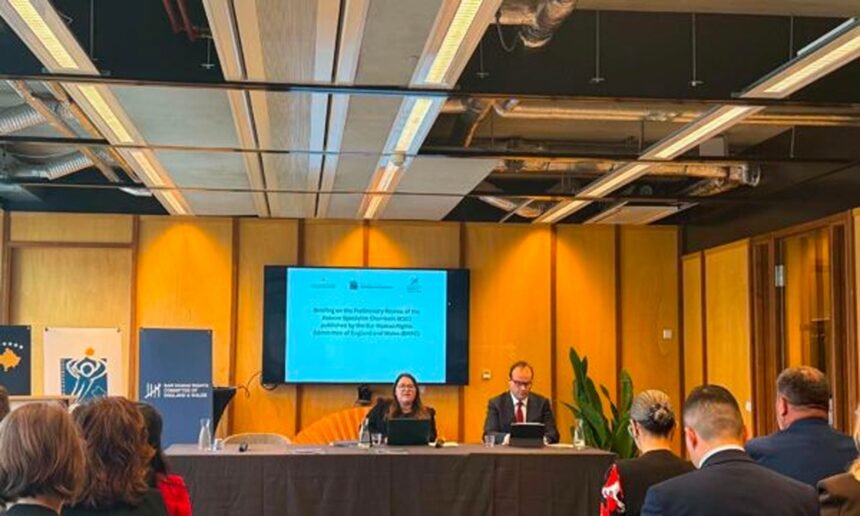
The Hague – While attention remains focused on the pending verdict in the case of former Kosovo President Hashim Thaçi and his co-defendants, legal experts, diplomats, academics, and international justice observers gathered in The Hague on Thursday to discuss a report that has raised serious questions about the functioning of the Kosovo Specialist Chambers.
The event, hosted by the Embassy of Kosovo in the Netherlands at Humanity Hub, featured the authors of a report commissioned by the Kosovo Ombudsperson and prepared by the Human Rights Committee of the Bar Council of England and Wales.
The report, authored by Gus Waschefort and Lauren Lederle and published in April, identified a number of concerns regarding the Specialist Chambers, including prolonged pre-trial detention, restrictions on provisional release, limited judicial accountability mechanisms, transparency issues related to evidence, and an imbalance between the prosecution and defense.
The experts argued that independent scrutiny of international courts is essential to ensuring fairness and public confidence in judicial proceedings.
According to the report, particular concerns exist regarding the handling of evidence obtained from external sources, including Serbia, and whether sufficient judicial review has been applied before such material is admitted into proceedings. The report also questioned aspects of the court’s institutional structure, including its reliance on international funding and personnel.
Notably, representatives of the Specialist Chambers, the Specialist Prosecutor’s Office, and the court administration did not attend the event despite being based in The Hague.
Kosovo’s Ambassador to the Netherlands, Dren Doli, welcomed the discussion and stressed that independent assessments should not be viewed as a threat to justice.
“Critical analysis and independent evaluations are not a threat to justice; they are essential components of it,” Doli said, emphasizing that open debate strengthens confidence in judicial institutions.
During the discussion, representatives from several countries, including the United States, France, Ireland, and Luxembourg, raised questions about the report’s findings and timing.
A representative from Luxembourg questioned why the report was released before the conclusion of the trial. In response, Lauren Lederle argued that waiting until proceedings are over would defeat the purpose of monitoring ongoing judicial processes.
“If such assessments are conducted only after a trial has ended, it is too late to address the concerns identified,” she said.
French representatives expressed support for the Specialist Chambers but questioned whether the report sufficiently considered the interests of victims and whether its criticism of judicial conduct was justified.
Lederle responded that even highly respected judges should not be immune from criticism and stressed that the report was intended to encourage discussion rather than take sides.
“The purpose of this report is not to choose sides but to shed light on issues that deserve scrutiny,” she said.
One issue discussed extensively was a 2020 meeting involving former Specialist Prosecutor Jack Smith and diplomats in The Hague. According to the report, the existence of the meeting was not disclosed to the defense at the time.
When some participants argued that such interactions are common in international justice settings, Lederle maintained that questionable practices should not be justified simply because they have occurred elsewhere.
“A fair trial serves both justice and victims. An unfair trial serves neither,” she stated.
The report’s authors also revealed that they had sought engagement with the Ombudsperson of the Specialist Chambers but never received a response.
Kosovo Ombudsperson Naim Qelaj criticized the court’s refusal to participate in the discussion, describing it as a rejection of legitimate criticism.
“They refuse to answer the concerns that have been raised. They report privately on the process while refusing public discussion. This is an insult to the people of Kosovo and not in line with the standards promoted by the European Union,” Qelaj said.
Also attending the event was Nevenka Tromp, who criticized the Specialist Chambers for failing to build trust among Kosovars and argued that the court has not adequately communicated its work to the public.
The discussion comes as the Specialist Chambers continues deliberations in the Thaçi case. On May 5, the court announced that it would require an additional 60 days before issuing a verdict due to the complexity and volume of the case.
While no date has yet been set for the judgment, the debate surrounding transparency, accountability, and fair trial standards at the court appears certain to continue.