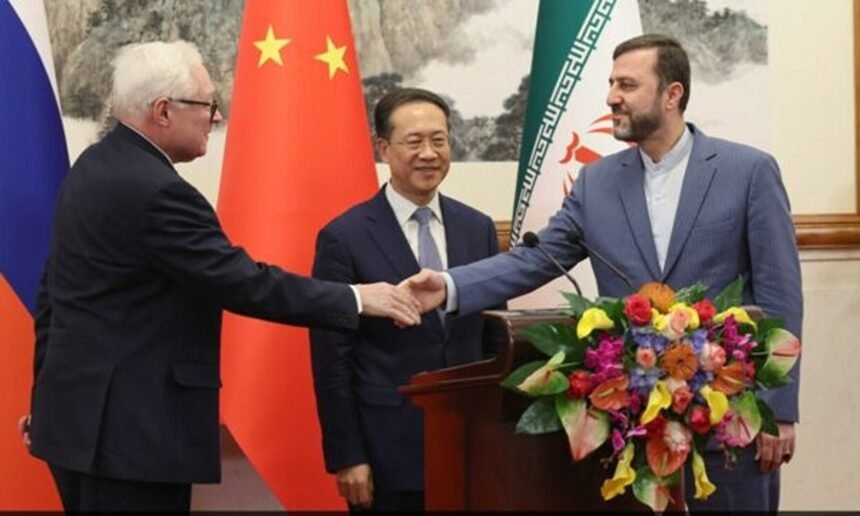
Russia, China, and Iran are increasingly forming a strategic alliance of convenience that American policymakers must confront, according to a group of U.S. experts and former officials, as it seeks to undermine the global order.
Speaking on June 10 at a national security conference titled “America’s Adversaries: The Russia Reality,” organized by the Independent Women’s Forum, several panelists emphasized that the transactional benefits of this alignment are already producing significant strategic gains—particularly for the Iranian regime, which remains largely isolated internationally.
Driven by shared opposition to U.S. dominance, the three countries are coordinating diplomatically, integrating military cooperation, and developing methods to bypass Western sanctions.
“The question is whether this is a disruption strategy, a tactical convenience alliance or opportunism, or whether it is designed to create another set of strategic outcomes in terms of the global order,” said Nadia Schadlow, senior fellow at the Hudson Institute and former U.S. Deputy National Security Advisor.
To counter this growing axis, she argued that Washington must stop treating Russia, China, and Iran as separate regional theaters and instead develop more creative approaches to disrupt their cooperation.
“We need to make their relationship as difficult as possible,” Schadlow said.
Although Russia, China, and Iran are not bound by a formal trilateral defense treaty, their interests have converged in recent years through shared conflicts and geopolitical pressure.
Since Russia’s full-scale invasion of Ukraine in February 2022, global sanctions have tightened around its economy, pushing Moscow to deepen ties wherever possible.
Similarly, Iran has long been under heavy sanctions, intensified further after U.S. and Israeli airstrikes on February 28.
Beyond internal survival, this authoritarian synergy is creating a dangerous cycle of battlefield feedback, said Ilan Berman, vice president of the American Foreign Policy Council.
Berman noted that while Iran has supplied waves of drone munitions to support Russia’s war in Ukraine, Western intelligence agencies fear that battlefield data collected in Europe could eventually be transferred back to Iran, making its domestic arsenal more lethal.
“The problem with Iran is not just Iran. It is a Russia–Iran–China problem,” Berman said, adding that Moscow and Beijing provide Tehran with an economic and technological lifeline to withstand internal unrest and sanctions.
However, some panelists stressed that despite expanding cooperation, relations among the three remain largely transactional.
Or, as Congressman Pat Harrigan described it, the alignment is more of a “marriage of convenience.”
“When it stops being mutually beneficial, those actions also stop,” Harrigan said, suggesting the partnership is driven by short-term interests rather than long-term strategic unity.
Still, these transactional benefits are already yielding significant strategic dividends, particularly for Iran.
Berman pointed out that during domestic protests earlier this year, China and Russia provided the Iranian regime with a digital shield to suppress dissent, resulting in the deaths of thousands of protesters.
Meanwhile, Iran has supplied Russia with waves of ammunition for its war in Ukraine, while Western intelligence agencies warn that combat data gathered in Europe may soon be transferred back to Iran, enhancing its weapons capabilities.
China’s Financial Support
This military cooperation is underpinned by China’s financial backing, which serves as a key guarantor of the Iranian regime’s survival.
“About 90% of Iran’s oil exports go to a single country—China,” Berman said, arguing that without Chinese purchases and Russian diplomatic and military support, Iran would not be financially viable.
Daniel Hoffman, former CIA Moscow station chief, said Russia’s war in Ukraine extends far beyond its borders and represents a broader systemic confrontation between democratic norms and resurgent authoritarianism.
“Ukraine is now on the geopolitical frontline between dictatorship and democracy,” Hoffman said.
He argued that Vladimir Putin’s aggression is driven less by territorial ambition and more by an existential fear of democratic influence spreading near Russia’s borders.
“What Vladimir Putin fears most is democracy,” Hoffman said, describing an emerging “axis of dictatorships” including Russia, China, Iran, and North Korea, united by a shared goal of reducing U.S. global influence.
He added that Moscow’s rhetoric about a “multipolar world” is merely diplomatic cover for restoring spheres of influence.
“What they really want is the freedom to conquer their neighbors and subjugate them within spheres of influence,” he said.
According to Hoffman, Western hesitation risks giving this axis room to strengthen.
“When we introduce military capabilities into a theater in a fragmented way… we actually create the equivalent of antibiotic resistance in the Russian military,” Harrigan warned.
Schadlow likewise argued that the era of reactive crisis management is over, and that the U.S. must return to strong deterrence and clear demonstrations of power.
As Washington considers its next strategic steps, Berman emphasized that understanding this interconnected adversarial ecosystem is essential for any effective containment strategy.
“The sooner we understand this,” Berman said, “the sooner we can apply pressure in the right way.”