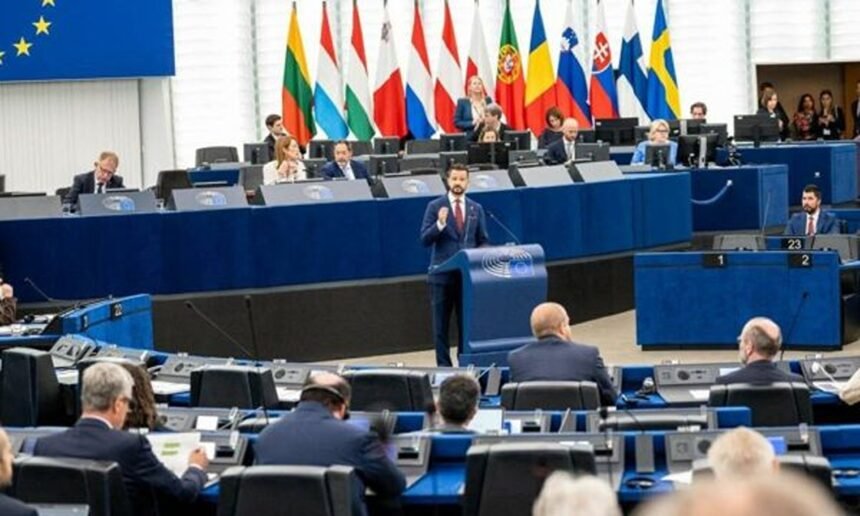
Montenegrin President Jakov Milatović addressed the plenary session of the European Parliament in Strasbourg on Tuesday, declaring that Montenegro is close to achieving one of the most important goals in its modern history: membership in the European Union by 2028.
Milatović stated that, twenty years after restoring its independence, Montenegro stands on the threshold of the European Union as a country that has remained committed to the European values of peace, freedom, democracy, and solidarity.
Recalling Montenegro’s peaceful and democratic restoration of independence in 2006, he said the country simultaneously chose the path of building a democratic, civic, and European state based on the rule of law and strong institutions.
According to Milatović, European integration has never been merely a foreign policy objective but rather a national consensus that has guided Montenegro’s development for two decades, regardless of changes in governments or parliamentary majorities.
Speaking about accession negotiations, he acknowledged that Montenegro’s EU path has not been without challenges, including periods of stagnation and missed opportunities. Nevertheless, he emphasized that citizens have consistently supported EU membership as the best route toward a more prosperous future.
The Montenegrin president highlighted that reforms currently being implemented directly affect citizens’ lives through stronger institutions, a more effective judiciary, economic development, and greater opportunities for young people.
Milatović noted that Montenegro has opened all 33 negotiating chapters with the EU and has provisionally closed 16 of them. He added that the EU Council has already begun work on preparing Montenegro’s accession treaty.
“This is an institutional signal that the final stage of our European integration has become a concrete political and legal process,” he said.
Addressing the current geopolitical environment, Milatović argued that EU enlargement is no longer merely a political issue but a strategic necessity for the stability and security of Europe.
He pointed out that Montenegro is already closely aligned with the EU, citing its use of the euro as its official currency, membership in NATO since 2017, and full alignment with EU foreign and security policy, particularly following Russia’s aggression against Ukraine.
Milatović also praised Montenegro’s democratic maturity, referring to the peaceful transfer of power in 2020 and the presidential and parliamentary elections of 2023 as evidence of the country’s democratic capacity.
At the same time, he acknowledged that significant challenges remain, including strengthening the rule of law, independent institutions, public administration reforms, and accelerating economic convergence with the European Union.
Concluding his speech, Milatović stressed that Montenegro seeks EU membership not to become something else, but because it historically belongs to the European political and cultural space.
“Montenegro is ready. We are ready to assume the responsibilities of a member state, contribute to European policies, and tie our future to our common European future. We are ready to become the next member of the European Union.”
He added that Montenegro’s accession by 2028 would be a shared victory for Montenegro, the European Union, and the entire Western Balkans. His speech was met with applause from members of the European Parliament.