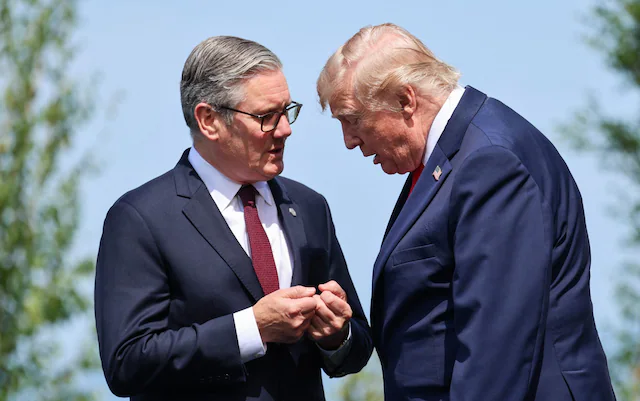
U.S. President Donald Trump delivered a scathing critique of British Prime Minister Sir Keir Starmer following Starmer’s abrupt resignation on Monday.
Speaking to reporters at the White House, Trump mixed personal pleasantries with sharp political broadsides against the Labour Party leader, attributing his political downfall to catastrophic policy decisions regarding immigration, green energy, and national security.
““He is very nice, I would say in a way, a friend,”” Trump remarked, before immediately pivoting to policy attacks. ““But he wasn’t good to us in NATO… He shot himself in the foot.””
The Iran Operation and NATO Tensions
The primary catalyst for the diplomatic rift between the White House and Downing Street was Starmer’s refusal to align the United Kingdom with recent U.S. military operations against Iran.
Trump, who has repeatedly demanded that NATO allies carry a heavier burden and strictly back Washington’s global security initiatives, expressed deep dissatisfaction with London’s lack of military solidarity during the multi-month Middle Eastern conflict. According to Trump, Starmer’s refusal to back the strikes severely weakened the alliance’s unified front.
Trump categorized Starmer’s leadership failures into three distinct pillars:
- Energy: Trump continued his long-standing, fierce opposition to Britain’s heavy investments in wind energy, which he labeled a failure.
- Immigration: The U.S. President insisted that London should have taken inspiration from his own hardline anti-immigration offensives.
- Crime: Trump claimed that failing to curb rising domestic criminality completely hollowed out public support for the Labour government.
A Swift Exit from Downing Street
Starmer’s resignation follows months of escalating domestic pressure and political isolation. On Monday morning, the British Prime Minister formally met with King Charles III to tender his resignation before delivering a brief, somber farewell address outside 10 Downing Street.
UK Leadership Transition Timeline:
[Monday] Starmer tenders resignation to King Charles III
[Mid-July] Anticipated selection of next Prime Minister
Early consensus within Westminster suggests that Andy Burnham, a prominent figure on the British center-left and a frequent internal rival to Starmer’s faction, has emerged as the frontrunner to succeed him. Political analysts estimate that a new Prime Minister could be formally installed by the second half of July.